
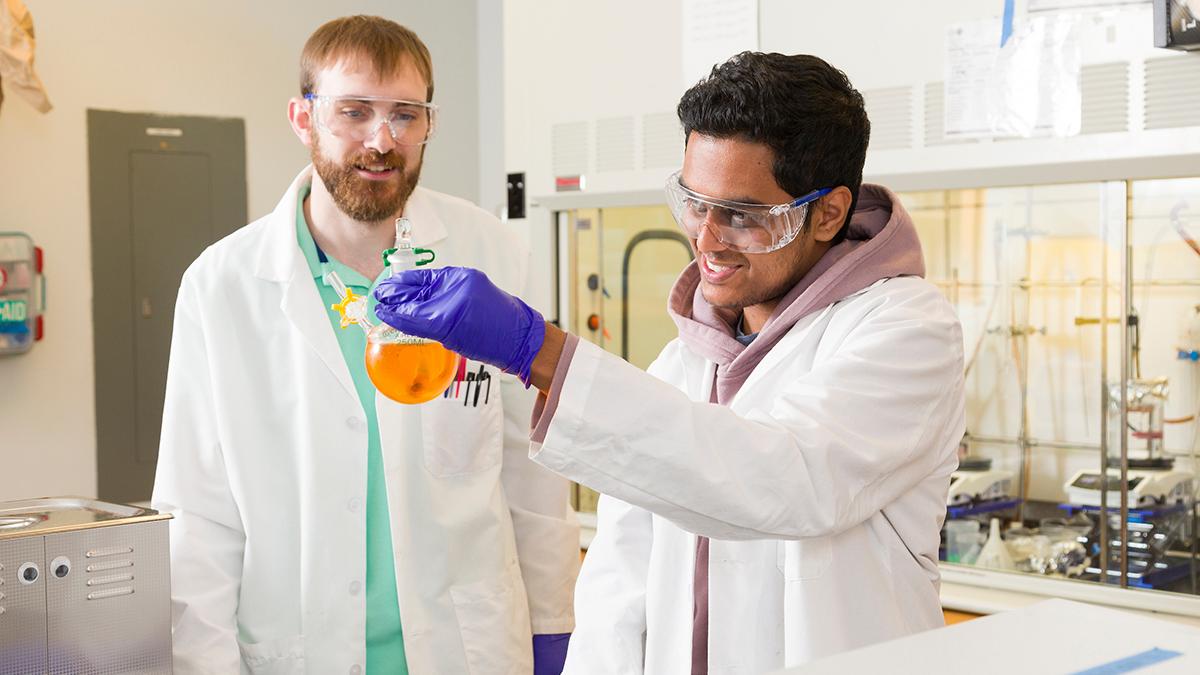
Graduate student Daniel Barzycki (L) and high school student Viswa Janapati in Dr. Ralm Ricarte’s lab at the FAMU-FSU College of Engineering. (Scott Holstein/FAMU-FSU College of Engineering)
The FAMU-FSU College of Engineering’s Department of Chemical and Biomedical Engineering (CBE) has secured more than $16 million in competitive research grants from the National Science Foundation (NSF), NASA, the Army Research Office (ARO) and other federal agencies.
This substantial investment advances cutting-edge research initiatives in sustainable materials, battery technology, biomedical applications and space exploration while enhancing student learning outcomes and fostering pioneering discoveries.
Building Research Infrastructure Through Federal Investment

Bruce R. Locke, chair and distinguished research professor of chemical and biomedical engineering at Florida State University and the joint college, emphasized the transformative impact of these grants.
“This research funding is vital to advancing our education and research missions through providing support for equipment and top students to work in the laboratories,” Locke explained. “Engineering education requires access to state-of-the-art equipment and labs, and we are very fortunate to have outstanding faculty able to compete nationally to obtain these resources.”
CBE’s research initiatives encompass a broad spectrum, integrating both chemical and biomedical engineering disciplines to foster dynamic exchange between student education and faculty innovation. With a strategic focus on soft matter, gels, complex fluids and biomaterials, the department is creating vital connections between engineering principles and essential biomedical applications. This interdisciplinary approach significantly enhances the department’s appeal for prospective graduate students pursuing advanced degrees in engineering research.
Major Research Initiatives Driving Innovation
NSF CREST Center: Advancing Sustainable Materials Development
The college secured a $7.5 million grant from the NSF for the Center of Research Excellence in Science and Technology (CREST II). Led by Professor Subramanian Ramakrishnan, this initiative develops novel materials and characterizes their properties to manufacture functional structures and devices.
“We are excited to explore bioderived sustainable thermoplastics, flexible hybrid recyclable electronics and responsive sensors and actuators,” Ramakrishnan enthusiastically shared. “This initiative is pivotal for enhancing our research capabilities while preparing the next generation of engineers to tackle pressing national challenges. The team will incorporate advanced discovery methods and machine learning techniques to improve custom materials design.”
Professor Daniel Hallinan serves as co-principal investigator in the CREST II project, working alongside Professor Ramakrishnan and Professor Emerita Rufina Alamo. Hallinan’s work targets the development of recyclable polymers that could revolutionize packaging practices. Alamo’s research focuses on bioderived and recyclable polymers to find sustainable alternatives to petroleum-based materials. Meanwhile, Associate Professor Jamel Ali investigates bioprinting, biohybrid soft materials and micro-robotics.
NASA Partnership: Advancing Space Exploration Technologies
In a collaborative effort with NASA, Jamel Ali and Subramanian Ramakrishnan advance composite materials and manufacturing technologies across seven institutions, including the joint college. The NASA grant ($5 million, awarded last year) was leveraged to acquire an equipment grant from the NSF ($689,000) for a state-of-the-art six-axis 3D printer, which will be used for printing sensors and devices.
“Our center combines fundamental expertise in both chemical and biomedical engineering to print sensors and devices to enhance space exploration,” Ali said. “Research is tightly coupled with student education in the center, with internships at Goddard and Kennedy Space Flight centers.”
NSF Research Grants: Advancing Battery Technology and Biomedical Applications
The department’s versatility is further demonstrated through multiple NSF-funded research projects addressing critical national challenges:
- Lithium Battery Innovation – Assistant Professor Hadi Mohammadigoushki received $500,000 from NSF for research focusing on 3D modeling of bacterial movement to develop alternative treatments for infections. He also received another NSF grant for $300,000 to advance magnetically assisted recycling of critical metals from end-of-life lithium-ion batteries, addressing growing concerns about battery waste management. Professor Daniel Hallinan, Jr. received an additional NSF grant for $661,034 to study single-ion conducting polymer blend electrolytes for lithium batteries through collaborative research with Kennemur in Chemistry and Oak Ridge National Laboratory.
- Cancer Research Breakthrough – Professor Yan Li received a $650,000 grant from the NSF to further collaborative research with Purdue University, focusing on glioblastoma, an aggressive form of brain cancer. Her group investigates how chimeric antigen receptor (CAR)-associated extracellular vesicles (EVs) can impact tumor growth and enhance the efficacy of drug delivery systems.
- Sustainable Materials Research – Assistant Professor Yimin Mao received $266,658 from the NSF Division of Chemical, Bioengineering, Environmental and Transport Systems (CBET)/TTP-Thermal Transport Process to characterize the structure and dynamics of cellulosic materials. The group aims to elucidate the root causes of the pronounced transport properties of cellulose as a porous material.
Army Research Office: Developing Smart Materials
Assistant Professor Ralm Ricarte actively engages in research supported by both NSF and the Army Research Office. A $677,644 grant investigates vitrimer gels—dynamic polymer networks capable of altering their shape and properties. An additional $360,000 grant from ARO focuses on gels engineered to change shape and release medicine in response to specific signals within the body, aiming to enhance wound healing and prevent infections.

Impact on Engineering Education and Workforce Development
“The pioneering work by our faculty and students in the areas of soft materials for applications in biomedical and chemical engineering fields is significantly enhanced by the new projects,” Locke said. “Our faculty will continue to be able to provide opportunities for our students to participate in the development of new technologies for medical treatments and materials.”
These grants represent a small fraction of the department’s ongoing projects. CBE remains committed to pioneering research that elevates academic standards and holds the potential to make significant contributions to society through sustainable materials development, advanced battery technology, biomedical innovation and space exploration applications.
Editor’s Note: This article was edited with a custom prompt for Claude Sonnet 4.5, an AI assistant created by Anthropic. The AI optimized the article for SEO discoverability, improved clarity, structure and readability while preserving the original reporting and factual content. All information and viewpoints remain those of the author and publication. This article was edited and fact-checked by college staff before being published. This disclosure is part of our commitment to transparency in our editorial process. Last edited: 12/11/2025.
RELATED ARTICLES
Engineering Professor Earns Prestigious AIMBE Fellowship for Groundbreaking Biomedical Research
FAMU-FSU Engineering Student Explores Innovative Cancer Therapies During Summer at Penn