
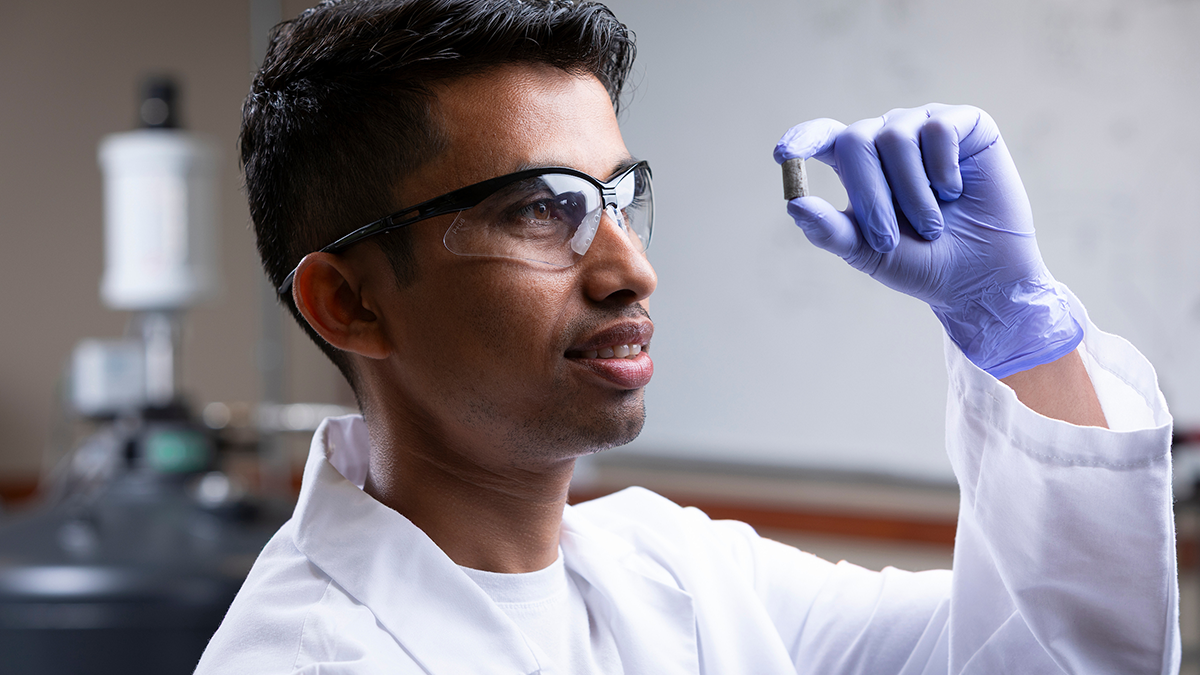
Doctoral student Manish Mandal poses with a bulk Nb3Sn superconductor sample in the Quantum Design 16 T Physical Property Measurement System (PPMS) lab in the Applied Superconductivity Center (ASC) in Tallahassee, Florida. Mandal received a 2026 IEEE Council on Superconductivity graduate study fellowship award for his work on alloying Nb3Sn superconductors to improve their high-field performance. (Scott Holstein/FAMU-FSU College of Engineering)
Key Points
Manish Mandal, a fourth-year materials science and engineering doctoral candidate at FSU and the FAMU-FSU College of Engineering, received the 2026 IEEE CSC Graduate Study Fellowship in Applied Superconductivity.
The award recognizes his research on alloying Nb₃Sn superconductors to improve their performance in high-field magnets.
Only six doctoral students worldwide in applied superconductivity receive this fellowship each year.
Mandal conducted the work under Professor David Larbalestier, director of the Applied Superconductivity Center at the National High Magnetic Field Laboratory, known as the MagLab.
Manish Mandal, a fourth-year Florida State University doctoral candidate in the FAMU-FSU College of Engineering, has received the 2026 IEEE CSC Graduate Study Fellowship in Applied Superconductivity for his work on alloying Nb₃Sn superconductors to improve their high-field performance.
Each year, only six doctoral students worldwide in applied superconductivity receive this fellowship from the Institute of Electrical and Electronics Engineers Council on Superconductivity, making it highly competitive. Mandal, who is pursuing a doctorate in materials science and engineering, conducted his work under the guidance of Professor David Larbalestier, director of the Applied Superconductivity Center, part of the National High Magnetic Field Laboratory.
“Receiving this fellowship is an incredible honor,” Mandal said. “Being recognized by the selection committee among such a talented global community of researchers is deeply humbling. It is a testament not only to the hard work put into exploring the fundamentals of Nb₃Sn, but also to the exceptional mentorship and collaborative environment at the college.”
Research focus

Nb₃Sn is a superconductor that can carry electricity without losing energy at low temperatures. Mandal’s research focuses on enhancing the properties of Nb₃Sn to improve the performance of powerful magnets used in critical technologies such as MRI machines for medical imaging, particle accelerators that advance scientific discovery and nuclear fusion projects that could enable cleaner energy sources.
“I’m working on ways to make Nb₃Sn even better at its job, so these magnets can be stronger and more efficient,” Mandal said. “This involves creating and studying new versions of the material to see if we can push the limits of what it can do, which could help shape the future of science and technology.”
What does this fellowship mean for materials science students at the college? The fellowship provides recipients like Mandal with a $5,000 award and an official certificate from the IEEE Council on Superconductivity. For materials science and engineering students in the FAMU-FSU College of Engineering, it signals that research conducted at the MagLab and the Applied Superconductivity Center is recognized on a global stage, in a field where only a handful of doctoral researchers worldwide are honored each year.
Originally from Nepal, Mandal earned his bachelor’s degree at Rajiv Gandhi Technological University in India before working in Japan, where he specialized in the production of hybrid vehicle motor cores. His experience abroad shaped his fascination with physics and superconductivity.
“Working daily with magnets fueled my fascination with physics and magnetism,” Mandal said. “I vividly remember my curiosity eventually led me to search online with a mission to find the world’s strongest magnet.”
That search led Mandal to the MagLab, home to some of the largest and most powerful magnet labs in the world. “That experience inspired me and eventually led me to pursue advanced studies and to the heart of superconductivity research at the MagLab,” he said.
“I’m working on ways to make Nb₃Sn even better at its job, so these magnets can be stronger and more efficient,” Mandal said. “This involves creating and studying new versions of the material to see if we can push the limits of what it can do, which could help shape the future of science and technology.”
Paying it forward
“I want to thank my advisor and professor David Larbalestier for his guidance and mentorship,” Mandal said. “David shared an inspiring message that resonated deeply with me. He said to always seek out those who believe in you, who offer opportunities and in turn, complete the cycle by doing the same for others. The IEEE-CSC fellowship is a reminder of the trust he placed in me, and I hope to honor David’s legacy by creating opportunities for others, just as he did for me.”
Why does mentorship like this matter for prospective engineering students? Mandal’s story reflects how closely doctoral researchers work with faculty mentors at the MagLab and the Applied Superconductivity Center, a hands-on model that shapes both the science and the researchers who go on to lead it.
Mandal plans to continue his work in superconductivity and will attend the 2026 Applied Superconductivity Conference awards celebration in Pittsburgh this fall to present his research.
Editor’s Note: This article was edited with a custom prompt for Claude Sonnet 5, an AI assistant created by Anthropic. The AI improved clarity, structure, SEO/GEO optimization and readability, while preserving the original reporting and factual content. All information and viewpoints remain those of the author and publication. This article was edited and fact-checked by college staff before being published. This disclosure is part of our commitment to transparency in our editorial process. Last edited: 07/31/2026.
RELATED ARTICLES
Materials science engineering student wins $5,000 IEEE Fellowship