
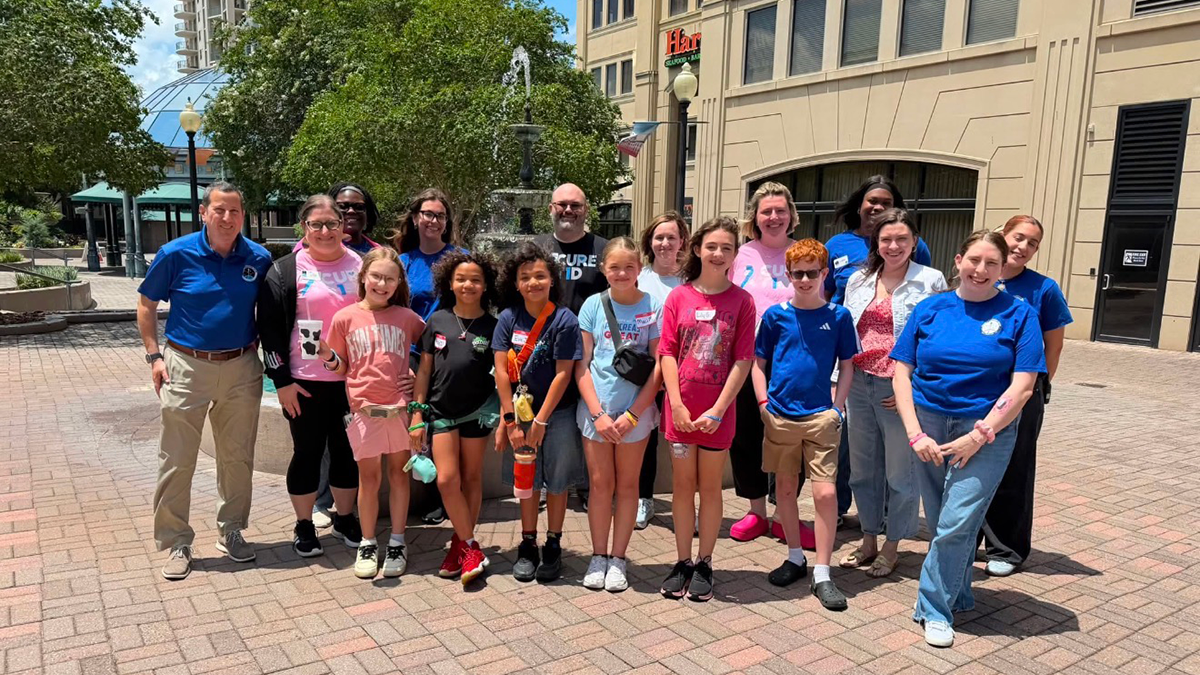
Campers and staff pose for a group photo during the inaugural Type 1 Diabetes (T1D) STEM Camp at the Challenger Learning Center of Tallahassee. (Courtesy Challenger Learning Center of Tallahassee Facebook page)
The Challenger Learning Center of Tallahassee, the K-12 outreach arm of the FAMU-FSU College of Engineering, has partnered with the Tallahassee Memorial HealthCare Foundation to host its first Type 1 diabetes (T1D) STEM Camp, expanding access to STEM education for children living with the condition.
The free summer camp held earlier this month was created to remove barriers that often prevent children living with Type 1 diabetes from participating in traditional summer camps by providing a safe, supportive environment where they could explore science, technology, engineering, and mathematics.
Removing Barriers to STEM Learning
The idea for the camp stemmed from conversations with families and firsthand experiences of staff members at the Challenger Learning Center. Staff recognized that many children living with Type 1 diabetes often miss opportunities to participate in traditional summer camps because of concerns surrounding their medical care and safety. A young camper who attended the Center’s summer camp last year was unable to participate in a field trip because of concerns about managing her diabetes away from her caregivers.
“That really made us realize what these kids have to go through,” said Alan Hanstein, executive director of the Challenger Learning Center. The partnership combined specialized medical support with hands-on STEM learning, creating a supportive environment where children living with Type 1 diabetes could safely participate in every activity while exploring science, technology, engineering and mathematics. Rather than centering the experience on diabetes, organizers focused on STEM exploration, building friendships and simply being kids.
“We wanted camp to be fun,” Hanstein said. “We wanted them to be able to do everything every other camper gets to do and not constantly be reminded of their condition.”
While creating a fun and supportive environment was a priority, organizers also viewed the camp as an opportunity to spark a lifelong interest in STEM.
“Our mission is to inspire the next generation of scientists and engineers to be excited about STEM,” said Hanstein. “This T1D camp is no different. We’re just reaching a group who may not normally have access to those places.”
“Our mission is to inspire the next generation of scientists and engineers to be excited about STEM. This T1D camp is no different. We’re just reaching a group who may not normally have access to those places.” —Alan Hanstein
Extending the University’s Educational Mission
For more than 25 years, the Challenger Learning Center has introduced K-12 students to STEM through immersive educational experiences. The Center serves approximately 60,000 students each year from more than 60 counties across Florida, Georgia and Alabama through programs featuring its IMAX theater, planetarium, mission simulator, summer camps and year-round STEM programming.
Suvranu De, the Google Endowed Dean of the FAMU-FSU College of Engineering and a professor of mechanical engineering, believes programs like the T1D STEM Camp help children see themselves in STEM fields at an early age.
“Experiences like this show young people that engineering is about solving real-world problems and improving lives,” De said. “By introducing students to STEM at an early age in an environment where they feel supported and encouraged, we’re helping them build the confidence to imagine themselves as the next generation of engineers, innovators and leaders.”
The camp reflects the College of Engineering’s commitment to expanding educational opportunities beyond the classroom while inspiring the next generation of innovators.
Building Confidence Through Discovery

Throughout the camp, students participated in hands-on STEM activities while exploring the Challenger Learning Center’s unique educational spaces. Programs such as the Dream Big documentary introduced campers to engineering careers by highlighting how engineers solve real-world challenges, while additional activities encouraged creativity, teamwork and problem-solving. This year’s STEM camp welcomed nine campers, including eight girls and one boy. Medical professionals, including a registered nurse (RN) and licensed practical nurse (LPN), remained on-site throughout the program to ensure campers could safely participate in every activity.
For Rebeka Joseph, whose 10-year-old twin daughters, Eva and Leah, live with Type 1 diabetes, the camp provided peace of mind while giving her children an opportunity to connect with others who shared similar experiences.
“I was immediately put at ease when I dropped the girls off and got to talk with the nurses and staff, many of whom also had diabetes themselves,” Joseph said. “They were able to communicate with me throughout the day with updates about the girls’ blood sugars, and I never worried about their well-being.”
Being diagnosed with Type 1 diabetes as an adult, camp counselor Warren Watts brought both professional and personal experience to the program.
“For many campers, simply knowing they were not alone made a lasting impact,” Watts said. “By creating an environment that combined specialized support with the fun and excitement of traditional camp activities, the camp offered an experience that was both enjoyable and empowering for campers and their families.”
According to Hanstein, one of the camp’s most meaningful moments came when he saw the same young camper who missed last year’s field trip fully embrace this year’s camp experience.
“Seeing the kids having fun like I do every day here with the rest of the campers without feeling like they were different in any way, that’s ultimately the goal,” Hanstein said.
Following the success of its inaugural camp, organizers have already begun planning for next year.
“Our hope is to continue raising the scale,” Hanstein said. “More campers, more days and more programming.”
As organizers prepare to expand the camp next year from three days to a week, they hope even more children living with Type 1 diabetes will discover that neither their diagnosis nor their circumstances can limit their potential to explore, create and dream.
RELATED ARTICLES
Grit and determination were key for Diatech Diabetes engineering alumni entrepreneurs
Tallahassee Challenger Learning Center Gets New Executive Director
Tallahassee Middle School Teams Capture Top Honors in National Youth Cyber Defense Competition