
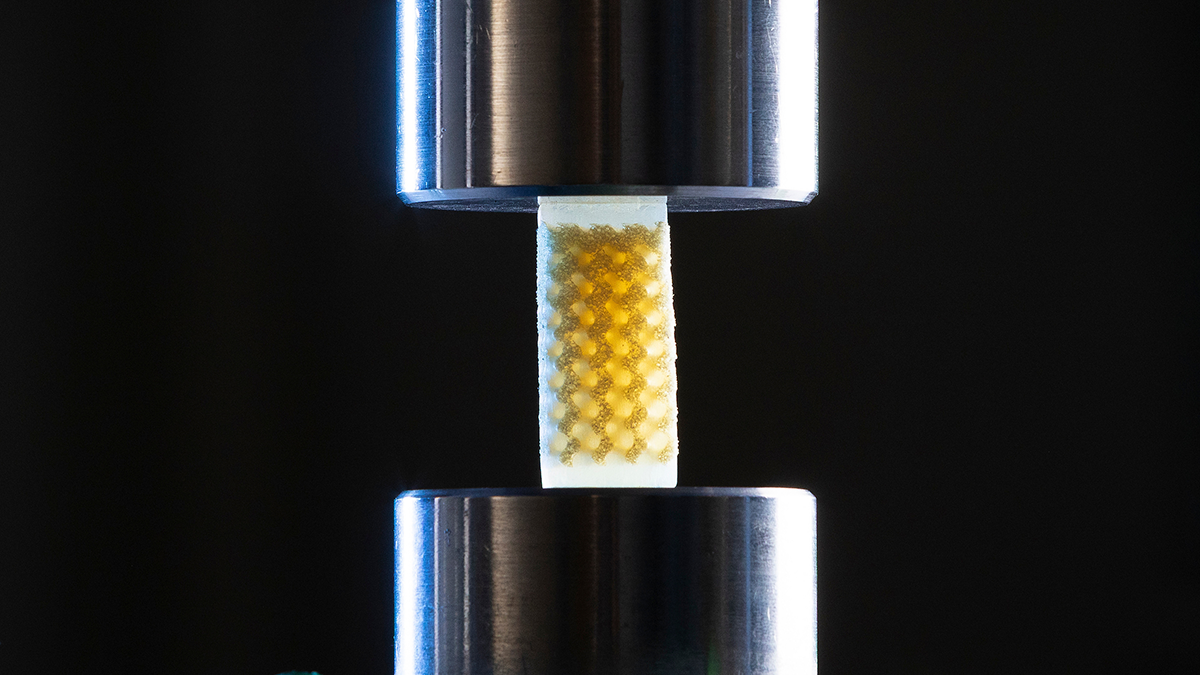
A lattice-foam sample sits in the Universal Testing Machine in the Mechanical Testing Room in the High-Performance Materials Institute (HPMI) in the Materials Research Building (MRB) at the joint FAMU-FSU College of Engineering in Tallahassee, Florida. The sample involves a 3D-printed framework with cushioning foam designed to better protect people and structures from impacts. (Scott Holstein/FAMU-FSU College of Engineering)
Key Points
Engineers have developed a lightweight composite that combines a 3D-printed gyroid lattice with polyurethane foam.
The lattice carries loads while the foam braces it against collapse and absorbs energy, giving the composite better compression resistance and impact cushioning than either component alone.
By varying the lattice’s density within the material, the researchers can control where compression begins, an approach that could inform future helmet liners and protective padding.
Researchers at the FAMU-FSU College of Engineering are developing a lightweight composite system to better protect people and structures from impacts.
Think sports helmets, car bumpers or aerospace components. The challenge: Most composite materials are either great at absorbing energy, like foam, or strong enough to carry heavy loads, like solid plastics or metals, but rarely both.
Jizhe Cai, an assistant professor in the departments of Industrial & Manufacturing Engineering and Mechanical & Aerospace Engineering, and Emmanuel Dada, a doctoral candidate, are researchers at the FAMU-FSU College of Engineering, the joint college of Florida A&M University and Florida State University. Both work at Florida State’s High-Performance Materials Institute (HPMI).
Cai co-led the study with Ramathasan Thevamaran, an associate professor of mechanical engineering at the University of Wisconsin-Madison. Together, their team developed a 3D-printed framework filled with cushioning foam.
The findings appeared in the journal Composites Part B: Engineering under the title “Interpenetrating Gyroid Lattice-Foam Composites With Synergistically Enhanced Stiffness and Energy Absorption for Impact Mitigation.”
“The framework of these composites is a repeating, curved gyroid geometry filled with foam,” Cai said. “The novelty is how the foam and geometry work together.”
The structure helps carry loads, while the foam supports the framework against collapse and helps dissipate energy. Together, they provide better resistance to compression and better impact cushioning than either component alone.
Why do better impact-absorbing materials matter?
The composite’s potential applications include helmet liners, protective padding, vehicle cushioning and packaging.
“People encounter impacts in everyday life, from sports injuries and vehicle collisions to accidentally dropping valuable equipment,” said Dada, a co-author of the study. “Better cushioning materials could help reduce the severity of the forces transmitted to a person or an object.”
How did the researchers build the 3D-printed lattice-foam composite?
The team began by 3D printing soft gyroid lattices. A gyroid lattice is a repeating three-dimensional structure with smoothly curved surfaces and interconnected channels. Next, the researchers infused these lattices with a polyurethane foam that expands and cures within the tiny spaces, a process known as in situ foaming. This technique creates a close bond between the foam and the lattice.
“Our process creates close contact between the foam and the framework throughout the material,” Dada said. “This close contact allows the two components to support one another and share the load during both compression and impact. The manufacturing process is crucial to achieving the material’s enhanced performance.”

How did the team test the new material?
Using scanning electron microscopes, the researchers confirmed that the foam was in contact with the framework. They then used 3D X-ray scans, a technique called micro-computed tomography (micro-CT), to examine the material’s internal structure.
The researchers carried out the work at HPMI and at the CT scan facility of the Core Laboratory for In-situ Facilities and Frontier Instruments (CLiFF), housed in Florida A&M University’s Center for Plasma Science and Technology.
“We used 3D printing, mechanical testing, fast imaging and detailed structural examination to test material performance,” said Cai. They examined the structure using electron microscopes and X-ray scans.
The team then tested how these new composites responded to both gradual and sudden impacts and used advanced imaging to confirm that the foam filled every nook and cranny, and to measure the material’s energy absorption and resistance to breaking under stress.
How does varying the lattice density control where the material compresses?
The team experimented with varying the lattice density in specific regions. This approach allowed them to control how and where the material bends or absorbs force, effectively programming designated zones to respond first in the event of an impact.
In the study, the researchers compared lattices with uniform relative densities of 20%, 40% and 60% against a graded lattice that shifts gradually from 20% to 60% along the direction of loading.
“We can vary the framework’s density within the material to control where compression begins and how it progresses,” Cai said. “This gives us a way to design materials that provide support during normal use and cushioning during an impact.”
“What makes this approach promising is that we can adjust the internal structure for different needs, for example, making one region softer for cushioning and another more supportive,” Dada said. “There are many potential applications that would require further testing for their specific conditions.”
Which universities collaborated on the study?
Beyond the two co-leads, Pavana Prabhakar, an Associate Professor of civil and environmental engineering and mechanical engineering at the University of Wisconsin-Madison, contributed to the study along with a team of doctoral students. The collaboration brought together contributions in material design, fabrication, mechanical testing, simulation and analysis.
“Working across the two institutions allowed us to connect the material’s internal architecture with its performance under both slow compression and impact,” Cai said. “It also gave students opportunities to contribute to a shared research problem across institutions.”

Who funded the lattice-foam composite research?
The Office of Naval Research partially supported the research through PANTHER, a University of Wisconsin-Madison initiative founded in 2017 to study how to detect and prevent traumatic brain injuries. Its work includes developing helmet liners that better protect against head impacts.
Additional support came from the National Science Foundation’s Excellence in Research program through a $786,000 grant awarded through Florida A&M University. The project, led by Cai and titled “Excellence in Research: Mechanics of Interpenetrating Strut-Foam Smart Composites for Aerospace and Beyond,” focuses on understanding how rigid struts and foam work together to create lightweight, load-bearing composites for aerospace and protective applications.
“Our material contributes to that goal by combining a lightweight, 3D-printed framework with energy-absorbing foam,” Cai said. “Together, these components provide structural support while reducing peak transmitted stress and acceleration compared with the framework alone.”
Because the researchers can tailor the internal architecture to control how the material compresses and absorbs impact energy, the approach offers a promising path toward future helmet liners that improve protection without adding excessive weight.
Editor’s Note: This article was edited with a custom prompt for Claude Opus 5.5, an AI assistant created by Anthropic. The AI optimized the article for SEO/GEO discoverability, improved clarity, structure and readability while preserving the original reporting and factual content. All information and viewpoints remain those of the author and publication. This article was edited and fact-checked by college staff before being published. This disclosure is part of our commitment to transparency in our editorial process. Last edited: 09/29/2026.
RELATED ARTICLES
FAMU-FSU Researcher Develops Advanced 3D-Printed Materials for Impact Protection
FSU-developed foam could offer NFL players powerful protection against head injuries
FAQ
A gyroid lattice-foam composite is a material that combines a 3D-printed gyroid lattice, a repeating structure with smoothly curved surfaces and interconnected channels, with foam that fills its open spaces. In a 2026 study by researchers at the FAMU-FSU College of Engineering and the University of Wisconsin-Madison, the lattice carried loads while the foam supported the lattice against collapse and absorbed energy.
Most materials excel at one job or the other. Low-density foams absorb energy well but lack the stiffness to carry heavy loads, while stiff materials such as solid plastics or metals carry loads but deform less and absorb less energy. Combining a stiff 3D-printed lattice with foam is one approach engineers are testing to get both properties in a single lightweight material.
Researchers led by Assistant Professor Jizhe Cai of the FAMU-FSU College of Engineering 3D printed soft gyroid lattices, then filled them with polyurethane foam that expanded and cured inside the lattice, a process called in situ foaming. They confirmed the fit with scanning electron microscopes and micro-computed tomography (micro-CT) X-ray scans, then tested the material under slow compression and sudden impact.
Researchers at the FAMU-FSU College of Engineering and the University of Wisconsin-Madison identified potential uses including helmet liners, protective padding, vehicle cushioning and packaging. Doctoral candidate Emmanuel Dada noted that each application would require further testing for its specific conditions.
Assistant Professor Jizhe Cai of the FAMU-FSU College of Engineering and Associate Professor Ramathasan Thevamaran of the University of Wisconsin-Madison jointly led the study. It was published online Aug. 25, 2026, in the journal Composites Part B: Engineering under the title “Interpenetrating Gyroid Lattice-Foam Composites With Synergistically Enhanced Stiffness and Energy Absorption for Impact Mitigation.”
The Office of Naval Research partially supported the study through PANTHER, a University of Wisconsin-Madison initiative on traumatic brain injury. The National Science Foundation’s Excellence in Research program also supported the work through a project led by FAMU-FSU Assistant Professor Jizhe Cai and awarded through Florida A&M University.