
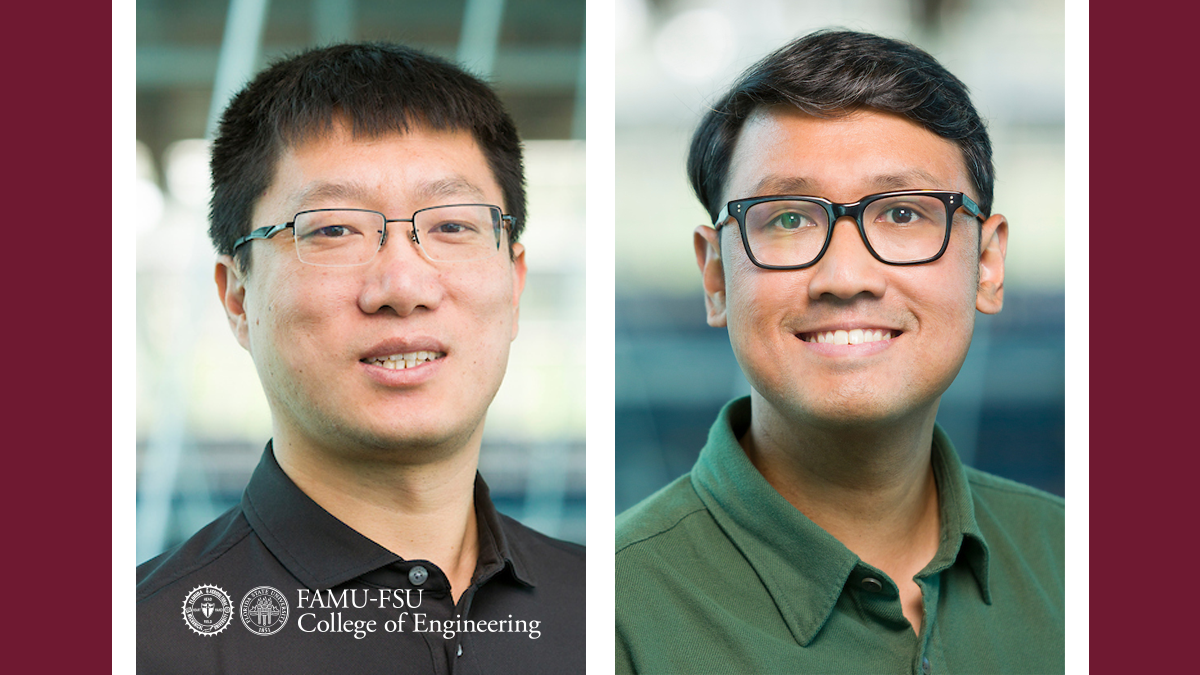
Assistant Professor Junliang Liu (left) and Associate Professor Ralm Ricarte of the FAMU-FSU College of Engineering and Florida State University recently received the prestigious US Department of Energy ECRP awards for 2026. (Scott Holstein/FAMU-FSU College of Engineering)
Key Points
Ricarte and Liu each received a DOE Early Career Research Program award of $875,000 over five years.
Ricarte studies energy-absorbing rubber materials; Liu studies materials for nuclear fusion reactors.
They are the only FSU researchers and the only two in Florida selected in 2026.
Ralm Ricarte and Junliang Liu, professors at the FAMU-FSU College of Engineering and Florida State University, have received U.S. Department of Energy (DOE) Early Career Research Program (ECRP) awards.
The recognition highlights Florida’s growing presence in national energy research.
This year, the DOE Office of Science selected 67 early-career scientists nationwide for the honor, awarding $96 million to support their research.
Ricarte is an associate professor in the Department of Chemical and Biomedical Engineering, and Liu is an assistant professor in the Department of Materials Science and Engineering. They are the only FSU researchers to receive the award in 2026, the only two from the state of Florida and two of just eight awardees in the Southeast. The recognition reflects the joint college’s growing reputation in materials research.
“Earning this award is a tremendous recognition of the innovative work happening at our college,” said Richard Liang, associate dean for research at the FAMU-FSU College of Engineering. “Professors Ricarte and Liu are trailblazers in their fields, and their research will drive discoveries that benefit society and reinforce America’s leadership in science.”
Building tougher, more adaptable rubber
Ricarte’s project, “Molecular Mechanisms Driving Enhanced Energy Dissipation In Dual Cross-Link Elastomers,” will receive $875,000 over five years. His research aims to develop resilient, energy-absorbing materials with applications ranging from transportation systems to advanced electronics.
“We will explore how specially engineered rubber materials can stay flexible and efficiently absorb energy under heat, repeated stress, and large deformations,” Ricarte explained. “These rubbers will feature permanent bonds that provide structural integrity and temporary bonds that can break and reform. We’ll investigate how the rate of this molecular exchange influences the materials’ energy absorption in various real-world scenarios.”
By combining materials development, mechanical testing, computer simulations and advanced X-ray analysis, the team will pinpoint how molecular-level changes affect overall material performance.
How do students benefit from an Early Career award?
The funding reaches beyond the lab’s principal investigator. Ricarte expects the award to support hands-on student training in advanced computational and experimental techniques, as well as new research collaborations.
“The Early Career Award gives us the time, resources, and access to Department of Energy facilities needed to rigorously test these ideas,” Ricarte noted. “It will also foster new collaborations and enable hands-on training for students in advanced computational and experimental techniques. The insights we gain will shape the next generation of durable, adaptable materials for vehicles, protective equipment, and energy-harvesting devices.”
Ricarte joined the college in 2020 following postdoctoral research in Paris. He holds a degree from the University of Minnesota and has been recognized as a Marie Curie PRESTIGE fellow.
Testing materials for fusion energy
Liu’s project, “Effects Of High Magnetic Fields On Hydrogen Retention In Vanadium Alloys,” will also receive $875,000 over five years. His research will advance materials capable of withstanding the extreme conditions inside nuclear fusion reactors, helping bring fusion energy closer to the electrical grid.
“Fusion is the same process that powers the Sun,” Liu said. “Scientists are striving to replicate this phenomenon on Earth, essentially building a miniature Sun to deliver nearly limitless clean energy.”
Materials in fusion reactors must withstand plasma temperatures above 100 million degrees Celsius and magnetic fields more than a million times stronger than Earth’s. Those fields are crucial for containing the plasma but present major challenges for structural materials. Liu’s research focuses on finding materials that can survive and perform in that environment.
“The award will enable us to utilize the world-class facilities at the National High Magnetic Field Laboratory (NHMFL) and FSU to replicate these extreme magnetic field conditions and study their effects on the microstructure and properties of fusion materials,” Liu said. “Our findings will help the scientific community better understand and qualify materials for fusion applications, bringing fusion energy one step closer to powering the grid.”
Liu earned his doctorate and completed postdoctoral research at the University of Oxford. He then worked as a staff scientist at the University of Wisconsin-Madison before joining the FAMU-FSU College of Engineering faculty in 2025.
What makes the DOE Early Career award significant?
The ECRP is among the nation’s most competitive honors for early career scientists. It provides multiyear funding to researchers at the start of their independent careers, and the 2026 cohort includes recipients from 39 universities, 11 DOE national laboratories and 26 states.
Editor’s Note: This article was edited with a custom prompt for Claude Sonnet 5.5, an AI assistant created by Anthropic. The AI optimized the article for SEO discoverability, improved clarity, structure and readability while preserving the original reporting and factual content. All information and viewpoints remain those of the author and publication. This article was edited and fact-checked by college staff before being published. This disclosure is part of our commitment to transparency in our editorial process. Last edited: 10-20-2026.
RELATED ARTICLES
Engineering professor Ralm Ricarte receives NSF CAREER Award
Researchers develop new model of flow properties for class of polymers
Revolutionary Polymers Reshape Materials Science and Sustainability