
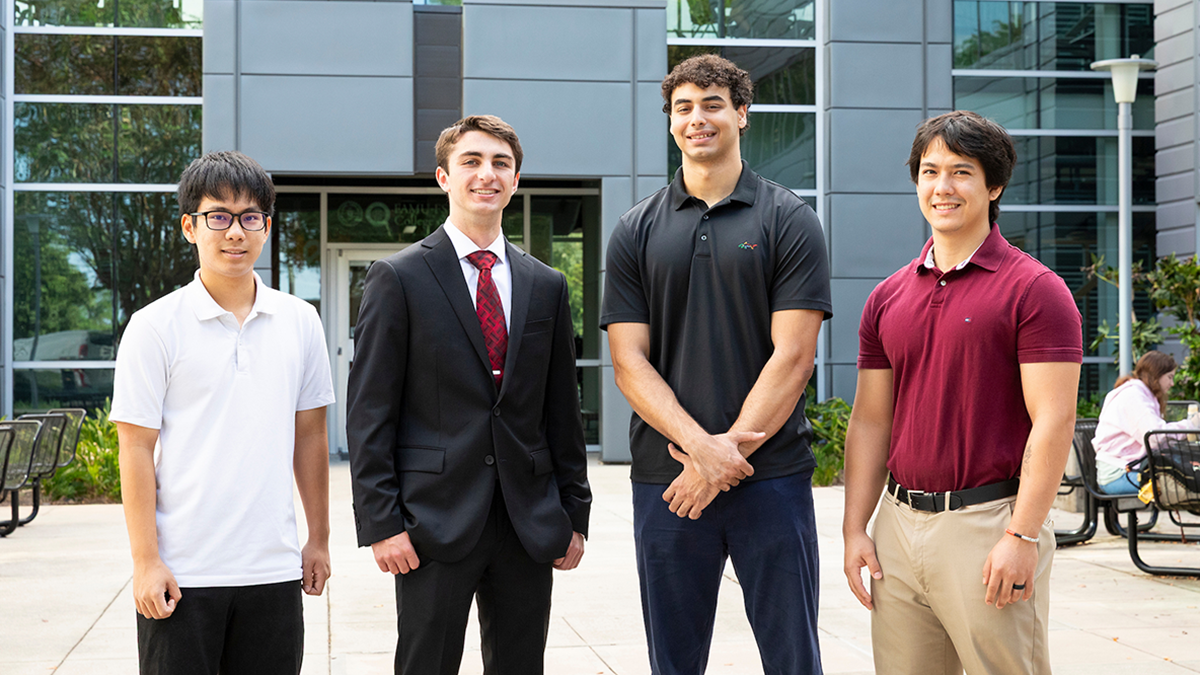
(Left to right): Kien Le, Joseph Lindley, Joseph Yousry Attalla, and Patriot Benton pose at FAMU-FSU College of Engineering in Tallahassee, Florida. (Scott Holstein/FAMU-FSU College of Engineering)
At the FAMU-FSU College of Engineering, undergraduate students are getting into research early, and several already have published papers to show for it.

“Engaging undergraduate students in research is an important part of our college mission and in the ECE Department in particular,” said Petru Andrei, chair of the Department of Electrical and Computer Engineering. “Research lets students move beyond the classroom to tackle real-world problems. It develops technical skills, critical thinking, creativity, independence and confidence, while exposing them to new areas of engineering.”
Tuy Nguyen, assistant professor of electrical and computer engineering, sees the results firsthand. Early research, he said, helps students clarify their goals and see themselves as contributors to new knowledge. Several of his students have published their work or presented at conferences.
“We’ve had undergraduates from chemical, biomedical, computer science and ECE backgrounds publish or submit research papers,” Nguyen said. “It’s a testament to the caliber of work our students are producing. My class is research-oriented, so there are many chances to do research at the undergraduate level.”
What students say about early research
Students describe the experience as both challenging and rewarding.
Kien Le, a computer science student, and Joseph Lindley, a chemical and biomedical engineering student, said collaborating across disciplines was eye-opening. Lindley is part of Florida State University’s Undergraduate Research Opportunity Program (UROP). Le, a former UROP student, has since graduated and is staying at FSU to pursue his master’s degree.
“Collaborating with ECE students showed me how machine learning applies to real-world challenges,” Le said. Lindley agreed: “Combining approaches often produced better results.”
Both were surprised by how far research pushed them outside their comfort zones.
“I was surprised by how much research requires learning beyond your discipline and how much trial and error is involved,” Le said. Lindley added, “Research takes many attempts and each iteration teaches you something new.”
Both said they were proudest of seeing their research published and of working as part of a dedicated team. “Seeing our work progress from idea to publication was extremely rewarding,” Le said. The experience changed his plans. “It motivated me to stay at FSU for my master’s and continue doing research.”
“It honestly changed what I wanted to do after college,” Le said. “Before research, I saw computer science as just building things and solving well-defined problems. Research opened my eyes to tackling questions without known answers, which I really enjoyed. It also taught me that research is a long journey—requiring patience, curiosity and a willingness to learn from failure. That experience inspired me to pursue my master’s at FSU and continue researching.”
Lindley added, “Being part of research my freshman year made me want to do more in the future. Research is difficult but also lots of fun. In a class, you research and have a defined result you are looking for but in the kind of research we are doing here, we have a desired result we are shooting for, but we are not sure how we will get there. There is a lot of trial and error. You are working with a team and become very close to them. That was new for me and something I found I really liked and I also enjoyed applying my knowledge to real-world problems.”
Andrei said research builds skills that are hard to develop in a lecture hall. “Undergraduate research helps students develop skills not easily acquired in the classroom,” he said. “It teaches them to solve open-ended problems, think critically and work independently.” He emphasized that these abilities are especially valuable as technology evolves and engineers must adapt.
Mentorship from graduate students

Quoc Bao Phan, an electrical and computer engineering graduate student who works with Nguyen, mentors undergraduates on several projects. “Mentoring undergraduates has been a great experience,” he said. “It’s valuable preparation for my goal of becoming a professor.” He focuses on helping students build independent thinking, teamwork and communication skills.
Reflecting on his own undergraduate research in Vietnam, Phan said, “I often had to figure things out on my own.” That experience made him more independent and persistent, and it motivates him to help others. “It’s one of the reasons I want to help undergraduates start research early—so they can receive guidance and develop essential research skills from the beginning.”
Published and accepted research
Journal and conference papers
Le and Lindley co-wrote two papers on using artificial intelligence (AI) to analyze heart data while protecting patient privacy.
The first, “An Encrypted Dual-Attention Federated Learning Framework for Personalized Electrocardiogram Classification,” appears in the journal Healthcare Analytics. The second, “Dual Attention Heads for Personalized Federated Learning in ECG Classification,” was accepted at the Institute of Electrical and Electronics Engineers (IEEE) International Midwest Symposium on Circuits and Systems in Cincinnati and published in the IEEE Xplore digital library.
“Both projects use AI to analyze heart signals and keep patient information private,” Le said. “Hospitals can’t share patient data, so we explored ways for them to train AI models together without exchanging sensitive details. Our first project focused on adapting models to different hospital demographics. The second added encryption and tested whether private ECG data could be recovered from shared information. Overall, we’re finding ways for hospitals to build better AI without compromising privacy.”
“The Dual Attention Heads project uses a machine learning algorithm with two parts: ‘local’ and ‘global,’” Lindley said. “The local part is trained on each hospital’s data for more personalized results. The global part is updated by averaging information from all hospitals, without sharing the full models. This way, patient information stays secure, but each facility still benefits from a specialized AI for ECG analysis.”
From classroom project to international conference
Joseph Yousry Attalla, Patriot Benton and Tomas Aparicio, electrical and computer engineering students at the FAMU-FSU College of Engineering, took Nguyen’s System-on-Chip Design class. Their paper, “Area-Time-Efficient Pipelined Design for Binary Neural Networks,” was accepted to the International SoC Design Conference in October 2026. The project focuses on designing computer chips that use only ones and zeros for AI tasks, helping devices run faster and more efficiently.
“We wanted to do meaningful work and Professor Nguyen’s class gave us an opportunity to do so,” Attalla said. “It’s rewarding to get our paper accepted, especially considering our research started as a classroom project. We were able to go beyond the classroom and work on a project worthy of being recognized by an international conference.”
The project builds on prior work to run small AI models efficiently on minimal local hardware, entirely offline. Using a field-programmable gate array (FPGA), a reconfigurable computer chip, the system reads a black-and-white hand-drawn number and outputs the correct digit.
Benton said he is most proud of his team’s perseverance. “Challenges arose when we began preparing a conference paper, which required improvements over previous systems,” he said. “This brought new hurdles and expanded both the scope and demands on our team.”
Research opportunities for undergraduates
Undergraduates can work with faculty and graduate students on projects in artificial intelligence, machine learning, cybersecurity, data analytics and more. Opportunities come through labs, research programs, senior design and funded positions.
“We encourage interdisciplinary collaboration, since many of the most exciting artificial intelligence applications are at the intersection of multiple fields,” Andrei said. “We offer a variety of AI courses that let students apply what they learn to real-world problems.”
Editor’s Note: This article was edited with a custom prompt for Claude Sonnet 4.6, an AI assistant created by Anthropic. The AI improved clarity, structure, SEO/GEO optimization and readability, while preserving the original reporting and factual content. All information and viewpoints remain those of the author and publication. This article was edited and fact-checked by college staff before being published. This disclosure is part of our commitment to transparency in our editorial process. Last edited: 10/8/2026.
RELATED ARTICLES
New Chip Research Improves Speed in Everything from AI to Wireless Communication
Opportunities for undergraduate research experience give students path to success