
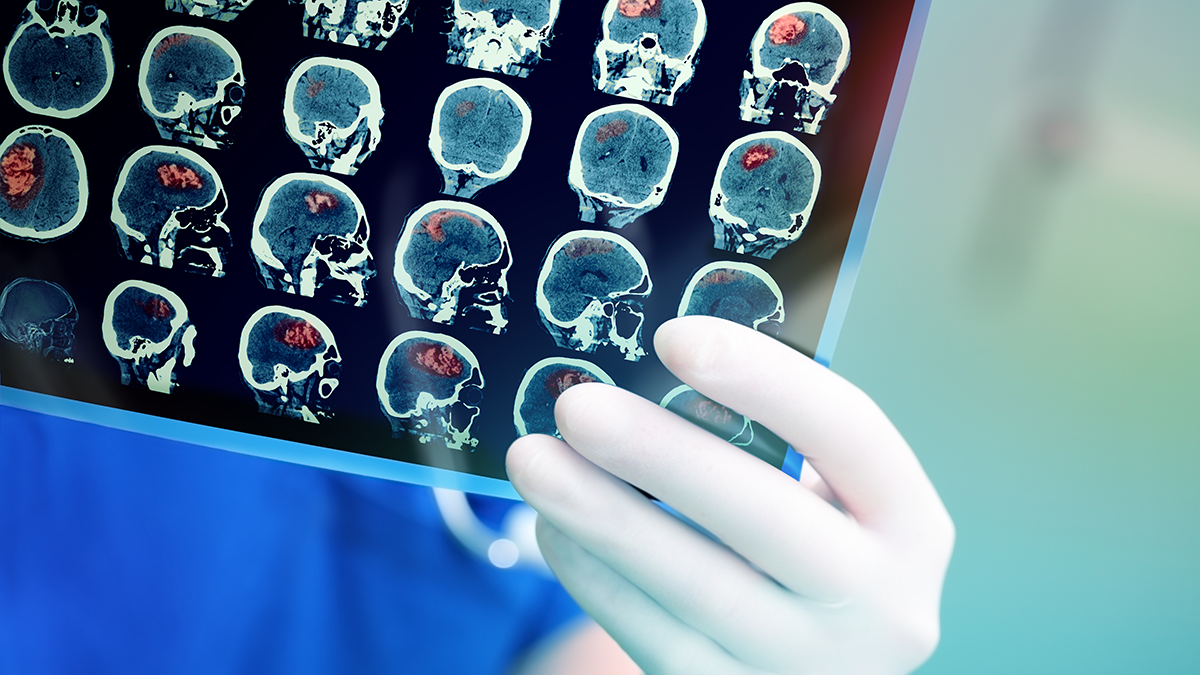
Doctor attentively examines the MRI scan of the patient. (sudok1 for AdobeStock)
Key Points
Researchers at the FAMU-FSU College of Engineering and MagLab studied a potential ischemic stroke therapy made from extracellular vesicles, or EVs, tiny particles that cells use to send chemical messages, derived from human mesenchymal stem cells.
In early-stage research published in the journal Theranostics in June 2026, the EV treatment showed trends toward improved brain recovery on MRI scans over several weeks, with the most favorable patterns observed in females.
The research team, including corresponding authors Yan Li and Samuel Grant, professors at the FAMU-FSU College of Engineering, says the findings are preliminary and require confirmation in larger studies.
The work could eventually help scientists design stroke treatments that account for differences between male and female patients, an area understudied in stroke research to date.
Researchers at the FAMU-FSU College of Engineering and the National High Magnetic Field Laboratory, or MagLab, have found early, preliminary evidence that a stem cell-derived therapy for ischemic stroke, a stroke caused when blood flow to the brain is blocked, may work somewhat differently in males and females.
The findings, published in the journal Theranostics, point to a promising direction for future stroke research. Researchers caution that the sex-related patterns they observed were trends, not statistically significant results, and say larger studies are needed before any conclusions about treatment can be drawn.
What Did Researchers Test in This Stroke Study?
Extracellular vesicles have shown potential as a treatment for a range of diseases, both as a way to deliver medicine to specific targets in the body and as a therapy on their own.
In this study, researchers extracted EVs from human mesenchymal stem cells, which can transform into a variety of cell types, and tested them as a therapy for ischemic stroke.
Using the MagLab’s 21.1-tesla ultra-wide-bore magnet, one of the most powerful MRI systems in the world for this kind of research, the team tracked changes in brain tissue and chemical activity over several weeks following treatment.
Across the subjects studied, EV-treated cases showed trends toward smaller stroke-damaged brain regions and improved chemical markers of brain health compared with untreated controls. The researchers noted that most of these differences did not reach statistical significance, given the modest scope of the study, and described the results as directional trends rather than confirmed effects.

Why Might Stroke Treatment Differ by Sex?

The female sex hormones estrogen and progesterone are known to have some protective effects on the brain. The researchers observed that female subjects, particularly those treated with EVs, tended to show more favorable recovery patterns across several measures.
“Extracellular vesicles are a way to use the body’s own biological messaging system to promote healing,” said study co-author Yan Li, the Simon Ostrach Professor of Biomedical Engineering at the FAMU-FSU College of Engineering. “That natural capacity to promote repair and restore balance could transform how we treat some of the most challenging diseases.”
Much stroke research has historically focused on male subjects to avoid data variation linked to female hormonal cycles. By examining how sex hormones may relate to stroke recovery, researchers hope to eventually help scientists develop treatments that better account for differences between male and female patients, though confirming this will require substantially more research.
How Do Extracellular Vesicles Work as a Stroke Treatment?
Researchers say EVs are a promising avenue for treating diseases because they may offer regenerative and anti-inflammatory properties associated with cell-based therapies, without the risks of introducing living cells into the body.
Drugs used to treat strokes must cross the blood-brain barrier to reach the affected area. EVs are small enough to potentially penetrate deeper into the brain than stem cells, which are more likely to be identified and attacked by a patient’s immune system.
“You’re getting an extra bang for your buck as a patient,” said study co-author Samuel Grant, a professor at the FAMU-FSU College of Engineering. “Even though estrogen is helping recovery, the EV therapy has the added benefit of helping to recover faster, to salvage more tissue and reestablish regulation of metabolic processes in the brain.”
What Are the Limitations of This Research?

The researchers were direct about the constraints of this study. The scope was modest; functional testing did not show statistically significant differences between treatment groups, and further work, including tissue-level analyses and larger studies, will be needed to confirm the biological mechanisms underlying the observed patterns.
Those caveats don’t diminish the value of the work. Identifying where sex differences might emerge in stroke treatment response is itself a useful contribution to a field that has often overlooked the question. But the findings are best read as an early signal for future research rather than a demonstrated treatment effect.
Who Conducted This Research?
Former FSU doctoral student Jamini Bhagu was the lead author of the study, which used an established preclinical stroke model. FSU graduate and undergraduate students also contributed as co-authors, alongside corresponding authors Yan Li and Samuel Grant, both professors in the Department of Chemical & Biomedical Engineering at the FAMU-FSU College of Engineering. The research was supported by the National Institutes of Health, the National Science Foundation through the National High Magnetic Field Laboratory, and the state of Florida.
Editor’s Note: This article was edited with a custom prompt for Claude Sonnet 5, an AI assistant created by Anthropic. The AI optimized the article for SEO/GEO discoverability, improved clarity, structure and readability while preserving the original reporting and factual content. All information and viewpoints remain those of the author and publication. This article was edited and fact-checked by college staff before being published. This disclosure is part of our commitment to transparency in our editorial process. Last edited: 09/04/2026.
RELATED ARTICLES
Biomedical Engineering Researcher Awarded $1.8M NIH Grant to Fund New Treatment for Stroke Patients
Using AI-Powered Robotics to Revolutionize Stroke Recovery and Balance Rehabilitation
Researchers Use 3D Culture Techniques to Develop Improved Therapy for Neurological Diseases
FAQ
An ischemic stroke occurs when blood flow to part of the brain is blocked, usually by a clot, cutting off oxygen and nutrients to brain tissue.
Extracellular vesicles, or EVs, are tiny particles released by cells that carry proteins, genetic material and other molecules, acting as a natural form of cell-to-cell communication. Researchers are studying whether EVs derived from stem cells can be used as a therapy on their own or as a way to deliver treatments to specific areas of the body.
In this early-stage study, female subjects treated with stem cell-derived extracellular vesicles showed more favorable recovery trends than male subjects across several brain health measures. However, researchers say most of these differences did not reach statistical significance given the modest scope of the study, and describe the results as early trends rather than confirmed findings.
No. This research is at an early, preclinical stage. Any potential treatment based on these findings would require substantial additional research, including larger studies and eventual human clinical trials.
The study was led by former Florida State University doctoral student Jamini Bhagu, with corresponding authors Yan Li and Samuel Grant, both professors in the Department of Chemical & Biomedical Engineering at the FAMU-FSU College of Engineering. FSU graduate and undergraduate students also contributed. The research was supported by the National Institutes of Health, the National Science Foundation through the National High Magnetic Field Laboratory, and the state of Florida.
The findings were published in the journal Theranostics in June 2026.