
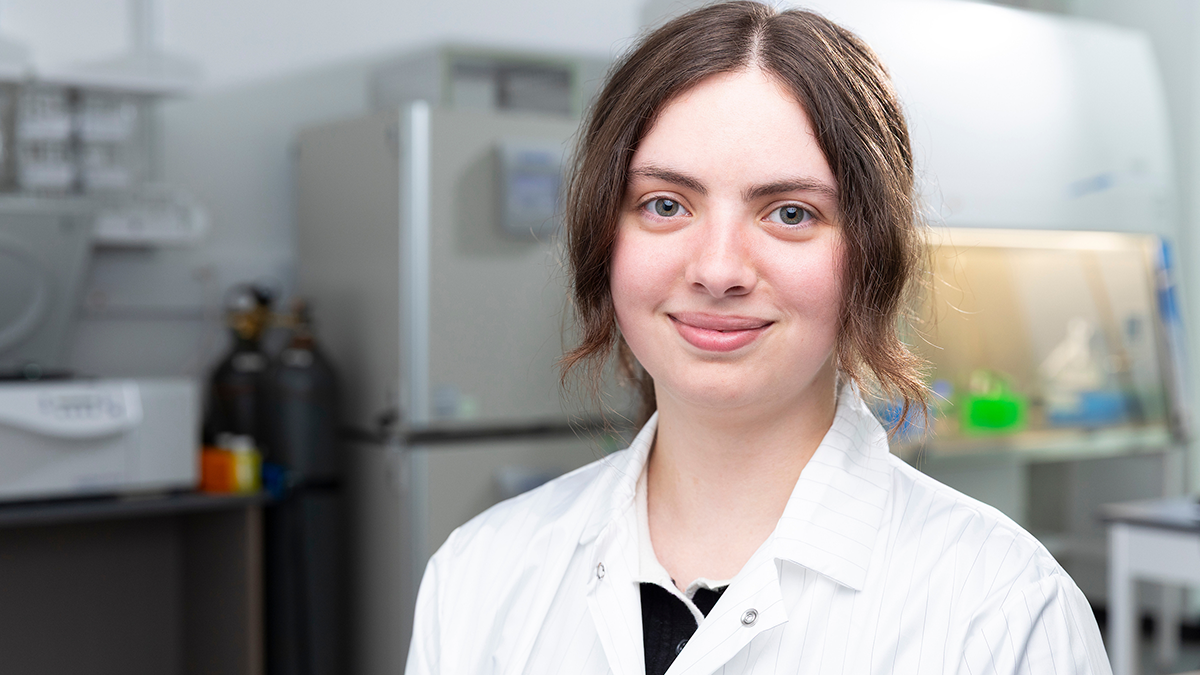
Biomedical Engineering doctoral student Isabela “Bela” Perdomo poses in the lab of Professor Jamel Ali, Ph.D., in the Interdisciplinary Research and Commercialization Building (IRCB) in Tallahassee, Florida. Perdomo was awarded the Department of War National Defense Science and Engineering Graduate Fellowship, which supports her work on developing microrobots—tiny, bioinspired machines that can swim through fluids using external magnetic fields. (Scott Holstein/FAMU-FSU College of Engineering)
At just 16 years old, Perdomo’s passion for environmental conservation took her from South Florida to the icy frontiers of Antarctica.
After winning the WPLG Local 10 Eco-Hero contest, a competitive honor awarded to one outstanding student each year, Perdomo embarked on a multi-week expedition to study Antarctic wildlife and gain hands-on conservation experience.
Today, Perdomo channels that early inspiration into research as a first-year doctoral student in biomedical engineering at the FAMU-FSU College of Engineering. Working at the National High Magnetic Field Laboratory, she is forging a path toward becoming a leader in her field.
The Journey Begins: Backyard Research to Antarctica
“The Eco-Hero Antarctica experience was truly transformative. It’s something I carry with me every day,” Perdomo said. “What began as a simple research project in my backyard blossomed into the chance to visit one of the planet’s most remote and scientifically vital regions.”
“Antarctica showed me what scientific exploration looks like at its highest level,” Perdomo explained. “I met researchers tackling challenges in one of the harshest environments imaginable and witnessed firsthand how science can help us understand our world, and our future, in entirely new ways.”
“That journey also deepened my fascination with extreme environments and exploration,” Perdomo continued. “I’ve always been captivated by space and seeing scientists thrive in Antarctica made me realize that research can propel you to truly extraordinary places. That inspiration still motivates me today, shaping my interest in developing technologies that could one day support human exploration beyond Earth.”
New Horizons: Fellowship and Future Research
Most recently, Perdomo was awarded the Department of War National Defense Science and Engineering Graduate Fellowship, one of the nation’s top honors for emerging researchers. Through the program, she is paired with mentors at the U.S. Army Laboratory and collaborates with leading Department of War research organizations.
The three-year fellowship supports Perdomo’s work developing microrobots, tiny bioinspired machines that swim through fluids using external magnetic fields. These microrobots could transform medicine by delivering drugs to targeted sites, detecting harmful agents or assisting with intricate medical procedures.
What is the significance of this fellowship for biomedical engineering students? The fellowship is one of the most competitive graduate awards in the country, and it gives Perdomo direct access to mentorship and research partnerships with defense laboratories. For biomedical engineering students at the FAMU-FSU College of Engineering, it’s a signal that research happening here can compete for, and win, national recognition.
Microrobots and Innovation
“My goal is to engineer a new generation of bioinspired microrobots that operate safely and effectively in complex environments,” Perdomo said. “Looking ahead, I hope these systems can advance targeted drug delivery, disease detection, environmental monitoring and even exploration in extreme places like outer space.”
“What sets our work apart is that these robots are not only inspired by biology. They can also integrate biological materials to enhance their capabilities,” Perdomo said. “Since they are guided remotely by magnetic fields, these robots could one day reach places in the body that conventional medical tools cannot access.”
Ultimately, Perdomo aims to create microrobots capable of performing tasks with unprecedented precision, minimizing unintended effects on healthy tissues and sensitive environments.
Army Readiness
“The Army is interested in technologies that can enhance medical readiness and bring innovative solutions to challenging environments,” Perdomo said. “Breakthroughs in targeted therapies, diagnostics and autonomous medical systems could benefit both military personnel and civilians.”
“Military operations often take place in settings where advanced medical care is not readily available,” Perdomo said. “Technologies that diagnose, treat or minimize invasive procedures could make a difference for service members in the field.”
Investing in emerging medical technologies strengthens national preparedness and fuels innovation for both defense and civilian health care.
Beyond the Lab: Transforming Health Care
Today’s medical treatments often affect the whole body, even when only one area needs attention. This can lead to unwanted side effects and a lower quality of life. More precise, targeted therapies could improve outcomes for patients while reducing those effects.
“While my research may benefit defense, its impact goes much further,” Perdomo said. “Microrobotic systems could drive advances in cancer treatment, disease diagnosis, drug delivery, environmental cleanup and future space missions. This work lays the groundwork for technologies that could transform health care and quality of life for many individuals.”
How does this research benefit biomedical engineering students at the FAMU-FSU College of Engineering? Students working alongside Perdomo gain exposure to interdisciplinary research that spans medicine, robotics and materials science, conducted at a facility with direct ties to the National High Magnetic Field Laboratory. That kind of hands-on access to national-caliber equipment and mentorship is uncommon at the graduate level.
Making an Impact
“I have always been drawn to both engineering and exploration,” Perdomo said. “Solving technical challenges excites me, but I am equally passionate about making a meaningful difference in people’s lives. Biomedical engineering brings together technology, medicine and innovation to directly improve health outcomes. At the same time, my longstanding love for space exploration keeps me curious about how we thrive in extreme environments.”
“My research today sits at the crossroads of these interests. Developing tiny robotic systems that can navigate complex environments often feels like turning science fiction into reality, and that is the thrill that drives me every day.”
Eyes on the Stars: A Vision for Space Exploration
“Looking ahead, my goal is to shape the future of human spaceflight,” Perdomo said. “After earning my doctorate, I hope to join the aerospace industry and help develop technologies that keep astronauts healthy and safe on long-duration missions.
“Whether it is advanced medical systems, autonomous technology or research supporting moon and Mars missions, I want my work to help expand humanity’s reach, safely exploring the most extreme environments on Earth and beyond.”
Editor’s Note: This article was edited with a custom prompt for Claude Sonnet 5, an AI assistant created by Anthropic. The AI improved clarity, structure, SEO/GEO optimization and readability, while preserving the original reporting and factual content. All information and viewpoints remain those of the author and publication. This article was edited and fact-checked by college staff before being published. This disclosure is part of our commitment to transparency in our editorial process. Last edited: 07/01/2026.
RELATED ARTICLES
FSU Engineering Student Earns National Science Foundation Graduate Research Fellowship
NIH Pre-Doctoral Fellowship awarded to biomedical engineering student for stroke research