
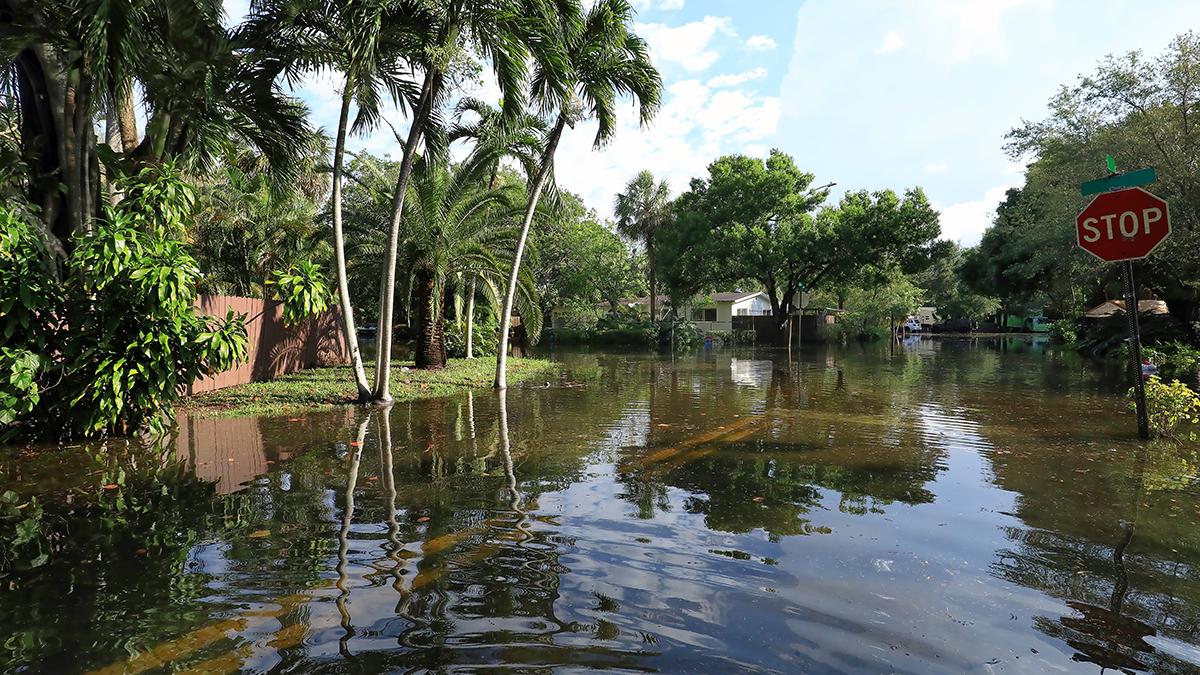
Twenty five inches of rain in 24 hours floods local Fort Lauderdale neighborhood streets. (Jillian Cain for AdobeStock)
Before rain begins to fall, scientists and engineers can predict where a storm might cause flooding thanks to advanced modeling and digital simulations that help guide billion-dollar decisions involving infrastructure design, emergency response, land-use planning, insurance, agriculture, water quality and public safety.
But as new models have evolved, they have diverged into narrow applications or found use beyond their intended scope. The result is a missed opportunity to integrate different methods and improve predictions for flood modeling across domains.

New research, featuring the FAMU-FSU College of Engineering and Florida State University’s Resilient Infrastructure and Disaster Response Center, examined several types of flood models to highlight their strengths and weaknesses and to propose a way forward for integrating model development. The research was published in Reviews of Geophysics.
The research supports critical decisions that protect the homes, livelihoods, emergency response, insurance markets and more.
“As scientists and engineers pushed forward innovation in flood modeling, their work has diverged into a variety of methods, each with its own strengths and weaknesses,” said Assistant Professor Ebrahim Ahmadisharaf, a co-author on the multi-institution study. “But integrating the improvements of various models is where we can really make the most impact across applications.”
How It Works
Flood models are crucial to land use planning, emergency management actions and engineering design. Models can be classified into four types: physics‐based, data‐driven, observational and experimental, and conceptual.
Although all models approximate and simplify the reality of floods and are subject to uncertainty, some trade reliability for efficiency in their computations. Newer models are inclined towards simplified, data-driven methods rather than computational, physics-based approaches because they are easier to implement.
Data-driven models are useful for exploring complex patterns of data and comparing the relationship between flooding and other variables, but these models have limitations when it comes to operational forecasting, design purposes, regulatory hazard analyses and predicting events beyond the conditions represented in their training data because of weak or absent physical constraints. Their generalizability beyond the data they are trained for is also limited.
“These patterns have inherent limitations,” Ahmadisharaf said. “As new methods have developed in isolation from older paradigms, their improvements are siloed within their domains. That limits our ability to better prevent flood events.”
Future Directions
The researchers suggest four key directives for future research and development: hybrid frameworks, enhanced physical representation, integration of data-based methods and bridging science and practice.
“We have high-performance computing resources, which could overcome barriers for flood inundation modeling, but there is a trend of using simplified models that don’t take advantage of these new advancements,” Ahmadisharaf said.
Rather than spending resources on overcoming the limitations of simplified flood models, researchers recommended that future developments should emphasize integrating different methods.
“People use simplified methods because they are faster and easier to implement. With data-driven models, however, there is a greater risk when data are limited, because these models are fully dependent on the data. Computational methods understand the physics, but they take longer to run,” Ahmadisharaf said. “Integrating these different models would lead to improvements for both methods.”
Why It Matters
Refining flood modeling systems is crucial to not overextending them beyond their actual capabilities. These systems support critical decision-making, so they need to be accurate and reliable.
“Flood modeling supports decisions for damage reduction, infrastructure design and more,” Ahmadisharaf said. “We aim to make scientists rethink the direction that flood modeling is going, and not use simplified, data-driven methods as a replacement for computational models. We need to use these models to support each other, so that we can better predict flooding events and protect our infrastructure and communities.”
Researchers from Bristol University, University of Alabama, University of Central Florida, Purdue University, University of California, Irvine, U.S. Army Engineer Research Development Center, the University of Tokyo, Tallahassee-based company Halff and UK-based company Fathom contributed to this study.
Ahmadisharaf’s research was supported by the National Science Foundation and the Gulf Research Program of the National Academies of Sciences, Engineering, and Medicine.
RELATED ARTICLES
Identifying Hidden Health Impacts of Hurricanes and Flood Damage