
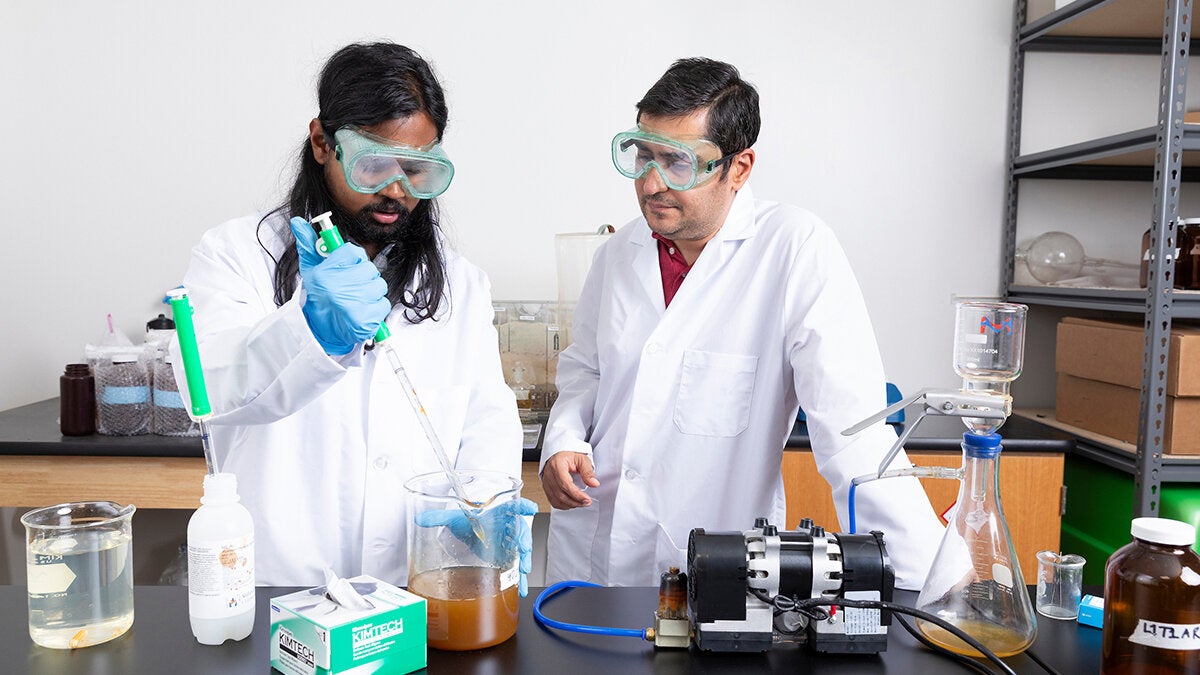
Doctoral student Abdul Mobin Ibna Hafiz (left) adds a solution to a water sample as Ebrahim Ahmadisharaf, Ph.D., watches at FAMU-FSU College of Engineering in Tallahassee, Florida. (Scott Holstein/FAMU-FSU College of Engineering)
Researchers at Florida State University and the FAMU-FSU College of Engineering have helped create the first standardized global data set of microplastics in urban stormwater runoff, filling a critical gap in pollution science and opening new pathways for environmental regulation and infrastructure design.
The Dataset of Urban RUnoff Microplastics (known as DURUM) compiles 180 sampling procedures from 15 countries into a centralized, publicly accessible resource on microplastic concentrations in urban runoff. The research, part of a multi-institutional study published in Scientific Data, enables comparisons across studies and supports drainage infrastructure, urban planning and environmental policy.

“Plastic pollution creates issues in the environment and human health. To protect ourselves and the world around us, we need to be able to predict the conditions under which microplastics spread and pollute our water,” said study co-author Assistant Professor Ebrahim Ahmadisharaf in the joint college’s Department of Civil & Environmental Engineering. “This was not possible until now. We synthesized several different sources to create a standardized data set, DURUM, which will have global impacts.”
Assistant Professor Jeffrey M. Farner, whose research at the college focuses on micro- and nanoplastics and water treatment, also served as a co-author on the study.
Addressing a Gap in Urban Pollution Data
When rain falls on city streets, stormwater runoff systems quickly drain excess water, protecting buildings and infrastructure. Those same systems can also carry microplastics—tiny plastic fragments shed from tires, litter and other urban sources—into rivers, lakes and oceans. Despite cities being a primary origin point for microplastic pollution, existing data sets have focused largely on marine and coastal environments.
DURUM changes that. Each entry in the data set includes the location where samples were collected, the types of microplastics identified, their concentration and additional contextual data. The standardized format allows researchers worldwide to make cross-study comparisons for the first time, supporting the development of reliable predictive models for urban stormwater systems.
“There are already global data sets on microplastics in marine environments, but our study dives into a completely new area,” Ahmadisharaf said. “Urban areas are unique because they have high populations and high plastic consumption. With our current technology, we cannot quickly and reliably detect these high microplastic concentrations. We need to develop new models and validate them with adequate observed data to predict microplastics in urban stormwater runoff.”
Why It Matters for Policy and Infrastructure
The absence of water quality regulations specifically addressing plastics makes the timing of DURUM especially significant. As policymakers and engineers work to address microplastic pollution, having a verified, global data foundation is essential.
“Right now, there are no established water quality regulations addressing plastics,” Ahmadisharaf said. “As such regulations are developed, it will be essential to identify and understand the sources of microplastics and the pathways through which they are transported into water bodies. This will help us design mitigation and prevention infrastructure to limit export of plastic to water bodies. The data we compiled supports the models that will inform these crucial decisions.”

Open Access and Growing
The DURUM data set is in the public domain, making it freely accessible to researchers globally. The College of Engineering team plans to update it continuously as new data emerges, broadening its utility for modeling research.
“This data set enables new capabilities for validating predictive models. With DURUM, we can be more confident about what our models predict,” Ahmadisharaf said. “It also creates a new understanding of the key drivers of microplastics in urban stormwater runoff and could lead to new insight as we continue to update the data set.”
Research Team and Funding
Abdul Mobin Ibna Hafiz, a doctoral student in the FAMU-FSU College of Engineering’s Department of Civil and Environmental Engineering, served as lead author. Joint college professors Ahmadisharaf and Farner both contributed as co-authors. Collaborating institutions include the University of Missouri, Wageningen University, the University of Exeter, Connecticut Agricultural Experiment Station, Tsinghua University and Tulane University.
The research was supported by grants from the U.S. Department of Agriculture and the National Science Foundation.
Editor’s Note: This article was edited with a custom prompt for Claude Sonnet 4.6, an AI assistant created by Anthropic. The AI improved clarity, structure and readability while preserving the original reporting and factual content. All information and viewpoints remain those of the author and publication. This article was edited and fact-checked by college staff before being published. This disclosure is part of our commitment to transparency in our editorial process. Last edited: 04/29/2026.
RELATED ARTICLES
Engineering researcher combines climate change and land use data to predict watershed impact
Engineering researcher develops a tool aimed at better stormwater management, planning
New climate model helps researchers better predict water needs