
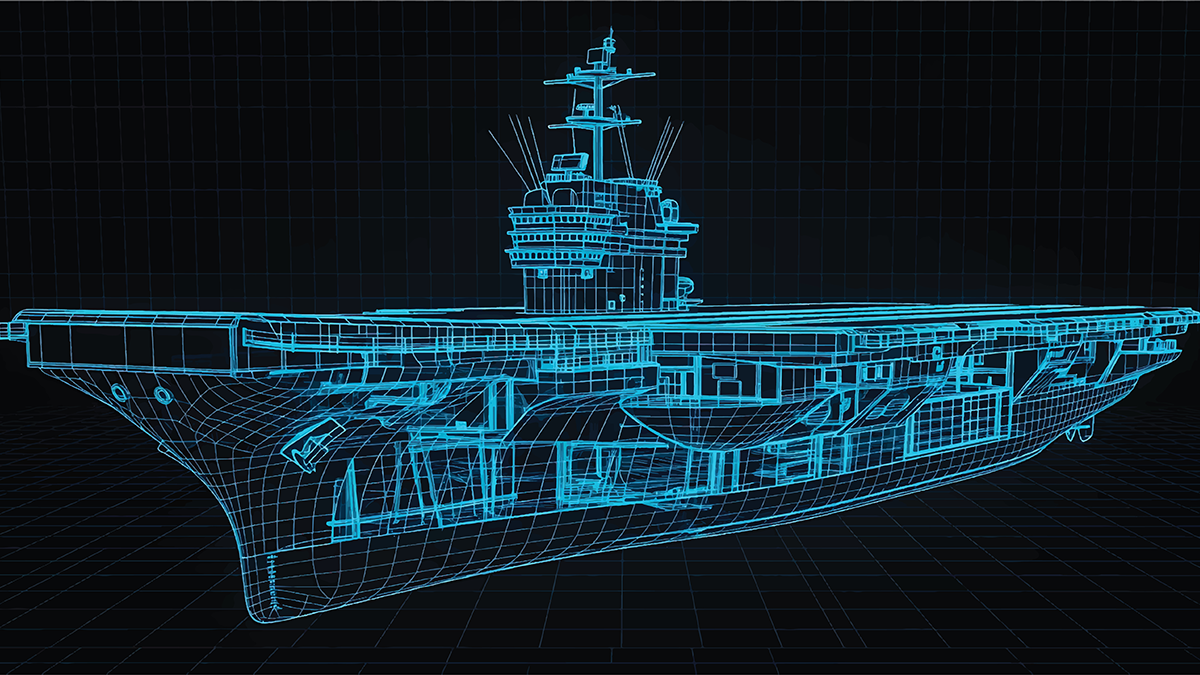
By RNB DESIGN for AdobeStock
Key Points:
- The Center for Advanced Power Systems (CAPS), a research center built in partnership with the FAMU-FSU College of Engineering, has secured an $88 million contract from the U.S. Navy — the largest in Florida State University's history.
- Twelve tenure-line faculty in the college's Department of Electrical and Computer Engineering hold joint appointments at CAPS, and the center's interim director, Sastry Pamidi, previously chaired that same department.
- The contract, awarded by Naval Sea Systems Command (NAVSEA), funds research and development to support the Navy's next generation of shipboard power and energy systems through June 2031.
- Built-in options could bring the total to $99.5 million. It's a moment two decades in the making for a center whose researchers, leadership and mission run directly through the college.
The Center for Advanced Power Systems (CAPS), a research center built in partnership with the FAMU-FSU College of Engineering, has secured an $88 million contract from the U.S. Navy—the largest federal contract in Florida State University’s history.
It’s a moment two decades in the making for a center whose researchers, leadership, and mission run directly through the FAMU-FSU College of Engineering.
Twelve tenure-line faculty in the college’s Department of Electrical and Computer Engineering hold joint appointments at CAPS. The center’s interim director, Sastry Pamidi, previously chaired that same department.
Why Was the Center for Advanced Power Systems Established?
CAPS was established in 2000 to do two things: conduct research in power systems, and train the power engineers the Navy and the nation would need for decades to come, using the college as its talent pipeline. The Florida State University-based center operates in close partnership with the college, from shared faculty appointments to shared research leadership on projects like this one.
What Does the $88 Million Navy Contract Cover?
The contract, awarded by the Naval Sea Systems Command (NAVSEA), funds a broad research and development effort to support the Navy’s next generation of shipboard power and energy systems through June 2031. CAPS will build digital models and architectures for advanced ship systems and test next-generation electrical power and energy systems before they’re installed on physical vessels—work meant to catch problems in simulation instead of at sea.
Leading the effort are Harsha Ravindra and James Langston, both of whom are CAPS research faculty and joint college graduates. Ravindra holds two degrees from the college; Langston holds three.
What Are FSU and CAPS Leaders Saying About the Contract?
“FSU’s Center for Advanced Power Systems is a national leader in highly specialized research and development that supports the U.S. Navy’s most advanced technology needs,” said FSU President Richard McCullough. “This major award reflects the Navy’s confidence in FSU’s expertise and underscores the important role our university plays in advancing power systems research with real-world impact.”
“Modern naval vessels are essentially moving microgrids, facing energy demands that were unimaginable a few decades ago,” Ravindra said. “This partnership with NAVSEA allows us to push the boundaries of what’s possible in modeling and simulation as well as testing of advanced power system components in controller- and power- hardware-in-the-loop environments for shipboard electrical design, rapid prototyping and deployment on ships. The expertise provided by CAPS supports the Navy in design and risk reduction of ships that are faster, more resilient and exponentially more energy efficient.”
“Collaborating with leading institutions and industry partners across the country requires a deeply integrated approach,” Langston said. “CAPS has the unique infrastructure, expertise and computational power to serve as the anchor for this nationwide research effort. It’s incredibly rewarding to lead a project that tackles real-world engineering challenges that directly impact national security.”
FSU Vice President for Research Stacey S. Patterson pointed to the team behind the win. “We are incredibly proud of Dr. Ravindra, Dr. Langston, Dr. Pamidi and the entire CAPS team for their leadership and hard work,” Patterson said. “Through this partnership with NAVSEA, FSU is helping shape the future of naval power systems, advancing national security innovation and demonstrating how our researchers translate groundbreaking ideas into real-world solutions.”
How Long Has CAPS Worked With the U.S. Navy?
The relationship goes back to CAPS’s earliest days. The center launched in 2000 with support from the Office of Naval Research, and in the 25 years since, it has secured hundreds of millions of dollars in grants, trained more than 100 doctoral students who’ve gone on to careers in academia and industry, and produced more than 60 patented technologies. In 2016, CAPS became the first university the Navy accredited to run power hardware-in-the-loop simulation testing on megawatt-scale equipment for surface combatants.
This new contract extends that track record. For the FAMU-FSU College of Engineering, it’s a reminder that the faculty and graduates who conduct sophisticated research and development and established unique capabilities at CAPS are the reason the Navy keeps coming back.
Editor’s Note: This article was edited with a custom prompt for Claude Sonnet 5, an AI assistant created by Anthropic. The AI optimized the article for SEO/GEO discoverability, improved clarity, structure and readability while preserving the original reporting and factual content. All information and viewpoints remain those of the author and publication. This article was edited and fact-checked by college staff before being published. This disclosure is part of our commitment to transparency in our editorial process. Last edited: 07/23/2026.
FAQ
What is the Center for Advanced Power Systems? The Center for Advanced Power Systems, known as CAPS, is a research center at Florida State University established in 2000 in partnership with the FAMU-FSU College of Engineering. It conducts research in power systems and trains power engineers, with twelve tenure-line faculty from the college's Department of Electrical and Computer Engineering holding joint appointments there.
How much money is the Navy contract worth? The Naval Sea Systems Command (NAVSEA) awarded CAPS an $88 million contract, the largest in FSU history. Built-in options could add $11.5 million more, bringing the potential total to $99.5 million. The contract runs through June 2031.
What will CAPS researchers do under this contract? CAPS will build digital models and architectures for advanced Navy ship systems and test next-generation electrical power and energy systems before they’re installed on physical vessels, catching problems in simulation instead of at sea.
Who is leading the CAPS research team on this project? CAPS research faculty members Harsha Ravindra and James Langston are leading the effort. Both are graduates of the FAMU-FSU College of Engineering; Ravindra holds two degrees from the college and Langston holds three. Sastry Pamidi, who previously chaired the college's Department of Electrical and Computer Engineering, serves as CAPS interim director.
How is the FAMU-FSU College of Engineering connected to CAPS? Twelve tenure-line faculty in the college’s Department of Electrical and Computer Engineering hold joint appointments at CAPS, and the center’s leadership and lead researchers on this project are college graduates.
How long has CAPS worked with the U.S. Navy? CAPS launched in 2000 with support from the Office of Naval Research. In the 25 years since, it has secured hundreds of millions of dollars in grants, trained more than 100 doctoral students, and produced more than 60 patented technologies. In 2016, it became the first university test site the Navy accredited to run power hardware-in-the-loop simulation testing on megawatt-scale equipment for surface combatants.
RELATED ARTICLES
Center for Advanced Power Systems Celebrates 25 Years of Advancing Science and Engineering