
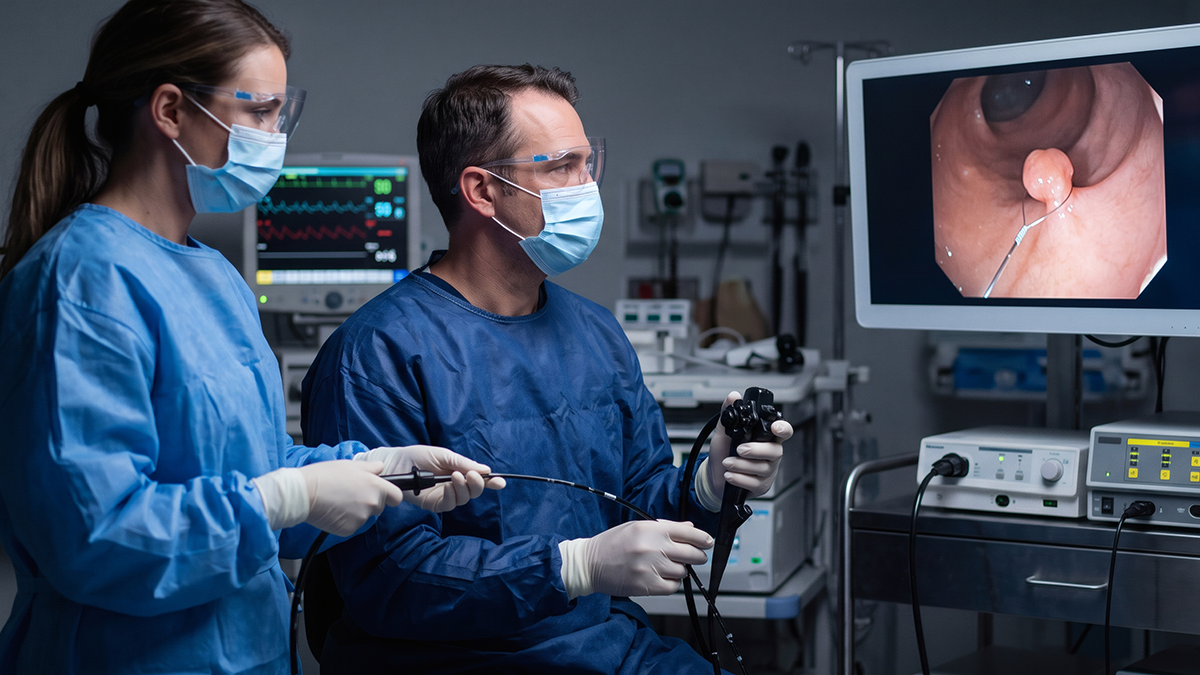
Minimally invasive laparoscopic surgery (By Five Million Stock for AdobeStock)
Key Points
Researchers at the FAMU-FSU College of Engineering, led by Dean Suvranu De, developed VBA-Net+, an artificial intelligence model that predicts surgical skills test scores from video.
The model analyzes recordings of trainees performing tasks from the Fundamentals of Laparoscopic Surgery exam, a requirement for board certification in general surgery. In testing, VBA-Net+ predicted scores and pass-fail outcomes on pattern-cutting and suturing tasks, including those for trainees it had not seen before.
The work matters because surgical skills grading still depends on expert reviewers, which is slow, costly and sometimes inconsistent. The findings were recently published in npj Digital Medicine, a Nature Portfolio journal.
Researchers at the FAMU-FSU College of Engineering are using artificial intelligence to improve how surgeons are trained and evaluated.
Their video assessment tool, VBA-Net+, could make surgical training more effective and accessible for aspiring surgeons.
VBA-Net+ can predict standardized surgical performance scores from videos, offering a potentially scalable approach to assessment. Suvranu De, Google-endowed dean of the FAMU-FSU College of Engineering and professor of mechanical engineering, leads the research group.

The team’s findings, recently published in npj Digital Medicine, a Nature Portfolio journal, show the potential of VBA-Net+ for evaluating surgical performance. The work examines tasks from the Fundamentals of Laparoscopic Surgery program, a required component for board certification in general surgery. That requirement makes a reliable, scalable assessment tool especially important.
“We are exploring whether AI can learn from videos of surgical trainees and predict their performance on standardized skills tests,” De said. “The goal is to make high-quality assessment more accessible and provide a foundation for more consistent feedback during training.”
How are surgical skills assessed today?
A surgeon’s skill can mean the difference between life and death. Traditionally, assessing that skill has relied on expert observation and manual scoring. These methods work, but they are time-consuming, costly and sometimes inconsistent.
The Fundamentals of Laparoscopic Surgery (FLS) exam was created to bring greater consistency to the process by testing skills such as suturing and pattern cutting in a standardized way. However, FLS assessment still requires manual evaluation of test performance.
How does AI video assessment work for surgical training?
To address this, the researchers developed an AI-powered video model using technology similar to large language models but tailored to video. Instead of generating text, the model predicts scores and pass-fail outcomes on standardized FLS tasks.
The researchers tested VBA-Net+ using videos of trainees practicing on simulation boxes. The AI’s task was to predict the scores and outcomes a human examiner would assign. The team tested the system on two tasks: pattern cutting and surgical suturing.

(Scott Holstein/FAMU-FSU College of Engineering)
How accurate is VBA-Net+ at predicting surgical performance?
VBA-Net+ performed especially well on pattern cutting and strongly on suturing, including for trainees whose videos were not used to train the prediction model. The system predicted both FLS scores and pass-fail outcomes as a human reviewer would, with the potential for greater speed and scalability.
“What makes this approach particularly exciting is that the AI models were not specifically trained on surgical videos, yet they could accurately predict surgical performance scores, even for trainees they had never encountered before,” said Sangrock Lee, lead author of the study.
What could AI-assisted assessment mean for future surgeons?
The research marks a step toward making surgical skill assessment more objective and scalable. Automated video review could eventually provide faster feedback and greater consistency. The team plans to expand the approach to other surgical specialties.
The researchers hope to partner with more institutions to evaluate the technology in broader training environments. Their long-term goal is to make advanced assessment tools available to more surgeons.
“Our long-term objective is not to replace expert educators, but to give them the additional tools to assess performance and help trainees improve,” De said.
Who conducted and funded the research?
Lee, a postdoctoral researcher at the FAMU-FSU College of Engineering, led the study with De. Assistant Professor Fnu Rahul of Rensselaer Polytechnic Institute co-authored the work. The research was funded by the U.S. Army Futures Command, Combat Capabilities Development Command Soldier Center STTC cooperative research agreement.
Editor’s Note: This article was edited with a custom prompt for Claude Opus 5.5, an AI assistant created by Anthropic. The AI optimized the article for SEO/GEO discoverability, improved clarity, structure and readability while preserving the original reporting and factual content. All information and viewpoints remain those of the author and publication. This article was edited and fact-checked by college staff before being published. This disclosure is part of our commitment to transparency in our editorial process. Last edited: Oct. 21, 2026.
RELATED ARTICLES
Building a Better Surgeon: Researchers Develop Artificial Intelligence Tool for Surgical Training
Researchers Launch U.S. Army Study Using Ultrasound to Examine Burn Wounds
FAQ
VBA-Net+ is an artificial intelligence video model developed at the FAMU-FSU College of Engineering in Tallahassee, Florida. It analyzes videos of surgical trainees and predicts their scores and pass-fail outcomes on standardized surgical skills tests.
The Fundamentals of Laparoscopic Surgery (FLS) exam is a standardized test of surgical skills such as suturing and pattern cutting. It is a required component for board certification in general surgery.
In a study published in npj Digital Medicine, the VBA-Net+ model predicted FLS scores and pass-fail outcomes as a human reviewer would. It performed especially well on pattern cutting and strongly on suturing. The researchers describe it as a tool to support, not replace, expert educators.
The developers say no. Suvranu De, dean of the FAMU-FSU College of Engineering, said the goal is to give expert educators additional tools to assess performance and help trainees improve.
VBA-Net+ was developed by a team led by Suvranu De, Google-endowed dean of the FAMU-FSU College of Engineering. Postdoctoral researcher Sangrock Lee was lead author, and Fnu Rahul, an assistant professor at Rensselaer Polytechnic Institute, co-authored the study.
The research was funded by the U.S. Army Futures Command, Combat Capabilities Development Command Soldier Center STTC cooperative research agreement.