
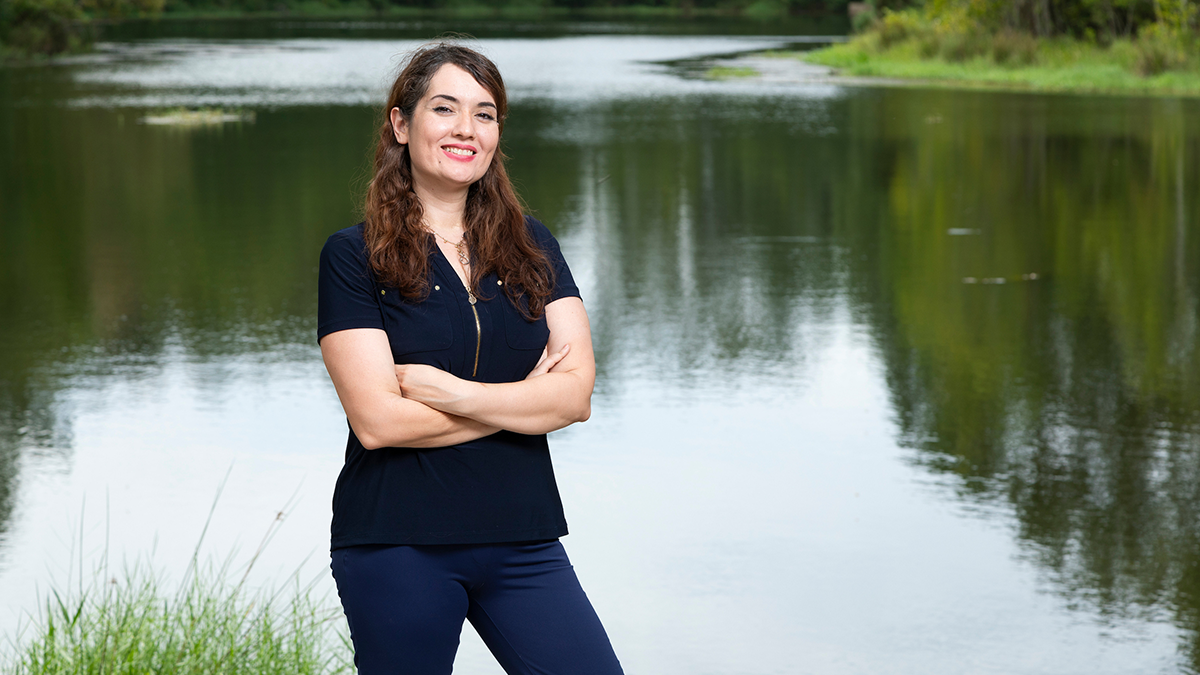
Associate Professor Nasrin Alamadari was recently selected for NASEM’s Gulf Research Program Early-Career Research Fellowship based on her work in environmental engineering. (Scott Holstein/FAMU-FSU College of Engineering)
The National Academies of Sciences, Engineering, and Medicine, or NASEM, is recognizing a FAMU-FSU College of Engineering faculty member for her research that supports safe and clean water for communities in Florida and beyond.
Associate Professor Nasrin Alamdari is part of the 2026-2028 cohort for NASEM’s Gulf Research Program Early-Career Research Fellowship, which supports emerging scientific leaders whose work strengthens the well-being of coastal communities and ecosystems.
“It is an honor to be selected,” Alamdari said. “Part of what makes it meaningful is that this fellowship funds people rather than a single project. Over the next two years, I aim to bridge the gap between forecasting and helping planners with real-world decisions.”
Research to support healthy coastal communities
Alamdari’s research focuses on watershed hydrology, stormwater management, predicting and mitigating harmful algal blooms and developing natural and nature-based solutions. She uses data-driven and process-based models to address water resource problems.
Her team developed fine-scale hydrologic models of Florida’s urban watersheds involving individual stormwater practices such as rain gardens, bioretention cells and retention ponds. They also used machine learning models to forecast cyanobacteria blooms in lakes and coastal estuaries, including Biscayne Bay and Lake Okeechobee.
Her work has produced statewide decision-support tools that help municipalities identify and size stormwater practices for nutrient reduction, estimate the monetary value of green infrastructure assets and predict cyanobacteria in freshwater lakes.
“Data is scarcest precisely in the communities facing the greatest risk,” Alamdari said. “But if we can predict bacteria levels or an algal bloom a few days in advance, even in a county with almost no monitoring, we can transform when warnings are issued and how much a community must spend responding afterward. If a family can make a safer decision about where their children swim or what comes out of their tap, then the research did its job.”
NASEM Fellowship
The NASEM Fellowship supports scientists, engineers and health professionals in the critical pre-tenure phase of their careers, providing a two-year grant for research and professional development.
During the fellowship, Alamdari plans to connect her water quality and algal bloom forecasts to public health data in partnership with health departments and public health researchers and to evaluate how infrastructure performs through events such as back-to-back storms or simultaneous drought and extreme heat.
Alamdari received the fellowship through the program’s Community Track, which supports applied research on climate-related stressors such as heat, flooding and pollution and their impacts on human health, community resilience and regional economies.
Alamdari
Alamdari is an associate professor in the college’s Department of Civil and Environmental Engineering and a member of the college’s Resilient Infrastructure & Disaster Response Center, or RIDER. She has led 15 funded projects, supported by organizations like the National Science Foundation, the U.S. Environmental Protection Agency and the Florida Department of Environmental Protection.
Alamdari holds a doctorate in biological systems engineering from Virginia Tech and completed postdoctoral research at the Colorado School of Mines. In 2025, she received the American Water Resources Association's A. Ivan Johnson Young Professional Award.
She was also selected for the National Science Foundation’s National Center for Atmospheric Research Faculty Innovator Program, which supports her project to integrate high-resolution atmospheric and hydrologic forecasts into an artificial intelligence-driven statewide early warning system for harmful algal blooms.
Visit Alamdari’s website to learn more about her work. Visit the National Academies website to learn more about the Early-Career Research Fellowship and see the 2026-2028 cohorts.
RELATED ARTICLES
Nasrin Alamdari Selected to Attend the ASEE DELTA Junior Faculty Institute
Engineering Researchers Reveal Harmful Blue-Green Algae Hotspots Across Florida’s Lakes