
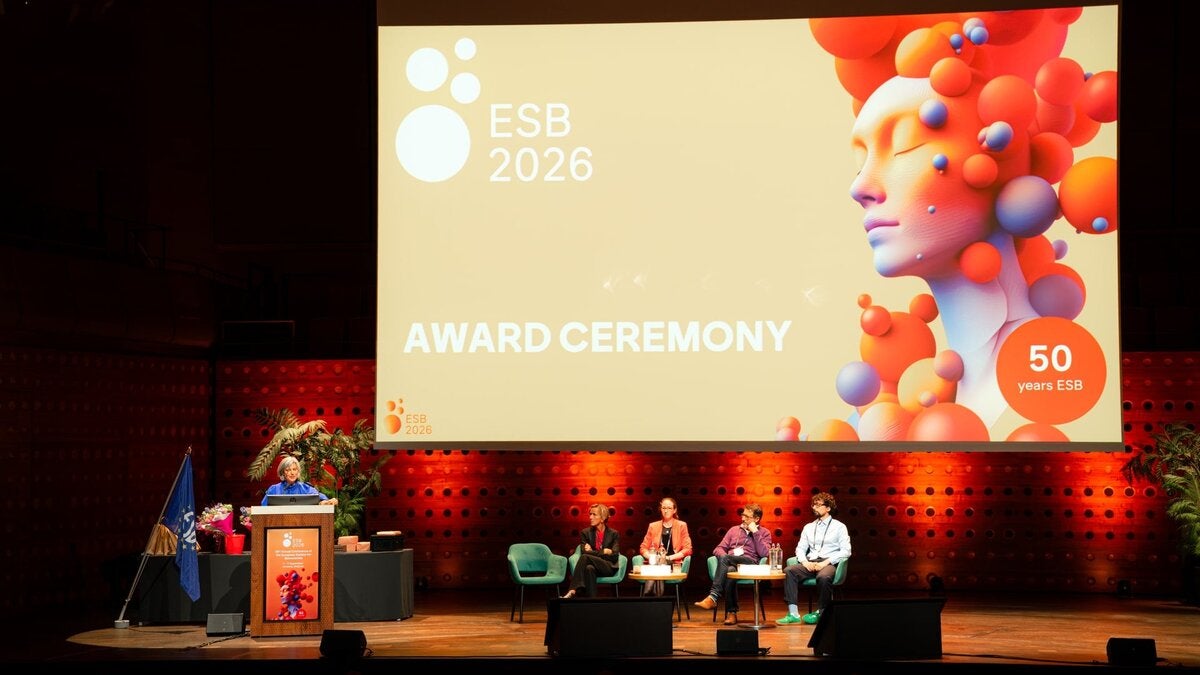
(By Fredography for ESB 2026)
Sophie Jermyn, a fifth-year doctoral student in biomedical engineering at Florida State University and the joint FAMU-FSU College of Engineering, won the Best Oral Presentation award at the 35th Annual Conference of the European Society for Biomaterials (ESB), held Sept. 7-11 in Antwerp, Belgium.

Jermyn was one of only three students to receive the honor. She earned it for her talk, “Protein nanofiber resins for 2PP fabrication of immunostimulatory micro swimmers,” which presented her research on nanorobotic drug delivery systems. The work seeks new approaches to diagnosing and treating cancer, with a focus on melanoma and glioblastoma.
The ESB is a nonprofit organization and one of the leading professional societies in the global biomaterials field.
“The ESB conference is a central gathering point for those in the field,” Jermyn said. “It promotes interactions between basic researchers, applied scientists, clinicians and industry to drive the development of innovative solutions for clinical applications. It is surreal for my work to be recognized from among over 500 who gave oral presentations at the event.”
What does this award mean for a biomedical engineering doctoral student?
The Best Oral Presentation award put Jermyn’s work in front of researchers, clinicians and industry representatives from around the world, and she was one of only three students recognized. For a doctoral researcher, that visibility can open doors to collaborations and give her lab’s work a wider audience.
Her research
Jermyn conducts her research at the National High Magnetic Field Laboratory, working with FAMU-FSU Engineering Associate Professor Jamel Ali in the micro- and nanorobotics subgroup. They are developing targeted ways to deliver therapeutics to tissues such as solid tumors while reducing the side effects of traditional chemotherapy.

Jermyn is developing protein nanofiber resins that can be 3D printed with a laser, a technique called two-photon polymerization (2PP). The resins are made of highly concentrated strands of proteins from Salmonella Typhimurium, a bacterium commonly associated with food poisoning, that trigger a response from immune cells.
Why use proteins from bacteria?
“Because immune cells recognize these bacterial proteins as threats, we use this reaction to activate suppressed immune cells without exposing them to live bacteria,” Jermyn said. “We can embed features such as magnetic nanoparticles to steer these structures—hence the micro swimmer concept—or load them with cancer drugs for targeted delivery.”
Inspired by life experience
“Growing up in Chicago, I never imagined I’d be on this path,” Jermyn said. “But after working as an emergency medical technician in the city, I realized I wanted to go into biomedical engineering and develop new treatments for patients who had run out of options.”
Her determination deepened as she watched loved ones battle diseases like Alzheimer’s and cancer.
“After earning my bachelor’s in biomedical engineering, I chose to stay and pursue my doctorate when my father was diagnosed with stage four melanoma in 2021,” she said.

Jermyn sees her work as one small piece of a much larger puzzle.
“If I can contribute a new insight into immune responses, spark a fresh idea for drug delivery, or add a small but meaningful piece to the world’s scientific knowledge, I’ll consider it a success,” Jermyn said. “Changing the world isn’t a solo endeavor—but together, through collaboration, we can complete the puzzle.”
Editor’s Note: This article was edited with a custom prompt for Claude Sonnet 5, an AI assistant created by Anthropic. The AI improved clarity, structure, SEO/GEO optimization and readability, while preserving the original reporting and factual content. All information and viewpoints remain those of the author and publication. This article was edited and fact-checked by college staff before being published. This disclosure is part of our commitment to transparency in our editorial process. Last edited: 09-23-2026.
RELATED ARTICLES
Building Futures, Breaking Barriers, FAMU-FSU Researchers Empower Female Students in Science