
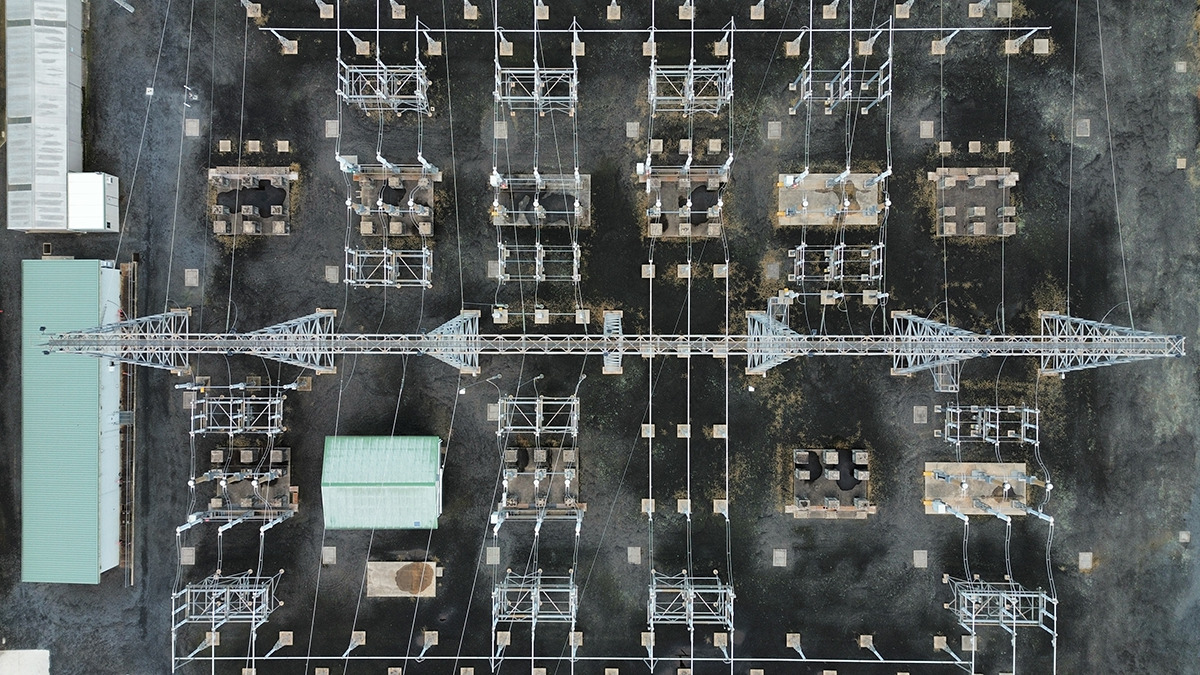
An electrical substation providing power and energy to the grid (By GoAerials for AdobeStock)
Key Points
A research team at the FAMU-FSU College of Engineering has won a $4.1 million grant from the U.S. Department of Energy’s Advanced Research Projects Agency-Energy (ARPA-E) to develop new high-voltage direct current (HVDC) technology for the U.S. power grid.
The project, called CRITIQAL, is led by Distinguished Research Professor Hui Li and based at the FSU Center for Advanced Power Systems, with partners Eaton Corp, the Georgia Institute of Technology and the University of Nebraska-Lincoln.
The award is part of ARPA-E’s $35 million DC-GRIDS program, announced in March 2026, which is funding 12 research teams nationwide working to modernize the country’s power grid infrastructure.
The team says its new silicon carbide-based valve module could handle far more voltage while cutting costs and energy loss, helping the grid meet rising demand from data centers, electric vehicles and the broader digital economy.
Imagine a future where energy flows seamlessly across the country, powering homes, data centers and electric vehicles with greater reliability than ever before.
That future is one step closer, thanks to a team of researchers from Florida State University at the FAMU-FSU College of Engineering and the Center for Advanced Power Systems (CAPS).
Hui Li, Distinguished Research Professor in the Department of Electrical & Computer Engineering at the joint college, is leading the project. “HVDC systems are likely to see wider use in the future because they can move electricity over long distances efficiently and reliably,” she explains.
The group recently landed major funding from the U.S. Department of Energy’s Advanced Research Projects Agency-Energy, or ARPA-E, to lead groundbreaking research on high-voltage direct current, or HVDC, technologies.
“This is important as artificial intelligence data centers, the digital economy and electric vehicles need more power,” Li continued. “Our project will create new types of direct current converters to make the power grid stronger and safer, helping the United States deliver more homegrown energy to homes, data centers and businesses.”

Why HVDC Technology Matters for Electrical Grid Infrastructure
According to Li, traditional HVDC valves are based on silicon devices and modular multilevel converter designs. However, they face limitations such as low switching frequencies, large submodule capacitors and high explosion-proofing costs, resulting in significant station footprints and system costs.
“Our project aims to solve major technical problems by creating a new type of valve module that uses silicon carbide, or SiC,” Li said. “We are using a new design, affordable power supply, improved cooling and new ways to reduce interference.”
A Better HVDC Valve Module
The team believes the work should make their new valve module much better than older ones by handling 50 times more voltage, being 20 times more powerful for its size, losing half as much energy and costing 70% less per megawatt.
Their goal is to create a next-generation HVDC power electronics module, featuring a unique structural design, a built-in auxiliary power supply and advanced systems for cooling and reducing electromagnetic interference.
Ultimately, the goal is to make HVDC stations smaller, more efficient and more affordable by combining these new technologies.
ARPA-E’s DC-GRIDS Program and Power Grid Investment
ARPA-E has invested $35 million in projects aimed at expanding and modernizing the nation’s power grid infrastructure. It’s an important step to address America’s growing energy needs.
Through its Disruptive DC Converters for Grid Resilient Infrastructure to Deliver Secure Energy, or DC-GRIDS, program, ARPA-E aims to revolutionize the nation’s traditional alternating current, or AC, infrastructure by developing advanced HVDC technologies.
Collaborative Research: The CRITIQAL Project Team
Florida State University’s project, called Cascaded Resonance-Insensitive Quasi-Two-Level SiC Valve Modules, or CRITIQAL, has received $4.1 million, the largest award among the 12 selected projects.
CRITIQAL is an FSU collaboration with Eaton Corp, Georgia Institute of Technology and the University of Nebraska-Lincoln on the multi-institution project. Each institution brings unique expertise:
- Florida State University leads in wide-bandgap power electronics to improve efficiency and provides hardware-in-the-loop verification for proposed power systems technologies.
- University of Nebraska-Lincoln specializes in press-pack silicon carbide, or SiC, module packaging for medium-voltage applications.
- Eaton Corp provides advanced cooling systems and insulating materials.
- The Georgia Institute of Technology focuses on high-voltage insulation.
Together, the team is developing the proposed HVDC valve module.
Li is collaborating with Gian-Carlo Montanari, Research Professor at CAPS, who will help ensure the new valve module design is free of partial-discharge issues. Graduate students and postdoctoral researchers will also contribute to the project.
Editor’s Note: This article was edited with a custom prompt for Claude Sonnet 5, an AI assistant created by Anthropic. The AI optimized the article for SEO/GEO discoverability, improved clarity, structure and readability while preserving the original reporting and factual content. All information and viewpoints remain those of the author and publication. This article was edited and fact-checked by college staff before being published. This disclosure is part of our commitment to transparency in our editorial process. Last edited: 09/17/2026.
RELATED ARTICLES
FSU Names FAMU-FSU College of Engineering Faculty Member Distinguished Research Professor
Engineering Researchers Use AI to Enhance Defect Detection in Metal 3D Printing
FAMU-FSU Researchers Pioneer New Hydrogen Storage System for Zero-Emission Aviation
FAQ
In 2026, a research team at the FAMU-FSU College of Engineering, a joint engineering school of Florida A&M University and Florida State University in Tallahassee, Florida, received a $4.1 million grant from the U.S. Department of Energy’s Advanced Research Projects Agency-Energy (ARPA-E). The funding supports a project called CRITIQAL, which is developing new high-voltage direct current (HVDC) technology to strengthen and modernize the U.S. power grid.
Hui Li is a Distinguished Research Professor at the FAMU-FSU College of Engineering and a longtime power electronics researcher at the college’s Center for Advanced Power Systems (CAPS). She is the principal investigator leading the CRITIQAL project, which is developing a new type of HVDC valve module using silicon carbide technology.
DC-GRIDS, short for Disruptive DC Converters for Grid Resilient Infrastructure to Deliver Secure Energy, is a $35 million U.S. Department of Energy program administered by ARPA-E. Announced in March 2026, it funds 12 research teams across the country developing high-voltage direct current technology to make the U.S. power grid more resilient and better able to handle rising electricity demand from data centers and electric vehicles.
Florida State University leads the CRITIQAL project in collaboration with Eaton, the Georgia Institute of Technology and the University of Nebraska-Lincoln. Florida State University focuses on wide bandgap power electronics and hardware-in-the-loop testing; the University of Nebraska-Lincoln specializes in press-pack silicon carbide module packaging; Eaton contributes cooling systems and insulating materials; and Georgia Tech focuses on high-voltage insulation.
HVDC technology can move electricity over long distances more efficiently and reliably than the alternating current, or AC, systems that make up most of today’s power grid. As demand grows from artificial intelligence data centers, electric vehicles and the broader digital economy, researchers say HVDC upgrades could help the U.S. deliver more domestically produced energy while making the grid stronger and more secure.
According to lead researcher Hui Li, the silicon carbide-based valve module being developed at FSU is designed to handle up to 50 times more voltage, be 20 times more powerful for its size, lose half as much energy and cost 70% less per megawatt than older HVDC valve designs.