
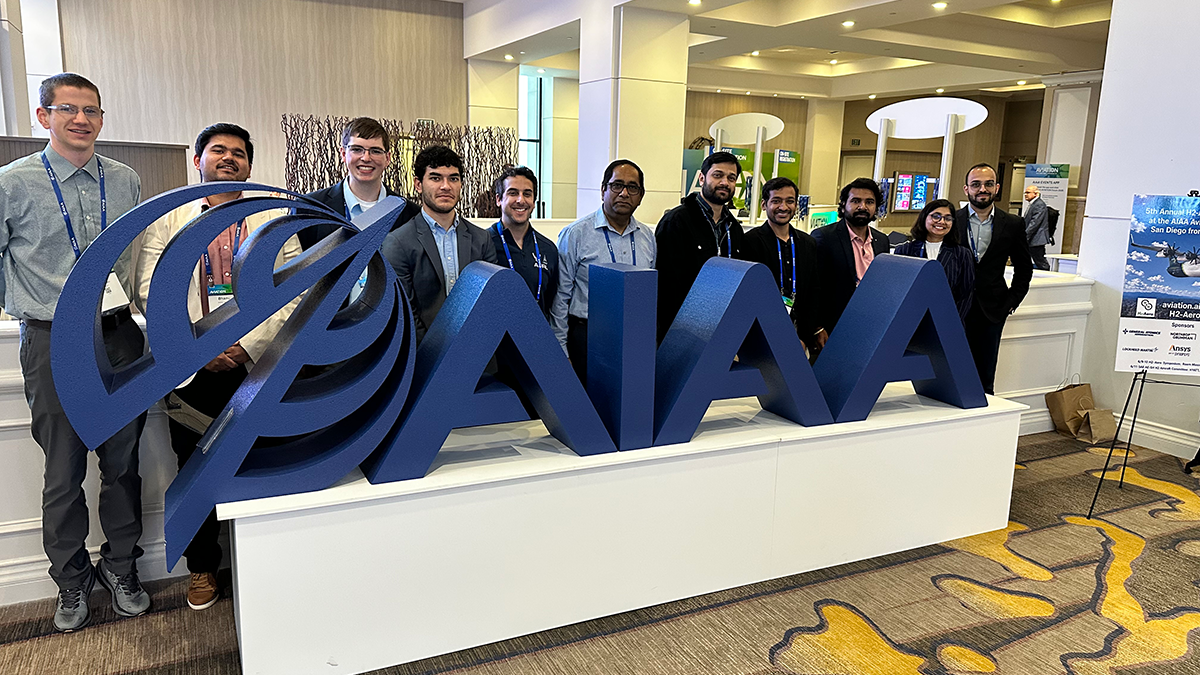
Left to right: Luke Aagaard (PhD student), Bhanu Pratap Akherya (PhD student), Robert D. Smith (PhD student), Duvall Dickerson-Evans (PhD student), Eric D. Smith (PhD and Alumni), Rajan Kumar (PhD and professor), Unnikrishnan S. Nair (PhD and Associate Professor), Dilip Kalagotla (PhD and Postdoctoral Research Scholar), Nitin Singh (PhD student), Gargi Dashora (PhD student), Anirudh Lakshmi Narasimha Prasad (PhD and Postdoctoral Research Scholar) at the 2026 AIAA conference in San Diego, CA. (Courtesy Kalagotla)
Key points
- Students, postdoctoral researchers, alumni and faculty from the FAMU-FSU College of Engineering presented research at the AIAA Aviation Forum 2026 in San Diego.
- The forum, hosted by the American Institute of Aeronautics and Astronautics (AIAA), is one of the world’s premier aerospace conferences, drawing more than 2,500 professionals from 45 countries.
- Presenters included graduate students and postdoctoral researchers from the Department of Mechanical and Aerospace Engineering (MAE) and the Florida Center for Advanced Aero-Propulsion (FCAAP), alongside faculty co-authors and two college alumni now working in industry.
- Research topics ranged from supersonic flow diagnostics to hypersonic vehicle protection and the use of AI in research workflows.
For Dilip Kalagotla, a Florida State University postdoctoral researcher at FCAAP and the FAMU-FSU College of Engineering, attending the AIAA Aviation Forum 2026 in San Diego was a chance to showcase the breadth of the center’s work.
The forum, hosted by the American Institute of Aeronautics and Astronautics, is one of the world’s premier aerospace conferences, attracting more than 2,500 professionals from more than 45 countries.
“From supersonic flow diagnostics to studies on inlet and cavity flows, as well as agentic AI in research workflows, the forum was a fantastic platform for our students to share their work with the larger aerospace community,” Kalagotla said.
Students, postdoctoral scholars, alumni and faculty from the Department of Mechanical and Aerospace Engineering at the FAMU-FSU College of Engineering presented research to industry leaders on topics aimed at designing faster, safer and more efficient high-speed aircraft.
Who Presented
Graduate students Luke Aagaard, Bhanu Pratap Akherya, Robert D. Smith, Duvall Dickerson-Evans, Nitin Singh, Gargi Dashora and Nishchal Poudel, along with postdoctoral researchers Dilip Kalagotla, Anirudh Lakshmi Narasimha Prasad and Ashwani Kumar Pal, were among the presenters. Professors who co-authored the student research included Rajan Kumar, Unnikrishnan S. Nair, Kourosh Shoele, William Oates and Alexander Berger.

FAMU-FSU Engineering alumni Eric D. Smith, of the Air Force Research Laboratory at Eglin, and Andrew Baldwin, of Tunnel Nine, also attended and presented on topics reflecting the industry perspective.
The event featured presentations and workshops spanning electric, hybrid and fuel cell aircraft, hypersonic aerothermodynamics and propeller aerodynamics for advanced air mobility. Kalagotla led a workshop on the application of agentic AI in aerospace, demonstrating how AI can help researchers set up and validate simulations by referencing trusted data at each stage.
“There is a real divide now,” Kalagotla explained. “While adoption of generative AI is nearly universal in universities and industry, many people were given these tools without proper training on how to use them effectively.”
“We believe this can quietly erode the judgment of even the best researchers, so our approach ensures that experts remain involved in every decision,” he continued. “If we get this right, it will enhance individual researchers and transform how we prepare the next generation for tomorrow’s workforce.”
What does agentic AI mean for aerospace research training?
Kalagotla’s workshop addressed a gap he’s observed industrywide: widespread AI adoption without matching training. His approach keeps researchers actively involved in validating each step of a simulation, rather than treating AI output as a finished answer.
The forum brought together representatives from government, academia and the private sector, offering professional development opportunities, workshops, in-person courses and immersive training sessions to build expertise and expand student capabilities.
Research highlights
Student and postdoctoral presentations reflected research conducted with faculty mentors in the Department of Mechanical and Aerospace Engineering and FCAAP.
Kalagotla’s work quantified measurement uncertainties in high-speed airflow experiments, providing greater confidence in wind tunnel data. Akherya and Aagaard introduced a cost-effective application of pressure-sensitive paint to measure aerodynamic forces on wind tunnel models, offering an alternative to traditional force-measurement systems.
Pal and Poudel contributed research aimed at protecting hypersonic vehicles from extreme temperatures and pressures: Pal investigated how droplets respond to rapid pressure and temperature shifts caused by shock waves from high-speed aircraft, while Poudel focused on shielding the sharp leading edges of hypersonic vehicles from intense heating.
Smith and Dashora’s research advanced the understanding of flow behavior in mixed-compression intakes, supporting improved jet engine efficiency and future aircraft design. Prasad’s work computationally investigated supersonic flow over a cylindrical body, and Singh’s work focused on the physics of separation over an airfoil.
Why does this matter for FAMU-FSU engineering students?
Presenting at a conference of this scale gives students direct access to industry professionals, government researchers and peers from other institutions—connections that can shape future research collaborations and career paths well beyond the event itself.
Rajan Kumar, chair and professor of mechanical and aerospace engineering and director of FCAAP, said, “The AIAA Aviation Forum gives our students a tremendous opportunity to present the cutting-edge research happening at the FAMU-FSU College of Engineering. They are able to connect with industry professionals and create new opportunities for future research at these events.”

Full list of student research presented
Rajan Kumar’s research group
- Uncertainty quantification of particle inertia effects in supersonic particle image velocimetry (Dilip Kalagotla)
- Influence of Particle Inertia on PIV Measurements in Supersonic Wall-Mounted Hemisphere Flow (Dilip Kalagotla)
- Effects of inflow boundary layer thickness on supersonic cavity flow (Duvall Dickerson-Evans)
- Experimental flow field characterization of a mixed compression intake using particle image velocimetry (Robert D. Smith)
Kourosh Shoele’s research group
- Dynamics of drop deformation and breakup under high-speed shock wave interaction (Ashwani Kumar Pal)
- Multi-Fidelity Fluid-Thermal-Structural Assessment of Heat-Pipe-Cooled Hypersonic Leading Edges (Nishchal Poudel)
Unnikrishnan Sasidharan Nair’s research group
- Unsteady effects induced by inflow contamination in a mixed compression inlet (Gargi Dashora)
- Effect of angle of attack on the shockwave-boundary layer interaction over an axisymmetric body (Anirudh Lakshmi Narasimha Prasad)
- Compressibility effects on near-stall flow separation over NACA 0012 Airfoil (Nitin Singh)
Alexandre Berger’s research group
- Evaluation of unsteady loads on an elliptical cone through integration of global pressure data (Luke Aagaard)
- Validation of film-based pressure-sensitive paint–derived forces against force balance measurements on an elliptic cone (Bhanu Pratap Akherya)
Alumni
- Boundary layer characterization of the FSU Polysonic Wind Tunnel (Eric D. Smith)
Editor’s Note: This article was edited with a custom prompt for Claude Sonnet 5, an AI assistant created by Anthropic. The AI optimized the article for SEO discoverability, improved clarity, structure and readability while preserving the original reporting and factual content. All information and viewpoints remain those of the author and publication. This article was edited and fact-checked by college staff before being published. This disclosure is part of our commitment to transparency in our editorial process. Last edited: 07/14/2026.
RELATED ARTICLES
Louis Cattafesta, Ph.D. elected Fellow of American Institute of Aeronautics and Astronautics
Department Formalizes Aerospace Identity, Reflecting Decades of Research Excellence
Researchers Seek to Support Multicultural Impact in Aerospace Engineering