
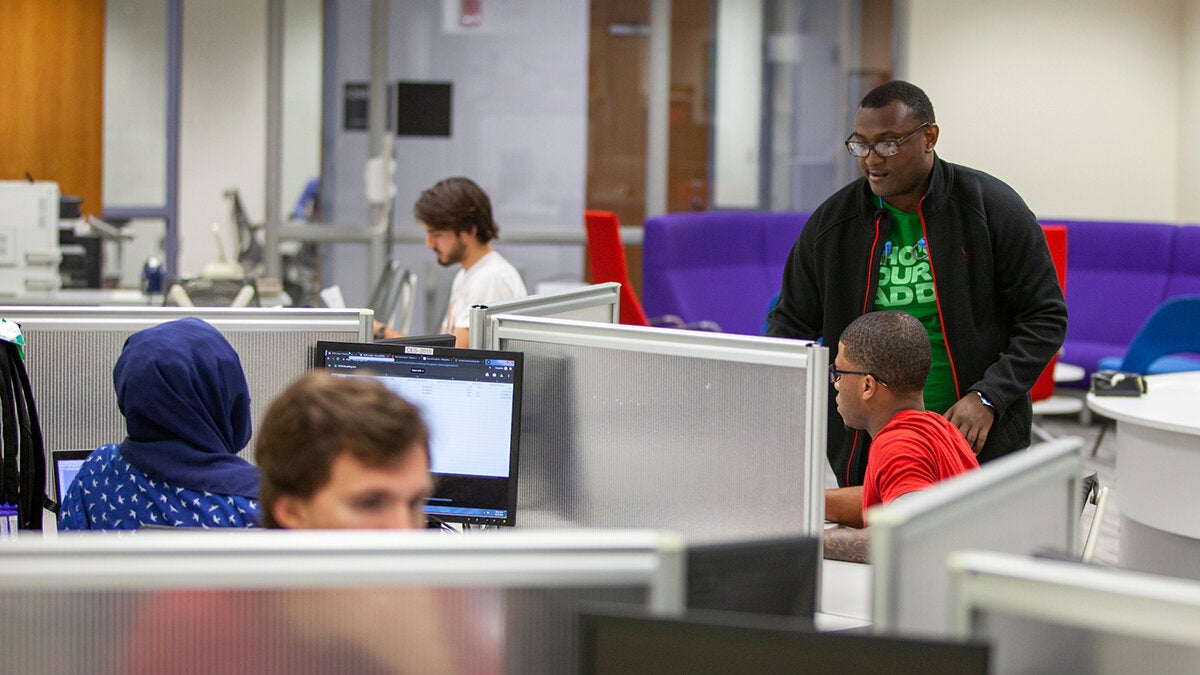
Library student assistant Kimani Patterson helps a student in the COE Library on the second floor of the A building at the FAMU-FSU College of Engineering in Tallahassee, Florida. (Mark Wallheiser/FAMU-FSU College of Engineering)
Key Points
- The FAMU-FSU College of Engineering, established by the Florida Legislature in 1982, is the only shared college of engineering in the United States, serving students from both Florida A&M University and Florida State University on a single campus in Tallahassee, Florida.
- Students enroll and graduate through their home university—either FAMU or FSU—and share the same professors, facilities and coursework once prerequisites are complete.
- The college offers more than 30 student organizations, free parking, free shuttle service from both campuses and amenities including a cafe, outdoor recreation areas and a Makerspace with advanced tools available at no cost.
- Faculty include nationally recognized researchers and award recipients, among them Associate Professor Christian Hubicki, director of the Optimal Robotics Laboratory and a two-time contestant on CBS’s “Survivor.”
- Students gain hands-on experience through undergraduate research, industry internships, a biannual career and internship fair drawing more than 150 employers and a required senior capstone project presented at Engineering Senior Design Day.
You’ve probably heard that the FAMU-FSU College of Engineering is unlike most programs. Two flagship universities. One campus. An engineering community where Rattlers and Seminoles study, build and problem-solve side by side.
But what is it actually like to go to school here? Prospective students often have real, practical questions that don’t always get answered on a campus tour. This is our attempt to answer them honestly—AMA style.
What Makes the FAMU-FSU College of Engineering Unique?

The FAMU-FSU College of Engineering, established by the Florida Legislature in 1982, is the joint engineering school for Florida A&M and Florida State universities—the only shared college of engineering in the nation. That distinction shapes everything about the student experience here.
One of the most common misconceptions prospective students encounter is this: that choosing engineering at FAMU or FSU means leaving your home university and re-enrolling somewhere else. That is not how it works.
The College of Engineering is an official, full college of both universities—not a separate institution you transfer into. Students enroll and graduate as Seminoles or Rattlers. They start their college experience on the home campus, and once prerequisites are complete, they learn, study and research together at the shared engineering building. Your tuition, your diploma, your alumni status—all of that stays with the university you chose. The joint college is simply where the engineering happens.
And once you’re here, that distinction fades quickly. In the classrooms, labs and hallways of the engineering building, no one is sorting people by which university they pay tuition to or where they are building their retirement. Students, faculty, staff and researchers are all just engineers. That shared identity—built around the work, not the institutional affiliation—is one of the things that makes this place genuinely different.
The college is situated in Innovation Park, approximately three miles between the two university campuses.
Do I Apply to the College of Engineering Separately, or Through My University?
You apply through either FAMU or FSU—not through the College of Engineering directly. There is no separate engineering application. When you apply to and are accepted by your home university, you are admitted as a pre-engineering student. Once you meet the prerequisite coursework requirements set by your program, you move into your declared engineering major and begin taking classes on the joint engineering campus. For specific admission requirements and prerequisite checklists, contact the admissions office at whichever university you plan to attend.
Who Will Be My Academic Advisor?
Advising works in two stages that follow your progression through the program. When you first enroll at FAMU or FSU as a pre-engineering student, your academic advisor will be an engineering advisor on your home university’s main campus. That advisor will help you navigate prerequisite coursework and prepare for the transition to the joint campus. Once you complete your prerequisites and begin taking the majority of your classes at the engineering building, your advising transitions to an engineering advisor at the joint college. That advisor works specifically with engineering students and is familiar with the curriculum, degree requirements and resources available on the engineering campus. The handoff is a natural part of the progression—it is not something you need to initiate on your own.
What Is Campus Life Like at the FAMU-FSU College of Engineering?

With students arriving from two universities, the energy on the engineering campus is genuinely diverse. You’ll find community study spaces, student organizations built around specific disciplines and identities, and regular events throughout the academic year.
Student involvement outside of the classroom contributes to important learning gains and a well-rounded college experience that prepares students for life after graduation. Meeting engineers from different backgrounds—people whose paths into the field look different from your own—expands your perspective in ways that classroom learning alone cannot replicate.
The campus also has practical day-to-day amenities worth knowing about. The COE Cafe offers a grill and quick meals between classes. Outdoor spaces include volleyball nets and ping pong tables. The Makerspace gives students access to state-of-the-art tools and technology at no cost—a resource that supports everything from course projects to independent exploration.
Do I Get Access to Both Universities’ Facilities?
On the engineering campus itself, all facilities are fully available to every student regardless of which university they are enrolled through. FAMU and FSU students have equal access to everything here—the Makerspace, the COE Cafe, study spaces, computer labs and the rest.
Main campus amenities are a different matter. Access to libraries, recreation centers, student health services and other facilities on each university’s home campus is generally tied to enrollment at that institution. An FSU student does not automatically have access to FAMU’s main campus resources, and the reverse is also true. If access to specific facilities matters to your daily routine, check with your home university’s student services office for the most current guidance on what is and is not available to you.
How Do Students Balance Home Campus Life With the Engineering Campus?

Commuting between campuses is a common concern for incoming students, and it’s a fair one. The good news: both universities run free shuttle service that takes students directly to the engineering campus throughout the day.
If you prefer to drive, parking around the college is available free to all students and visitors on a first-come, first-served basis—and it’s considerably less crowded than many campus lots.
One consistent piece of advice from current and former students: build commute time into your schedule when selecting classes. Giving yourself enough time between campuses reduces friction and keeps the experience manageable.
Finding activities on the engineering campus that genuinely interest you also helps. With around 30 student organizations at the FAMU-FSU College of Engineering campus, there’s something to interest everyone. Student organizations go to competitions, host events and create opportunities for lasting connections. These recognized student organizations are officially recognized by the college, which means they can meet on campus, hold official events and collaborate with the college on academic opportunities. They are made by students for students.
The engineering campus is designed to add to your college experience, not compete with it.
Is There Housing at or Near the Engineering Campus?
The college does not have its own residential housing. Most students live in dormitories on their home university campus—FAMU or FSU—or in off-campus rental housing in Tallahassee. Because both universities run free shuttle service to the engineering campus throughout the day, living on a main campus and commuting to the engineering building is straightforward and is the norm for most students. If housing is a priority in your decision-making, contact the housing office at whichever university you plan to enroll through for information on on-campus options and availability.
What Academic and Professional Opportunities Are Available?

The college has well-established relationships with industry partners and graduate programs, and those connections translate into real access for students—internship pipelines, research positions and project-based learning that starts well before graduation.
Twice a year, in fall and spring, the college hosts a career and internship fair exclusively for engineering students on the engineering campus. More than 150 employers attend each semester, recruiting specifically for engineering roles. That kind of direct, engineering-focused access to employers—on your own campus, twice a year—is not something most programs can offer.
FAMU-FSU Engineering prioritizes undergraduate research opportunities because the next generation of engineering researchers are just now learning the science. Faculty are genuinely invested in mentoring students at that level, not just graduate researchers. The college’s location in Innovation Park puts students within walking distance of some of the nation’s most advanced research facilities, including the National High Magnetic Field Laboratory—the largest and highest-powered magnet lab in the world. More than 50 undergraduates from the college work in research labs at the Mag Lab, gaining hands-on experience alongside scientists conducting research across physics, materials science, chemistry and engineering.
The college is also a core university partner of Oak Ridge National Laboratory (ORNL) through the Neutron Nexus program, launched in 2024. The first program of its kind in the country, the Neutron Nexus connects engineering students and faculty directly to ORNL’s world-class neutron scattering facilities, opening research pathways in materials science and related fields that few undergraduate programs anywhere can offer.
During senior year, students participate in Engineering Senior Design Day—a capstone event where teams present a year-long project to faculty, peers and industry visitors. It is one of the most direct bridges between the academic experience and professional life.
Does It Cost Extra to Attend the Joint Engineering Campus?
No. Students pay tuition to their home university—FAMU or FSU—and those tuition rates cover enrollment in engineering coursework at the joint campus. There is no separate tuition charged by the College of Engineering, and no additional enrollment fee for studying on the shared campus. Financial aid, scholarships and payment arrangements all remain with your home university.
Are There Scholarships Specific to the College of Engineering?
Yes. The college offers scholarships specifically for engineering students, administered through a scholarship coordinator in the dean’s office—separate from the general university scholarship pools at FAMU and FSU. These awards support students across disciplines and backgrounds, and some are targeted toward students from groups historically underrepresented in engineering. Students are encouraged to reach out to the dean’s office directly for current opportunities, eligibility requirements and application deadlines—and to explore scholarship options at their home university simultaneously.
What Engineering Majors Are Available?

The college offers undergraduate degrees in six engineering disciplines: chemical engineering, civil engineering, computer engineering, electrical engineering, industrial engineering and mechanical engineering. Civil engineering students can also pursue an environmental engineering option. Graduate programs—including master’s and doctoral degrees—are available across six academic departments: Chemical and Biomedical Engineering; Civil and Environmental Engineering; Electrical and Computer Engineering; Industrial and Manufacturing Engineering; Materials Science and Engineering; and Mechanical and Aerospace Engineering. Note that while computer engineering is offered at the undergraduate level, graduate degrees in computer engineering are not currently available. Graduate certificate programs are offered for current students, recent graduates and working engineering professionals. For current program listings and degree requirements, visit eng.famu.fsu.edu.
Is the College ABET Accredited?

Yes. The college’s undergraduate engineering programs are accredited by ABET, the recognized accreditor for college and university programs in applied and natural science, computing, engineering and engineering technology. ABET accreditation means the program has been reviewed against rigorous national standards for curriculum, faculty qualifications, student outcomes and institutional support. For prospective students, ABET accreditation matters because many professional engineering licensure pathways—including sitting for the Fundamentals of Engineering exam—require a degree from an accredited program. Accreditation details and program educational objectives are available on the college’s accreditation page.
Is the FAMU-FSU College of Engineering Considered an HBCU Program?
This is one of the most common questions the college receives, and the answer requires a little context. Florida A&M University is a Historically Black College and University—one of the nation’s most respected HBCUs. Florida State University is a Tier-1 public research university. The College of Engineering is the official engineering college of both institutions simultaneously. So depending on which university you enroll through, your degree may carry HBCU designation through FAMU. What that means in practice is that students pursuing an engineering degree through FAMU receive the full academic standing and recognition associated with an HBCU credential—while studying alongside FSU students in shared classes and labs. That dual identity is not a contradiction; it is the specific value the college was designed to create.

What Do Both Identities—HBCU and R-1 Research University—Mean on Campus Day to Day?
Both identities are real, and both shape the experience here in tangible ways. FAMU’s HBCU legacy brings a tradition of excellence within Black academic communities, a strong sense of collective purpose and a commitment to producing engineers who reflect the full breadth of American society. FSU’s R-1 research designation means access to nationally recognized research centers, significant grant funding and a graduate research infrastructure that benefits undergraduate students as well. On the joint campus, those two institutional cultures meet in classrooms, labs and student organizations where students from genuinely different backgrounds work on the same problems. The college does not ask students to leave either identity at the door. The goal is an environment where both are assets—and where the diversity of perspectives that results produces better engineers.
What Are the Faculty Like at the FAMU-FSU College of Engineering?

The faculty here are active researchers, not just instructors. Many hold grants, have received national awards and lead projects that connect students to research happening at the leading edge of their fields.
They also show up beyond the lab. Faculty regularly host STEM-focused events, offer mentorship and stay accessible in ways that students at larger, more impersonal programs often don’t experience.
All faculty are jointly appointed at both Florida A&M and Florida State universities, which means students are taught by people who are genuinely embedded in both institutions.
One example that often comes up: Associate Professor Christian Hubicki, director of the Optimal Robotics Laboratory in the Department of Mechanical and Aerospace Engineering. Hubicki runs the lab with a team of students, developing algorithms for robots to navigate complex, real-world environments. He is also a two-time contestant on CBS’s “Survivor”—first appearing on Season 37 and returning for the landmark Season 50, which airs in spring 2026.

Hubicki is open about what the show taught him and how those lessons apply to his students. “What it takes is an open mind and it takes persistence,” Hubicki said. “It takes an openness to other people. And that’s exactly the thing we expect of our students here at the university. You don’t come in knowing everything you’re supposed to know, otherwise, why are you here? You must adapt to these classes that come your way, that are harder than you thought they were going to be.”
That kind of candor—from a faculty member who has literally competed for survival on national television and come back to teach robotics—reflects something real about the culture here.
Editor’s Note: This article was edited with a custom prompt for Claude Sonnet 4.6, an AI assistant created by Anthropic. The AI optimized the article for SEO/GEO discoverability and improved clarity, structure and readability while preserving the original reporting and factual content. All information and viewpoints remain those of the author and publication. This article was edited and fact-checked by college staff before being published. This disclosure is part of our commitment to transparency in our editorial process. Last edited: May 1, 2026.