
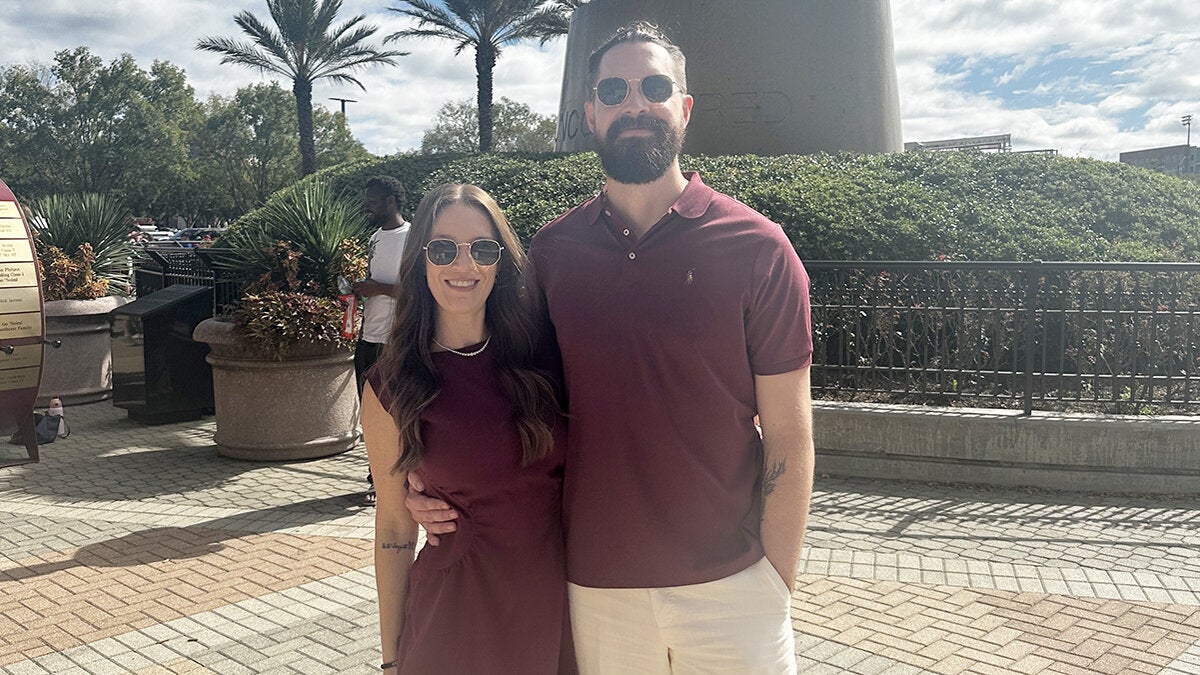
Photo provided by McKenzie and Christina Reed
Key points
- McKenzie and Christina Reed are Florida State University alumni who now co-lead CLN of South Florida, an industrial machinery manufacturer based in Belle Glade, Fla.
- McKenzie earned his degree in mechanical engineering from the FAMU-FSU College of Engineering; Christina studied Merchandising & Product Development at FSU.
- The couple acquired CLN in 2023 and are expanding its product line in 2026, with a focus on U.S.-based manufacturing and reshoring.
- Their story reflects the real-world impact a FAMU-FSU College of Engineering education can have beyond graduation.
- The company is sponsoring $50K in engineering senior design projects over five years.
When McKenzie and Christina Reed reflect on their time at Florida State University, they remember more than textbooks and lectures—they recall the meeting of two worlds: design and engineering.
Christina developed her creative vision in FSU’s Merchandising & Product Development program, while McKenzie built his technical foundation through a degree in mechanical engineering at the FAMU-FSU College of Engineering. Their complementary backgrounds sparked a partnership that would drive real change in their industry and community.
In 2023, the Reeds acquired CLN of South Florida, stepping into leadership roles to guide the company into a new era of growth. McKenzie serves as president and Christina as vice president, and together they bring a renewed commitment to U.S.-based manufacturing and innovation.
Founded in 1997 and based in Belle Glade, Fla., CLN of South Florida is a family-owned industrial machinery manufacturer specializing in high-precision CNC machines for industries including sign-making and metal fabrication.
We sat down with McKenzie and Christina to learn more about their FSU experience, their business journey and the lessons they’ve carried forward.
How They Met—and Built Something Together
How did you meet?
McKenzie: We met while attending FSU but were friends while we were there and started dating a few years after graduation.
Christina: Good things come to those who wait.
What’s it like to work together as partners in the business?
McKenzie & Christina: Overall, it’s great. It’s nice to have a partner who’s up to speed on what’s going on in the business—with employees, customers, etc. We do have individual skills we bring into the business, as well as strengths that allow us to share workload and responsibilities. It’s challenging at times, especially when it comes to giving each other critical feedback and knowing when to set work aside to spend time together.
College Memories That Shaped Their Careers
What is the most memorable experience from your college years?
McKenzie: By far, it was working on my Senior Design project and competing in the NASA Lunabotics Mining Competition at the conclusion of the project. I made lifelong friends that I’m still close with and it truly set me up for success and my career in machinery, control and automation. I’m forever grateful for that experience. The hands-on opportunities and mentorship I received at FAMU-FSU College of Engineering gave me the confidence to take risks and lead in my field.
Christina: Having the opportunity to get an internship at a fashion house in New York City alongside my best friend from the program. Living in the heart of the industry was a whirlwind, but it was the first time I saw our FSU coursework come to life in a high-stakes environment. That semester taught me the level of professional grit and precision required in any industry before I graduated.
Why Senior Design Matters
The Reeds have been generous supporters of the FAMU-FSU College of Engineering’s Mechanical Engineering Senior Design program—and they’re clear about why. In 2026, they sponsored a team that worked on improving one of their sign manufacturing techniques, making it more efficient.

Why do you believe senior design is so important for students?
McKenzie & Christina: Senior Design is potentially the first time the coursework is put into practice. You learn hard and soft skills such as project planning, accountability to management and the team, problem-solving and the iterative design, test and evaluation process. It’s kind of hard to describe, but I feel that projects where teams actually build something or work with physical components are especially important because they outline the constraints of design in the real world.
I strongly believe engineers should work more closely with machinists and fabricators when designing parts, machinery, or entire systems, because something that looks like the perfect solution in CAD may not be feasible or may turn out to be extremely labor-intensive to produce in the real world.
Q: How did your FAMU-FSU College of Engineering education prepare you for leading a manufacturing company?
McKenzie: My senior design project set me on the path to a career in machinery leveraging automation and controls. The hands-on experience and mentorship I received gave me the confidence to take risks, lead teams and ultimately step into ownership. The deeper I get into manufacturing, the more exciting it becomes.
Florida’s Manufacturing Moment
Why is Florida a great place for a business like yours, and a pipeline for engineering talent?
McKenzie & Christina: Florida is not traditionally thought of as a manufacturing state, but we are within the top 10 in the United States for manufacturing output and are No. 1 in the U.S. for manufacturing in the marine market. Engineering talent will be critical for the state to continue moving up the ranks on a national scale, and we at CLN want to be at the forefront of pushing for legislation, exposure and resources so that Florida becomes synonymous with industrial-scale manufacturing.
What’s Next for CLN of South Florida
Could you share any recent news or updates about your company?
McKenzie & Christina: We’re proud to be launching a major hardware and software improvement to one of our core machinery product lines in 2026, as well as launching an entirely new third machinery product category this year. It’s a testament to pushing the limits of what’s possible as a small, privately owned manufacturing company, and we see this as not only a massive opportunity for CLN but a critical need for machinery and automation to support our workforce constraints in the United States.
Q: What would you say to current engineering students thinking about entrepreneurship or manufacturing careers?
McKenzie & Christina: Senior Design is where it starts—that’s when classroom theory meets real-world constraints. From there, seek out industries that are evolving, because the opportunities are greatest where change is happening fastest. Manufacturing is having a moment, and engineers are at its center.
Through their dedication to innovation, community and lifelong learning, McKenzie and Christina Reed reflect the values at the heart of the FAMU-FSU College of Engineering. Their journey is a reminder to current students and fellow alumni: with passion, collaboration and a willingness to embrace new challenges, Seminoles can make a lasting impact far beyond campus.
RELATED ARTICLES
FSU Engineering Alumni Drive Innovation: Four Graduates Named to Prestigious Seminole 100
Gabrielle Mayans—Pioneering NASA’s Cryogenic Engineering Frontier in Aerospace Innovation