
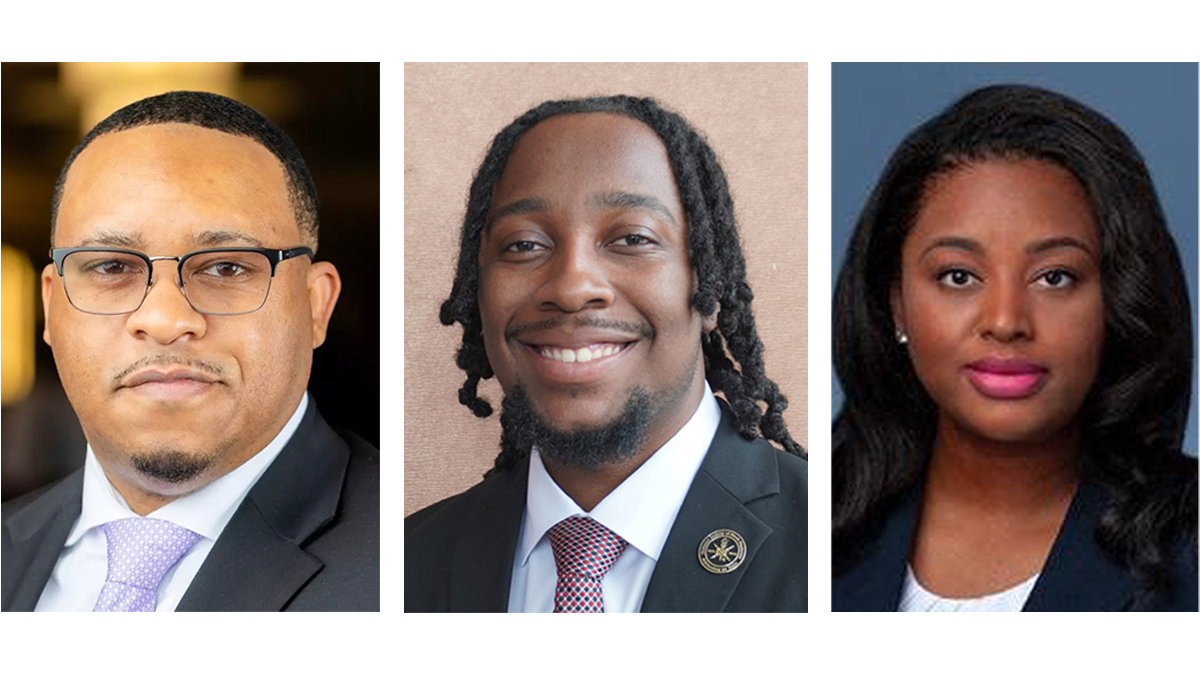
The joint college’s chapter of the National Society of Black Engineers (NSBE) has impacted countless young lives and has helped shape enduring careers. (Left to right) Johnnie Tangle, Julius Walls and Naomie Baptiste share their inspiring stories. (Courtesy Tangle, Walls, Baptiste)
Three engineers who came through the FAMU-FSU College of Engineering describe how membership in the National Society of Black Engineers changed the course of their careers—from a first-generation college graduate now managing $100 million defense contracts, to a current student leading regional outreach across five states.
The FAMU-FSU College of Engineering Chapter of the National Society of Black Engineers recently marked a milestone year, honoring nearly four decades of service to students and community. Each cohort that passes through the chapter carries forward a tradition rooted not just in technical training, but in mentorship, professional readiness and a commitment to expanding who gets to call themselves an engineer.
About NSBE and the FAMU-FSU Chapter
Founded at Purdue University in 1975, NSBE is one of the largest student-led organizations in the United States. The FAMU-FSU College of Engineering chapter was established in February 1986 and has operated for nearly 40 years as a hub where students build community, pursue academic excellence and develop the professional skills needed to compete in a global workforce.
Black workers currently make up about 9% of the STEM workforce despite comprising 11% of all employed adults in the U.S., according to the Pew Research Center. In engineering specifically, that share drops to roughly 5%. NSBE was built to change those numbers—one student, one chapter at a time.

Naomie Baptiste
Program Manager, Northrop Grumman
Class of 2006, B.S. Civil Engineering, FSU | NSBE Professionals National Membership Chairman
On how NSBE shaped her path:
“On my first day, at the E-school, I met a former NSBE National Chair Chancee Lundy-Russell who became my mentor. The FAMU-FSU NSBE Chapter provided career coaching, networking, and a support system that helped me become a program manager in the defense industry, leading $100M contracts. We even won National Chapter of the Year in 2006—a testament to the dedication of our student body and faculty.”
On staying connected to the college community:
“My advice: stay connected with your classmates and university. It brings me much joy to see my graduating classmates in industry today, including prestigious employers like Northrop Grumman and at conferences like NSBE, BEYA and SWE. It’s a reflection of the culture that FAMU-FSU COE embedded in us to excel in academics and leadership development. I’ve even hired engineers from FAMU-FSU COE which an alumnus once did for me and that speaks of how strong our alumni network is.”
On her fondest memory:
“Too many to share. Best memory was graduating, especially as a first-generation college student from Haiti. Joining FSU’s Center for Academic Retention and Enhancement (CARE) program, a summer bridge program that helped ensure college success. Also, another memorable experience was representing the College of Engineering on the FSU Homecoming Court and being a brand ambassador for the university and college. I’m forever grateful for these opportunities.”

Julius Walls
Automation Engineer Intern, Eli Lilly
Class of 2026, B.S. Computer Engineering, FAMU | NSBE Region III Vice-Chair
On NSBE’s A Walk for Education:
“NSBE’s A Walk for Education (AWFE) is an organization-wide initiative that calls back to the origins of NSBE and its outreach to underserved and underrepresented communities. It started as an event where students go door-to-door to provide information on STEM resources and contributions and has grown into events that highlight Black inventors. It’s an initiative close to my heart, replacing a culture of exclusion with one of accessibility.
Growing up, many of us didn’t see engineers who looked like us, which makes the ‘notable contributions’ segment of AWFE so vital. By highlighting Black excellence in STEM, we aren’t just teaching history; we are providing a mirror. Seeing a child’s eyes light up when they realize a Black inventor paved the way for the technology they use every day is a reminder of why I chose this path.”
On Black contributions to American innovation:
“Black history isn’t a sub-narrative—it’s the fundamental scaffolding of this nation. My ancestors were the architects of industries and silent drivers of innovation, often while being denied the very freedom they were helping to build.
When certain stories are discouraged or erased, it isn’t just a loss for the Black community; it’s a distortion of the American identity.
We have a responsibility to shine a light on these contributions, not just to grant long-overdue accolades, but to acknowledge that the modern world we enjoy was built on the intellect, labor and resilience of those who were consistently overshadowed by prejudice.”
On what NSBE gave him:
“NSBE gave me a space to drive my passion: it gave me a platform to give back to the community that shaped me, turning my individual success into a blueprint for others. With Black engineers making up less than 10% of the workforce, the imposter syndrome in classrooms and boardrooms is a real barrier to retention.
NSBE is essential because it dismantles that isolation. It provides mentorship, professional development and most importantly, the psychological safety required to thrive in a field where we are historically underrepresented. It’s not just about making more engineers; it’s about ensuring those engineers have a village that supports their excellence.”

Johnnie Tangle
Business Development Executive, Founder of Friends of the Program
Class of 2005, B.S. Industrial & Manufacturing Engineering, FAMU | NSBE Professionals National Chairperson-Elect
On how NSBE first reached him:
“NSBE was pivotal in sparking my interest in engineering. I first heard about NSBE when the University of Wisconsin-Milwaukee chapter invited my high school to join a 5-week Saturday program on engineering and college. Having already done a summer engineering program at Marquette in middle school, I signed up. There were only two of us who attended every session and that dedication earned us an invitation to the National Convention.
That first convention was life-changing. I saw NSBE Jr. students (high school) in business suits, competing, taking notes and being honored for their achievements. I knew immediately I wanted to be part of that. I also met national leaders—some of whom are still my mentors today—through the UWM president.
NSBE gave me my first real leadership experiences. I learned to lead teams, build relationships and seek partnerships. At FAMU-FSU, I served as NSBE Jr. and Pre-College Initiative (PCI) chair, then became Regional PCI Chair in my senior year. I even started a local NSBE Jr. chapter in Tallahassee, recruiting students from local high schools. It’s rewarding to see those students grow into doctors, lawyers and managers.
At FAMU-FSU, NSBE connected me with engineers from all disciplines and built a real sense of community, especially for those of us from out of state. My passion is driven by the idea of paying it forward.”
On learning to work across cultures:
“One of the most valuable aspects was having the opportunity to learn and grow in a truly multicultural academic environment. With the student body split between FAMU and FSU, the joint college created a unique ecosystem where students from different cultural, academic and social backgrounds worked side by side every day.
That experience prepared me in a very real way for today’s multicultural engineering and business environments. It taught me how to communicate effectively and to be comfortable with people who approached problems differently, had different lived experiences and brought different perspectives to the table. Engineering is fundamentally collaborative and being in classrooms, labs and team projects with students from both institutions helped me develop the ability to listen, adapt and align around shared goals.
It also helped me build confidence in navigating diverse professional spaces. I learned how to advocate for my ideas while also respecting and incorporating others’ perspectives. That balance—confidence and collaboration—are critical in modern engineering and business teams. Most importantly, the FAMU-FSU environment reinforced the idea that different voices strengthen outcomes. When people with different perspectives work together, the solutions are more innovative, more resilient and more impactful. That lesson has stayed with me throughout my career and continues to shape how I build teams and partnerships today.”
On his favorite memories and professors:
“My favorite time on campus is when companies came to speak with different groups on campus. You could learn about the company and meet some new colleagues along the way. I remember studying for finals or midterms and the school would be packed. We were stressed, but we were all in it together. That is what I loved about it.
My favorite teacher is Dr. Simone Peterson Hruda. I felt like she truly cared about each and every one of us and wanted us to really understand the material. Professor Okoli is another person who stands out and he left me with this mantra: Never get too comfortable and never be afraid to leave.”
NSBE Continues to Empower
By building academic excellence, professional skills and a strong sense of belonging, NSBE continues to push students toward new achievements and into roles where they were not historically represented. As the chapter looks ahead, its work remains threaded into the college’s identity—giving each new class of engineers the mentorship and inspiration they need to succeed.
The NSBE 2026 Annual Convention took place March 18-22 in Baltimore, Maryland. For more information, visit convention.nsbe.org.
Editor’s Note: This article was edited with a custom prompt for Claude Sonnet 4.5, an AI assistant created by Anthropic. The AI optimized the article for SEO discoverability, improved clarity, structure and readability while preserving the original reporting and factual content. All information and viewpoints remain those of the author and publication. This article was edited and fact-checked by college staff before being published. This disclosure is part of our commitment to transparency in our editorial process. Last edited: 03/23/2026.
RELATED ARTICLES
FAMU-FSU Engineering NSBE chapter wins big at 2018 annual conference
Solving problems is Bryan Anderson’s passion in engineering and service
Breaking Barriers, Building Bridges: How Twin Rattlers Engineered Their Futures