
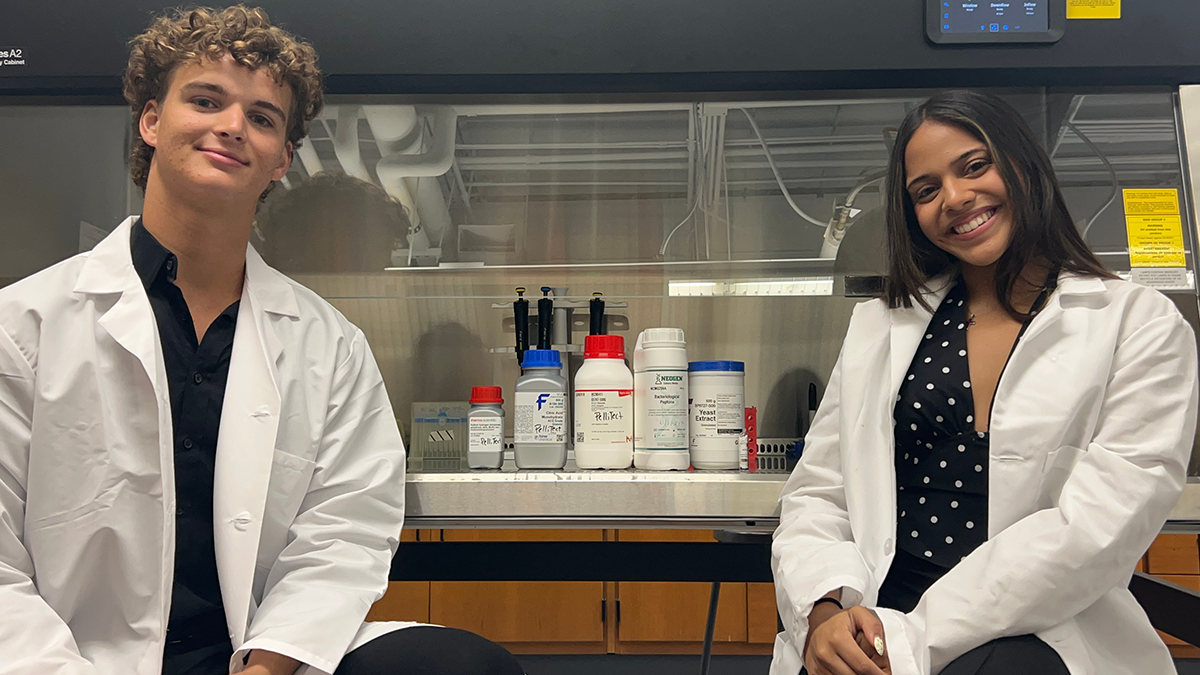
William Gragg and Andrea Ruiz Vasquez in the lab at the FAMU-FSU College of Engineering. (Courtesy Wandell)
Key Points
This summer, eight students developed seven projects in the 10-week, paid Innovation Experience for Undergraduates program.
Five students will exhibit their work at the IGNITE Tallahassee Open House + Innovation Expo on Wednesday, Oct. 21, 2026.
The program teaches students to test ideas against real-world evidence, a skill that applies in research, industry, graduate study or entrepreneurship.
When Robert J. Wandell became director of innovation at the FAMU-FSU College of Engineering in 2025, he brought a vision that reached beyond classrooms and textbooks.
“The primary goal is self-motivated learning,” Wandell said. “A question a student genuinely wants to answer gives them a personal reason to learn engineering, talk to people outside the classroom, and keep working when the first approach does not succeed.”

How iCREATE works
Wandell’s signature initiative, iCREATE, sits at the center of that vision. It gives undergraduates in the FAMU-FSU College of Engineering opportunities to tackle real-world problems they care about. Along the way, it teaches a repeatable process: identify a meaningful problem, connect with potential users, develop a value proposition and design experiments to test the most critical assumptions. The emphasis, Wandell explained, is not on defending an initial idea but on gathering evidence to guide what comes next.
Making ideas real
Turning theory into practice takes infrastructure. Three supports help students carry their ideas past the classroom: the college’s new makerspace, small grants for proof-of-concept experiments and a network of mentors that includes connections with IGNITE Tallahassee. Students are encouraged to continue their projects beyond a single course, or even after graduation.
Artificial intelligence is another tool in the iCREATE toolbox. “AI can help them explore unfamiliar subjects, develop hypotheses and plan investigations,” Wandell said. “But it cannot replace customer discovery, prototype testing, or experimentation. Students must understand their work and check their claims against real-world evidence and experiments.”

The Innovation Experience for Undergraduates
This past summer, the Innovation Experience for Undergraduates (IEU) extended iCREATE into a 10-week, paid program. The IEU invited students to pitch their own project ideas. It then gave them mentorship, prototyping resources and a curriculum built on Lean Startup principles and the National Science Foundation Innovation Corps (NSF I-Corps) method. The program ran in three stages: Discover, Build and Launch. Each stage emphasized customer discovery and real-world testing.
Weekly workshops, mentor check-ins and peer feedback sessions pushed students to challenge assumptions and learn from one another. “Peer feedback was a major part of the program: students questioned one another’s assumptions, offered suggestions, and learned from each other’s experiences,” Wandell said.
How does the IEU benefit engineering students at the FAMU-FSU College of Engineering?
Students pursue a problem they chose themselves, with pay, mentorship and prototyping resources behind them. They practice customer discovery and experiment design, and they learn to make decisions based on evidence rather than on attachment to a first idea.
The Zero-to-Launch Showcase

At the Zero-to-Launch Showcase, eight students presented seven projects.
- William Gragg and Andrea Ruiz Vasquez, PELLITECT: Investigated a naturally derived bacterial-cellulose patch concept intended to protect wounds and support faster healing, with tattoo aftercare identified as an initial target market.
- Isabela Steed, Chronic Wound Tracker: Explored a home-care concept using distance measurements to track changes in chronic wound shape and depth.
- Tendo Chen, CAR-EV Therapy: Investigated an engineered extracellular-vesicle approach to drug delivery for glioblastoma, an aggressive brain cancer.
- Riyad Rzayev, Braille Tutor: Developed a concept for a tactile learning device that uses vibration, audio and visual feedback to help people learn and teach Braille.
- Mia Padron, Potassium Monitor: Explored sweat-based potassium sensing for a possible wearable intended to help people manage complications associated with chronic kidney disease.
- Kelan Dennis, PairCare: Worked on an indoor air-monitoring concept intended to help users understand and address air-quality problems in their surroundings.
- Logan Knorowski, SILK: Investigated a spectroscopy learning kit designed to connect classroom concepts with hands-on experiments and real-world applications.
Gragg and Ruiz Vasquez took first place for PELLITECT.
As Wandell emphasized, “A compelling idea is just a starting point. The real work is figuring out who actually needs it and how badly, what would have to be true for it to work and which assumptions are the most important to test.”
The SILK spectroscopy kit was ruled a no-go. The reason was market economics, not a technical flaw.
“Something can be technically interesting without being the right product to pursue commercially. Recognizing that is an exercise in judgment, not a failure of creativity,” Wandell said.
Other projects, such as the Potassium Monitor, identified the key technical questions that will guide their next experiments. “That kind of focused question gives a student a concrete next experiment,” Wandell said.
Building skills beyond one summer
The value of iCREATE and the IEU extends well past a single summer.
“We want students to leave with a repeatable way to approach unfamiliar problems: identify what they do not know, find people who can inform the problem, design a useful test, interpret the results and decide what to do next,” Wandell said. “A student does not need to become a founder to benefit from learning how to assess whether an idea is technically feasible and useful to someone.”
Wandell believes these experiences help students become resilient, evidence-driven problem-solvers, whether they pursue research, industry, graduate study or entrepreneurship. “Building that confidence, while maintaining an honest standard of evidence, is one of the central purposes of iCREATE.”
Is a no-go decision a failure?
No. In iCREATE, deciding not to pursue an idea is a valid, evidence-based result. The SILK team found the concept technically sound but commercially weak, and recognizing that is the kind of judgment the program sets out to build.
What’s next
Applications for the 2027 iCREATE summer IEU program and the Interdisciplinary Product Design course are open through February 2027.

Five iCREATE students will exhibit their summer projects at the IGNITE Tallahassee Open House + Innovation Expo.
- When: Wednesday, Oct. 21, 2026, from 9 a.m. to 12:30 p.m.
- Where: IGNITE Tallahassee, 1729 W. Paul Dirac Drive
- Program: IEU student elevator pitches; a panel discussion moderated by Wandell, where students will describe their experience and encourage others to participate; and presentation of the TiE Tampa Bay ARTISAN Student Pitch Award.
The event is part of FSU Discovery Days. It is free and open to the public, and breakfast and lunch will be provided. Register here.
Editor’s Note: This article was edited with a custom prompt for Claude Sonnet 5.5, an AI assistant created by Anthropic. The AI optimized the article for SEO discoverability, improved clarity, structure and readability while preserving the original reporting and factual content. All information and viewpoints remain those of the author and publication. This article was edited and fact-checked by college staff before being published. This disclosure is part of our commitment to transparency in our editorial process. Last edited: 10-19-2026.
RELATED ARTICLES
College Appoints New Director to Lead Innovation Initiatives
Engineering Alumna Revolutionizes Waste Management with Vision AI Technology