
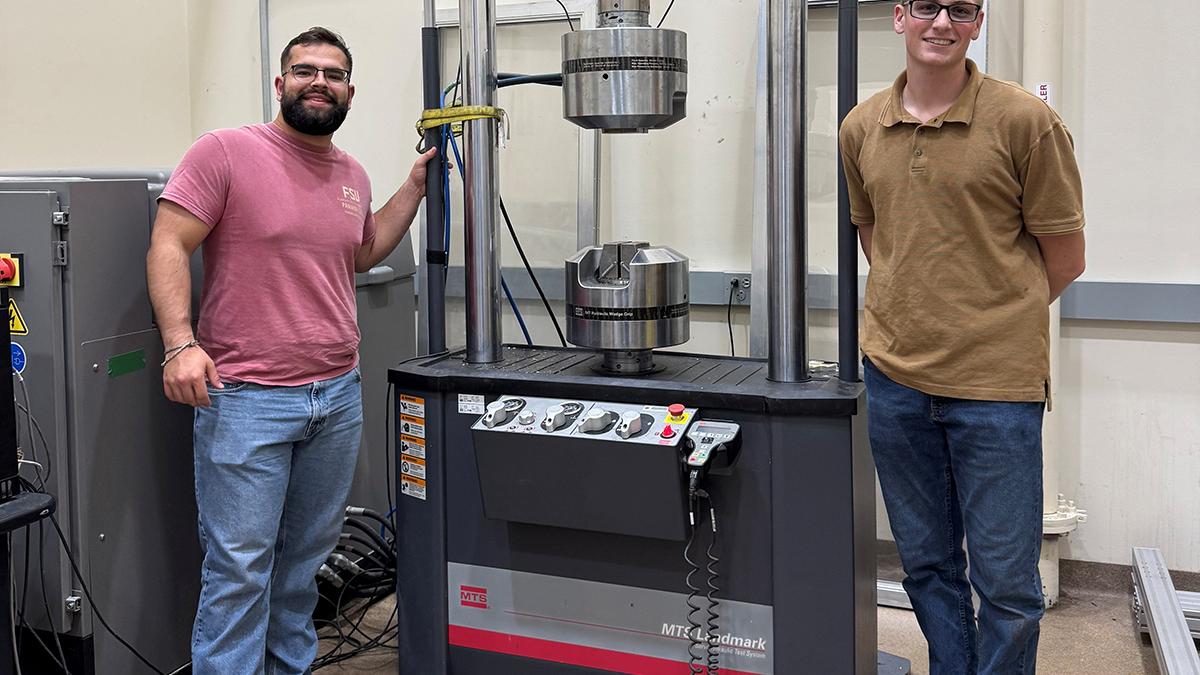
FAMU-FSU College of Engineering students Case Dyer and Jonathan Serbest at the High-Performance Materials Institute (HPMI) in Tallahassee. (Yvonne Traynham, Ph.D./FAMU-FSU College of Engineering)
FAMU-FSU College of Engineering students at FSU Panama City Leverage FSU InSPIRE-ASTRO-Maritech Partnership for Cutting-Edge Additive Manufacturing Research
When you’re launching a rocket into space, components are a crucial part of its success. High-cost materials can impede availability, while untested materials risk operational failure. Advances in additive manufacturing, or 3D printing, offer new designs that can reduce production costs while providing reliability superior to that of traditional castings and weldments.
So, when FAMU-FSU College of Engineering students from FSU Panama City’s Rocketry and Mechatronics team, including Kreig Conrad, Case Dyer and Jonathan Serbest, proposed the Inconel 718 Tension and Torsion Testing project for Professor Yvonne Traynham’s “Material Selection in Design” course, they had a specific goal in mind. They wanted to test 3D-printed Inconel 718 alloy to determine how it performs in high-heat, extreme environments, for a rocket launch submitted to FSU’s Undergraduate Research Symposium and NASA’s Student Launch Challenge.
“Our torsion testing included valuable resources from InSPIRE’s node at the ASTRO-Maritech facility and FSU's Materials Lab in Panama City. We had really impressive results,” said Dyer. “We provided designs that were manufactured on ASTRO's multi-laser metal powder bed additive manufacturing system, then heat-treated and finished by Maritech. The driver was to determine the effects of using a laser powder bed fusion 3D metal printing process on the material properties of Inconel 718 alloy and methods to improve its performance on bulkheads in our rocket launch.”
The two students worked closely with advanced manufacturing engineer Christopher Apple, who advised them on design, heat treatment and sample production. They completed their torsional testing under Traynham’s supervision to determine torsional yield, shear modulus and maximum shear stress. The students also characterized the fracture surfaces using microscopy methods.
“This was an exploratory learning journey for Kreig, Jonathan and Case,” Apple said. “Knowing the properties of as-built versus heat-treated Inconel is very useful because there can be slight differences. Materials data specification sheets often omit torsion specifications because they’re providing broad data on many material properties, not a deep dive into specific mechanical properties.”
For background, nickel alloys such as Inconel 718 are industry workhorses and often used in applications with heat because they maintain their strength at high temperatures, superseding even stainless steel. This makes them ideal for use in engines and other aerospace components. When heat-treated, the torsion properties improved significantly.
“While 3D printed Inconel has been consistent in tension testing, there are not a lot of applications that require torsion testing. Our torsion testing resulted in unexpectedly stronger results,” explained Serbest. “We explored a two-step heat treatment: solution anneal followed by aging, with significant increases in the alloy’s properties. We do expect that when we test our remaining samples, they will have much superior tensile properties than when tested in torsion. This is what surprised us; when we tested our samples in torsion, they required the same stress as we had expected necessary to fail the samples in tension.”

“The team at ASTRO was incredibly helpful in understanding the process,” added Dyer. “Our torsion test results indicated that our particular samples performed stronger in torsion than we had originally predicted them to perform in tension, based on the mechanical properties for our initial analysis of available data. Dr. Traynham suggested we continue upping the testing levels of the material properties and compare our results. We had lots of conversations about building components, heat treatments and what was the determining factor."
As stated in their proposal, many factors affect the mechanical, thermal and electrical properties of a material, including chemistry, microstructure, bonding, temperature and manufacturing processes. While 3D-printed metals are becoming more ubiquitous, relatively little is known about the effects of heat-treated Inconel 718 in torsion. By combining torsion and tension testing, Dyer and Serbest can estimate Poisson’s ratio from the results of both. Tension testing is currently underway at the joint college’s High Performance Materials Institute to determine the mechanical properties of elasticity, ultimate tensile strength, yield strength, resilience, ductility and percent reduction in area.
“Case and Jonathan are both outstanding students, and are doing some exciting work with this project,” Traynham said. “This project is currently being refined so they can submit their results to the Undergraduate Research Symposium in April. They’re also using this project in support of their student competition for NASA. We truly appreciate the support from HPMI and InSPIRE to our mechanical engineering undergraduates as they seek novel solutions for industry.”
The entire testing process for 3D-printed Inconel 718 will ultimately ensure the students’ bulkheads are strong enough to withstand rocket launch and landing. At the heart of the project is also the intent to publicize meaningful, open-source data so that future innovators can understand the parameters that cause Inconel to deviate in testing, thereby further standardizing its use.
“Often, materials characterization testing isn’t shared because it’s on proprietary or classified printing parameters or powders,” added Apple.
“InSPIRE and ASTRO are driving advanced manufacturing capabilities into Northwest Florida to build national supply chain resilience, fuel regional economic development and create local career pathways,” explained Abdalla Nassar, Ph.D., Vice President, AM Forward Technologies at ASTRO America. “Enabling Maritech and these students to operate state-of-the-art equipment in Panama City is a multimillion-dollar investment in people. Our efforts are also improving the ability of small to medium-sized manufacturers and entrepreneurs to supply components to prime contractors and ultimately, the U.S. Department of War.”
For their tension and torsion testing project, Dyer and Serbest are securing the best material to build and launch a rocket that will reach apogee at 4000 to 6000 feet, crest, then come down exactly where intended.
“InSPIRE gave us the ability to explore cost implications while testing and learning in real-world environments to see what’s going to work viably and cost-effectively. Materials can be very expensive, and 3D-printing is not always cheap, but you can build things you couldn’t do any other way, especially when components need to be lightweight and high performing,” added Serbest.
Results from Dyer and Serbest’s project were submitted to FSU’s Undergraduate Research Symposium and the NASA Student Launch, both taking place in April. The Undergraduate Research Symposium is an all-campus interdisciplinary showcase that provides students with the opportunity to present their work to the wider community.
NASA’s Student Launch is a 9-month-long challenge that tasks student teams across the U.S. with designing, building, testing and launching a high-powered rocket carrying a scientific or engineering payload. The team recently submitted their Critical Design Review and presented their designs to NASA and is now moving forward with the Final Readiness Report—the last deliverable before they launch their full-scale rocket with a scientific payload at NASA’s Marshall Space Flight Center.
RELATED ARTICLES
From Space Coast to Student Launch: Electrical Engineering Senior Reaches for the Stars
From Florida State University to NASA: Engineering the Next Giant Leap