
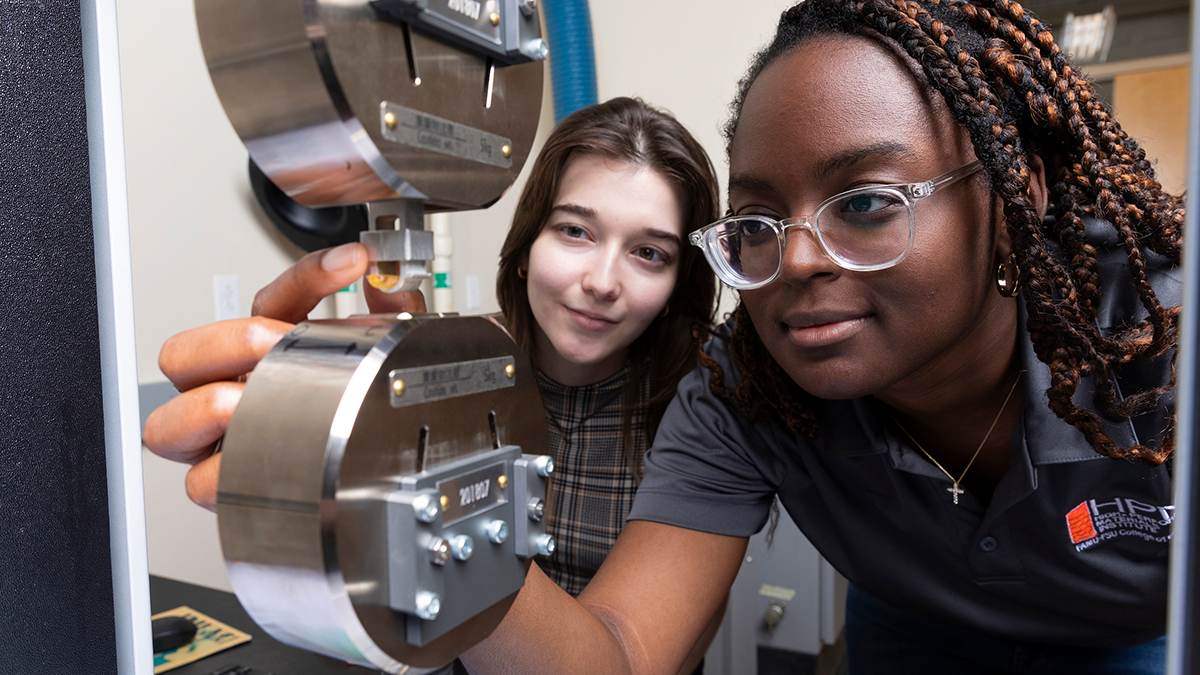
Ana De Leon, Ph.D. (left), and doctoral student Zipporah Harlan load a sample into the Universal Testing Machine in the Mechanical Testing Room in the High-Performance Materials Institute (HPMI) in the Materials Research Building (MRB) at the joint FAMU-FSU College of Engineering in Tallahassee, Florida. The team is researching the interfacial shear strength (IFSS) of carbon nanotube (CNT) yarn-reinforced polymer composites. (Scott Holstein/FAMU-FSU College of Engineering)
Key points
- Researchers at the FAMU-FSU College of Engineering and the High-Performance Materials Institute (HPMI) have published new findings on how carbon nanotube (CNT) yarn-reinforced polymer composites hold up under extreme heat, moisture and repeated mechanical stress.
- The study uses accelerated aging methods and data-driven statistical modeling to predict how these lightweight, high-strength materials perform over time in real-world environments.
- The work targets a persistent obstacle to deploying advanced nanomaterials in aerospace, automotive and energy applications: predicting long-term durability before a material ever leaves the lab.
What if the next generation of aircraft and automobiles could be built with materials engineered to last, regardless of what nature throws at them? At the FAMU-FSU College of Engineering’s High-Performance Materials Institute (HPMI), a team of researchers is working to answer that question.
By subjecting advanced nanomaterials to extreme conditions in the lab, they aim to predict how these materials will perform over years of real-world use, before they are ever installed in a vehicle, a structure or a spacecraft.
The team recently published their findings in the journal Polymer Composites.
“The core contribution of this study is about how we test materials under extreme conditions, apply accelerated aging methods and use data-driven approaches to better understand and predict manufacturing performance,” said Rebekah Downes, a faculty researcher on the project.
What Problem Are These Researchers Trying to Solve?
Composite materials, which combine plastic polymers with strong reinforcing fibers, are prized in aerospace, automotive and infrastructure engineering for their lightweight yet high-strength properties. But heat, moisture and other environmental factors can weaken them over time, sometimes in ways that are not immediately visible.
The FAMU-FSU team is focused on a specific challenge: how to make the bond between carbon nanotube (CNT) yarn and a surrounding polymer matrix stronger and more durable, so these materials hold up over years of exposure to variable weather and mechanical stress.
“A material can appear extremely strong in a controlled environment, but under environmental exposure the mechanical properties weaken,” said Zipporah Harlan, a Ph.D. candidate on the project. “Testing under real-world conditions gives insight into how durable these materials are over time, which determines whether a material is safe and viable for real-world applications.”

What Is a Carbon Nanotube Composite and Why Does It Matter for Aerospace?
Carbon nanotubes are cylindrical structures made of graphene sheets rolled at the nanoscale. Their atomic structure gives them exceptional mechanical strength, electrical conductivity and thermal stability, properties that make them particularly attractive for aerospace and automotive applications where the strength-to-weight ratio is critical.
CNT yarn-reinforced polymer composites combine those properties into a material that is both tough and light. They are used in aerospace structures, sports equipment and electronics, among other applications. But unlocking their full potential requires a reliable way to predict how the bond between the CNT yarn and the surrounding polymer, known as interfacial shear strength (IFSS), holds up under real-world conditions.
That is what the FAMU-FSU team set out to measure.
How Did the Researchers Test Composite Durability Under Extreme Conditions?
Rather than measuring only a material’s initial strength, the research team accelerated the aging process and subjected samples to a range of harsh conditions. This approach allows engineers to predict how durable a material will be after years of real-world use without having to wait years to find out.
Testing variables included temperature, moisture exposure, the rate at which the material was mechanically separated and the proportion of CNT fiber present in the composite. The team used a custom-made mold and testing fixture designed by the research group specifically for high-performance materials.
“I actually started this project as a graduate student, and now it’s exciting to continue it as a postdoctoral researcher,” said Ana De Leon, Ph.D., a co-author of the study. “It’s amazing to see how our work could help make materials stronger and safer. We even used a custom-made mold and testing fixture that our research group designed, and it’s incredible how well it works on high-performance materials.”
What Did the Study Find?
The results revealed that interfacial bond strength in CNT yarn composites is sensitive to a wide range of environmental and testing conditions, and that the relationship between those conditions and material performance is more complex than previously assumed.
Moderate water conditioning improved interfacial strength at room temperature. This was an unexpected finding, given that moisture is often associated with degradation. The researchers say it highlights the competing mechanisms that can occur at the fiber-polymer interface under controlled environmental exposure.

Higher temperatures reduced performance. Slower loading rates promoted stronger interfacial behavior, while rapid mechanical separation weakened the bond. Prolonged or excessive heat exposure ultimately reduced long-term durability.
The findings underscore that environmental conditioning and mechanical testing parameters must be carefully considered when qualifying composites for real-world applications. Interfacial performance is highly sensitive to both.
“This research paves the way for more durable and reliable carbon nanotube composites in real-world structures,” Harlan said. “We’re focused on understanding how environmental exposure impacts the adhesion between composite materials. Our next step is to apply this knowledge to develop manufacturing methods that improve interfacial adhesion, ultimately producing lighter, stronger, and longer-lasting materials for aerospace, automotive, and energy systems.”
How Data Analytics Is Reshaping Materials Research
The team paired extreme-condition testing with statistical analysis, variability assessment and data-driven modeling to build predictive frameworks that link manufacturing conditions to long-term material performance.
“One of the things I enjoyed most was using statistical analysis to make sure the results are solid,” De Leon said. “Hopefully this approach inspires others to use data-driven techniques to better understand and characterize materials.”
Professor O. Arda Vanli, a faculty researcher on the project, described the broader significance: “This is an excellent illustration of the joint application of cutting-edge materials research and advanced data analytics for materials discovery. We demonstrated how data analytics and statistical learning can be used to uncover patterns in experimental data and identify optimized materials in a cost-effective manner.”
Downes pointed to the team’s use of industrial engineering principles alongside materials science: “I am excited about the fusion of data analytics and advanced manufacturing within materials research,” she said. “By combining extreme-condition testing, statistical modeling, and industrial engineering principles, we are not only characterizing materials but building frameworks that strengthen how we design, manufacture, and qualify them for real-world performance.”
A Research Partnership Built Over Years
The research team includes postdoctoral researcher Ana De Leon and Ph.D. candidate Zipporah Harlan, both from the Department of Industrial and Manufacturing Engineering at the FAMU-FSU College of Engineering and the High-Performance Materials Institute. Faculty members Arda Vanli and Rebekah Downes supervised the study. The project was funded by the U.S. Department of Energy’s Minority Serving Institutions Partnership Program (MSIPP), which supports STEM research and workforce development at minority-serving institutions through partnerships with DOE national laboratories and sites.
De Leon began the project as a graduate student and has continued it as a postdoctoral researcher, a path that reflects the kind of sustained, multi-year collaboration HPMI is built around.

What Comes Next?
“I would estimate that this process will take 5 to 10 years, as the materials are already available and improving their reliability will take time,” Harlan said. “I believe advancements in environmental research will continue to contribute to the development of effective composites.”
The next phase of the work will focus on using insights from this study to develop manufacturing methods that improve interfacial adhesion, with the goal of producing composites that are lighter, stronger and more durable across aerospace, automotive and energy applications.
Editor’s Note: This article was edited with a custom prompt for Claude Sonnet 4.6, an AI assistant created by Anthropic. The AI optimized the article for SEO/GEO discoverability, improved clarity, structure and readability while preserving the original reporting and factual content. All information and viewpoints remain those of the author and publication. This article was edited and fact-checked by college staff before being published. This disclosure is part of our commitment to transparency in our editorial process. Last edited: 04/20/2026.
Frequently Asked Questions
What are carbon nanotube composites and what are they used for?
Carbon nanotube (CNT) composites embed CNT yarn, cylindrical graphene structures just nanometers in diameter, within a polymer matrix to create materials that are both exceptionally strong and light. They are used in aerospace structures, automotive components, sports equipment and electronics, where structural reliability and low weight are both priorities. Making them strong is not the hard part; keeping them strong after years of heat, humidity and mechanical wear is what researchers are working to solve.
What is the High-Performance Materials Institute (HPMI) and what makes it distinctive?
HPMI is a multidisciplinary research institute at Florida State University focused on advanced composites, nanomaterials and manufacturing processes. It serves as the primary research center for the FAMU-FSU College of Engineering’s Department of Industrial and Manufacturing Engineering and has drawn funding from NASA, the U.S. Department of Energy and other federal agencies. The institute pairs materials science with data analytics and industrial engineering, treating how a material is tested and qualified as just as important as the material itself.
How does statistical modeling fit into materials engineering research?
Most materials testing generates data under one set of conditions at a time. Statistical modeling lets researchers analyze results across many variables at once, including temperature, moisture level, loading rate and fiber volume, and identify which combinations improve performance and which lead to failure. For the FAMU-FSU team, that approach revealed patterns individual tests would have missed and produced predictive frameworks to guide manufacturing decisions before expensive production begins.
When might these findings translate into improved aerospace or automotive materials?
Ph.D. candidate Zipporah Harlan estimates the path from current research to improved manufacturing methods could take 5 to 10 years. (This is a researcher’s professional estimate, not a verified institutional or program timeline.) The next phase of the team’s work focuses on developing manufacturing methods that improve interfacial adhesion, the bond between CNT yarn and the polymer, based on what this study revealed about how that bond responds to environmental exposure.
RELATED ARTICLES
FSU Researchers develop thin heat shield for superfast aircraft
Engineering materials researcher named to National Academy of Inventors
Engineering Students Win with Nanotube Research at SAMPE 2022