
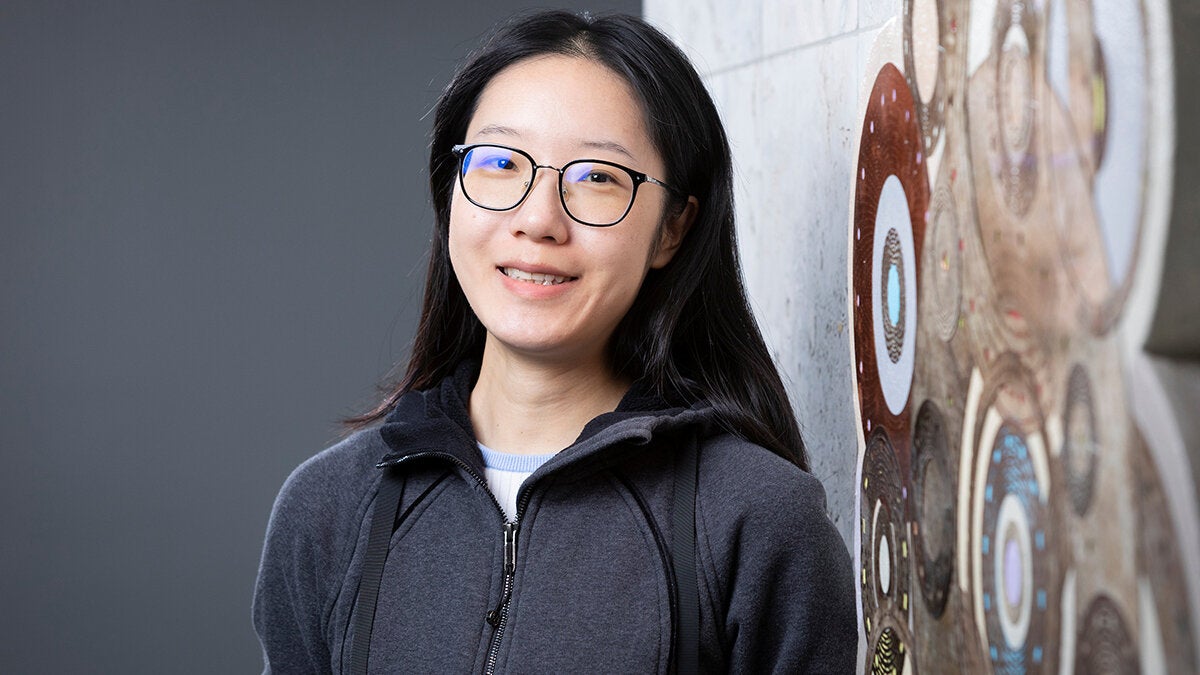
Postdoc researcher Yinghe Qi poses in the lobby of The National High Magnetic Field Laboratory (MagLab) in Tallahassee, Florida. Qi was selected for the prestigious Gustav and Ingrid Klipping Award by the International Cryogenic Engineering Conference (ICEC) Committee. (Scott Holstein/FAMU-FSU College of Engineering)
Key Points:
- Yinghe Qi, a postdoctoral researcher in the Department of Mechanical & Aerospace Engineering at the FAMU-FSU College of Engineering and the National High Magnetic Field Laboratory, has been selected to receive the 2026 Gustav and Ingrid Klipping Award from the International Cryogenic Engineering Committee.
- The award recognizes outstanding early-career contributions to cryogenic engineering and is presented every two years.
- Qi was nominated by Professor Wei Guo for her work on cryogenic platforms for dark matter detection, accelerator safety modeling and quantum device research.
- She will receive the award at ICEC30/ICMC 2026 in Daejeon, South Korea, in June 2026.
Yinghe Qi, a postdoctoral researcher in the Department of Mechanical & Aerospace Engineering at the FAMU-FSU College of Engineering and the National High Magnetic Field Laboratory (MagLab), has been selected to receive the Gustav and Ingrid Klipping Award, one of cryogenic engineering’s top international honors for early-career researchers.
The award will be presented at the 30th International Cryogenic Engineering Conference and International Cryogenic Materials Conference, scheduled for June 22–26, 2026, at the Daejeon Convention Center in Daejeon, South Korea.
What Is the Gustav and Ingrid Klipping Award?
The International Cryogenic Engineering Committee presents the Gustav and Ingrid Klipping Award to a young researcher for outstanding work in cryogenic engineering. The award honors the Klippings’ significant contributions to the field and, in particular, their commitment to involving the next generation of researchers. It is given on the occasion of the International Cryogenic Engineering Conference, held every two years and candidates must be 35 years of age or younger at the start of the conference.
“It is a privilege to be recognized by the cryogenic engineering community with this award,” Qi said. “I am incredibly thankful for the chance to work with Dr. Guo and our group at the MagLab. This environment has given me the support to tackle complex challenges in cryogenics, from dark matter detection to beamline vacuum break analysis and I am grateful for the opportunity to contribute to such impactful research.”

How Is Qi’s Research Advancing Dark Matter Detection and Accelerator Safety?
Qi was nominated by Professor Wei Guo of the FAMU-FSU College of Engineering, who cited her “broad knowledge, rigorous analytical ability and exceptional experimental and computational skills.” Her work spans several major research fronts—most notably the design of a cryogenic platform for the TESSERACT Collaboration’s dark matter search and new safety models for particle accelerator beamlines.
TESSERACT, which stands for Transition-Edge Sensors with Sub-EV Resolution And Cryogenic Targets, searches for low-mass dark matter roughly a hundred to a thousand times lighter than a standard WIMP (weakly interacting massive particle). Florida State University researchers, including members of Guo’s lab, are part of the collaboration and much of the effort in designing the specialized cryostat used in these searches was led by Guo’s team at the MagLab.
“This is a highly competitive international honor that recognizes exceptional early-career contributions to cryogenic engineering and applied low-temperature science,” Guo said. “Dr. Qi’s work has made a strong impact in cryogenic heat transfer and safety-relevant cryogenic-system modeling.”
Why Does Cryogenic Engineering Research Matter Beyond the Lab?
Qi’s research has produced world-leading results published in top peer-reviewed journals and carries direct practical value for laboratories internationally. Her work on sudden vacuum-break events in cryogenic accelerator systems—known as beamline vacuum break analysis—addresses a safety challenge with real consequences for facilities like particle accelerators that rely on liquid-helium-cooled beamlines.
Guo’s broader research program at the college and MagLab spans quantum fluids and solids, cryogenic platforms and quantum sensing and devices, and Qi has been a central contributor within that group for more than two years. Beyond her technical output, she has also been recognized as a dedicated mentor within the lab’s research culture.
Guo offered his “strongest recommendation” for the award, noting Qi’s scientific maturity and the rare breadth of expertise she brings across multiple subfields of cryogenic engineering.
Who Is Wei Guo and What Is the FSU Quantum Initiative?
Guo is Co-Director of the FSU Quantum Initiative and leads the Cryogenics Lab at the National High Magnetic Field Laboratory, where his research centers on cryogenics, with applications in quantum fluid dynamics, liquid-helium-based dark matter detection, cryogenic accelerator physics, quantum-fluid-based qubits and liquid hydrogen aviation.
The Klipping Award places Qi among a small group of early-career researchers recognized internationally for pushing the boundaries of low-temperature science. Her selection reflects both the depth of her individual contributions and the strength of the research environment at the FAMU-FSU College of Engineering and the MagLab.
Editor’s Note: This article was edited with a custom prompt for Claude Sonnet 4.6, an AI assistant created by Anthropic. The AI optimized the article for SEO discoverability, improved clarity, structure and readability while preserving the original reporting and factual content. All information and viewpoints remain those of the author and publication. This article was edited and fact-checked by college staff before being published. This disclosure is part of our commitment to transparency in our editorial process. Last edited: 03/26/2026.
RELATED ARTICLES
Engineering Researchers Part of TESSERACT’s Hunt for Dark Matter
New Path to Quantum Computing: Research Advances Trapped Electron Quantum Bits
Axions whisper, but can you hear them? Engineering researchers think so