
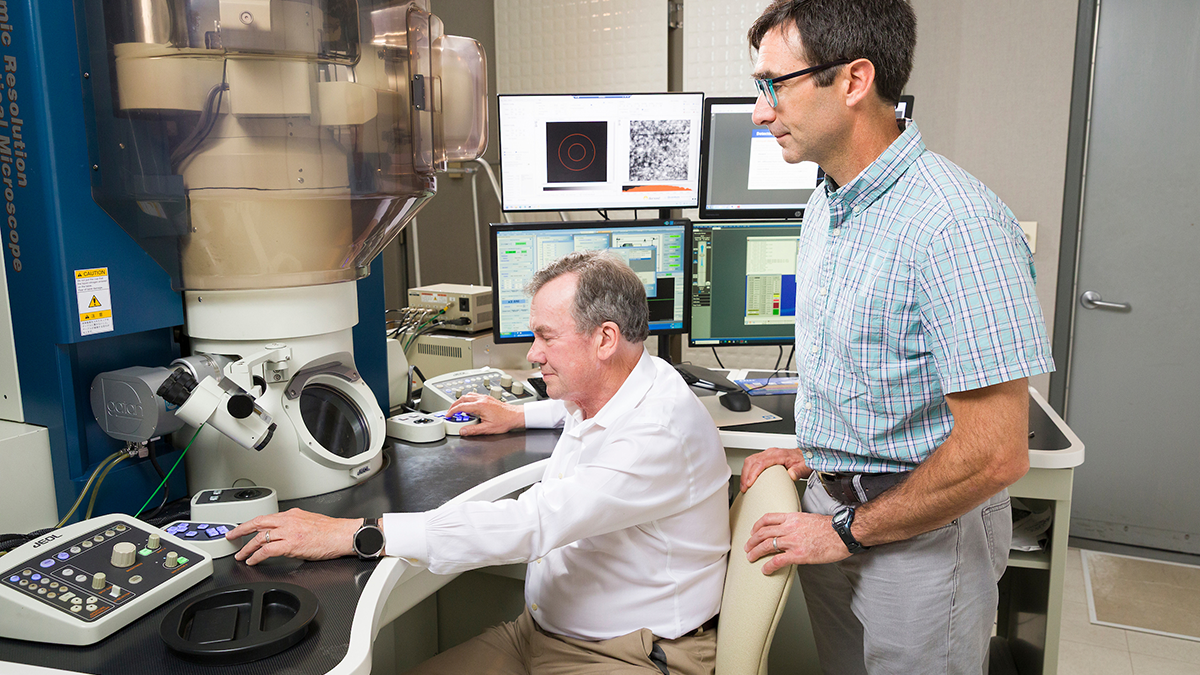
Professors Murray Gibson, Ph.D., (left) and Daniel Hallinan Jr, Ph.D., pose with an electron microscope in the National High Magnetic Field Laboratory in Tallahassee, Florida. (Scott Holstein/FAMU-FSU College of Engineering)
Key Points:
- Researchers at the FAMU-FSU College of Engineering have directly observed how molecular bonds organize at the nanoscale inside amorphous polystyrene, a common plastic.
- The work, published in the journal Applied Physics Letters, used a method called fluctuation electron microscopy to measure structure that scientists previously could only estimate indirectly.
- It matters because controlling that hidden structure could lead to lighter, stronger and more recyclable plastics, plus better thin-film electronics.
- The team was led by Professor J. Murray Gibson and included researchers from the college’s mechanical and aerospace and chemical and biomedical engineering departments in Tallahassee, Florida.
In what they believe is a scientific first, researchers at the FAMU-FSU College of Engineering have directly observed how molecular bonds organize at the nanoscale in amorphous polystyrene, a common plastic, using an advanced electron microscopy technique.

The work, published in the journal Applied Physics Letters, could reshape how scientists understand and engineer the structure and properties of polymers. The findings carry implications for high-tech materials such as the thin films and nanostructured layers inside smartphone screens, solar panels and microchips. Read the full study: https://doi.org/10.1063/5.0323625
The team, led by Professor J. Murray Gibson of Florida A&M University and the joint college’s Department of Mechanical and Aerospace Engineering, worked with colleagues in the Department of Chemical and Biomedical Engineering. They applied fluctuation electron microscopy, or FEM, to study atactic polystyrene. FEM is a technique Gibson helped pioneer in the 1990s for probing disordered solids, and here it let the team measure the “persistence length,” or the distance over which a polymer chain holds its orientation, at nanoscale resolution.
“By leveraging the sensitivity of our electron microscopy technique to bond-bond correlations, we have a new window into the nanoscale world of polymers,” Gibson said. “This insight is invaluable for understanding the detailed structure of polymers in miniaturized and nanostructured applications, where properties often differ dramatically from those of bulk materials.”
What did the researchers actually find inside the plastic?

Polystyrene shows up in packaging, insulation and everyday products, yet its molecular structure has long been understood only through statistical averages across large samples.
Until now, persistence length could be inferred only indirectly, using large samples and expensive analysis. FEM lets researchers probe these properties directly at the nanoscale, opening a clearer view of the thin films and interfaces that underpin modern technologies.
“This new approach to electron microscopy is a major step forward for studying polymers at the smallest scales,” said co-author Daniel Hallinan, Jr., professor of chemical and biomedical engineering at Florida State University and the FAMU-FSU College of Engineering.
“Previously, scientists determined average chain shape and size of amorphous polymers and struggled with electron beam damage and disorder, which confuses atomic scale images. This FEM approach to electron microscopy developed for hard materials by Professor Gibson and others has now been applied to soft polymers. It overcomes major limitations through statistical measurement and allows us to interrogate chain shape in small regions, revealing specific behaviors that would be obscured in the global average. We chose to use polystyrene as a benchmark for FEM of soft materials, because it is a well-known and prolifically studied polymer.”
By studying the local statistics of bonds and their relative orientations, FEM can pick out molecular chains in a disordered sample and measure their curvature.
Why does molecular order in plastic matter?
Understanding order at this scale could help engineers design plastic films that are lighter and stronger for uses such as packaging or medical devices. It could also lead to coatings that better resist heat and chemicals, or improve electronics that rely on ultra-thin polymer layers. Over time, the ability to observe and control local polymer structure may speed the development of sustainable, recyclable plastics built for specific jobs.

The study also compared experimental data with molecular dynamics simulations and found that real-world polystyrene shows more pronounced local ordering than current models predict. Atomic modeling by Joshua Mysona, an assistant professor of chemical and biomedical engineering, suggests this ordering comes from intermolecular correlations, or chains aligning with one another, that exist in real materials but are not fully captured in today’s simulations.
“These insights show that even in familiar materials like polystyrene, there are hidden levels of organization that we’re only now able to see,” Gibson said. “By uncovering this local order, we open the door to designing plastics with new and improved properties for a wide range of applications.”
Postdoctoral researcher Kyoungmin Kim, of the Department of Chemical and Biomedical Engineering, is a co-author and prepared the specimens for the electron microscope.
The research was supported by the National Science Foundation, the State of Florida, and the FSU President’s Sustainability and Climate Solutions Grant, with input from collaborators at Oak Ridge National Laboratory.
Editor’s Note: This article was edited with a custom prompt for Claude Opus 4.8, an AI assistant created by Anthropic. The AI optimized the article for SEO/GEO discoverability and improved clarity, structure and readability while preserving the original reporting and factual content. All information and viewpoints remain those of the author and publication. This article was edited and fact-checked by college staff before being published. This disclosure is part of our commitment to transparency in our editorial process. Last edited: June 5, 2026.
FAQ
What did FAMU-FSU researchers discover about polystyrene?
Engineers at the FAMU-FSU College of Engineering directly observed how molecular bonds organize at the nanoscale inside amorphous polystyrene, a common plastic. They believe it is the first direct observation of this kind of local molecular order in a soft polymer, as reported in Applied Physics Letters.
What is fluctuation electron microscopy (FEM)?
Fluctuation electron microscopy is an electron-microscopy method that measures tiny variations in how a material scatters an electron beam across very small volumes. That sensitivity lets scientists detect “medium-range” order in disordered materials. The technique was originally developed for hard materials such as amorphous silicon and metallic glasses, and this study applied it to a soft polymer.
What is “persistence length” and why does it matter?
Persistence length is the distance over which a polymer chain keeps pointing in roughly the same direction before it bends. It is a basic measure of a polymer’s stiffness and shape. Until this work, scientists could estimate it only indirectly using large samples; FEM measured it directly at the nanoscale, on polystyrene samples with a molecular weight of about 350 kg/mol.
Why does nanoscale order in plastic matter for everyday products?
Many modern technologies depend on ultra-thin polymer layers, where behavior can differ sharply from bulk plastic. Understanding and controlling local molecular order could lead to lighter, stronger films for packaging and medical devices, coatings that resist heat and chemicals, better thin-film electronics, and plastics designed to be more sustainable and recyclable.
Who led the research and how was it funded?
The team was led by Professor J. Murray Gibson of Florida A&M University and the FAMU-FSU College of Engineering’s Department of Mechanical and Aerospace Engineering, with co-authors Daniel Hallinan, Kyoungmin Kim and Joshua Mysona. Funding came from the National Science Foundation, the State of Florida, and the FSU President’s Sustainability and Climate Solutions Grant, with input from Oak Ridge National Laboratory.
Where can I read the original study?
The paper, “Direct observation of nanoscale bond-ordering in amorphous polystyrene,” appears in Applied Physics Letters (2026), volume 128, article 182702.
RELATED ARTICLES
Researcher Insights: Environmental Weathering Transforms Plastic Pollution
Five FAMU-FSU Engineering Faculty Earn 2025 Academy Recognition for Research Excellence