
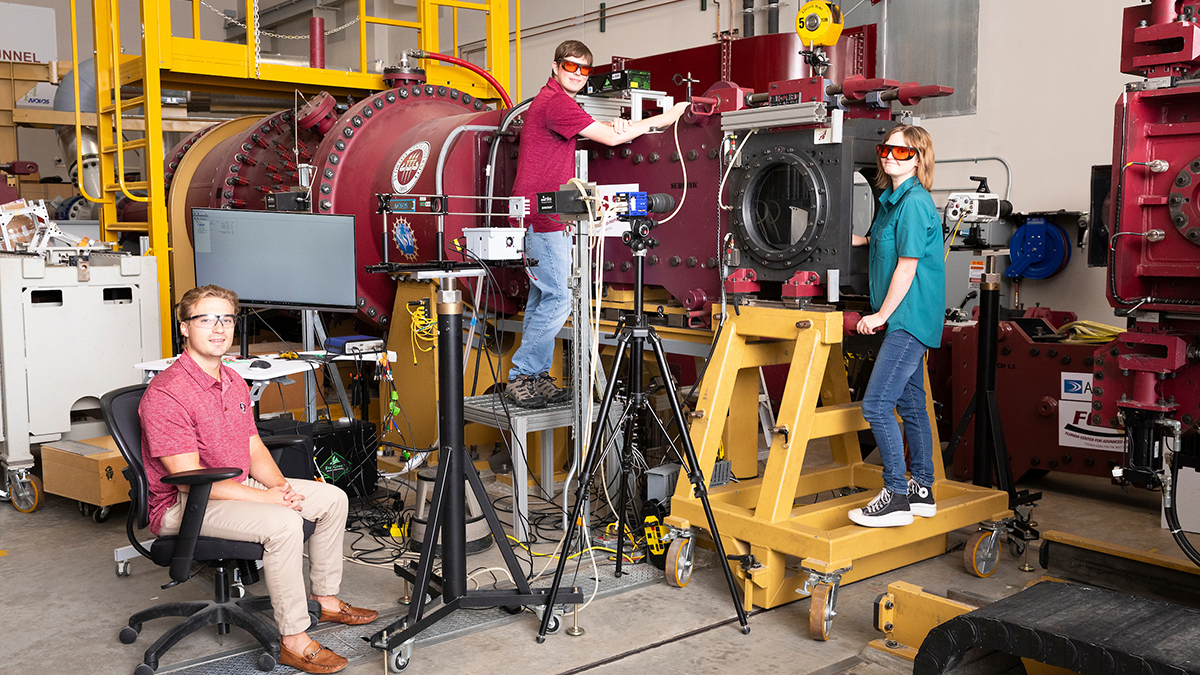
(Left-right): Nicholas Hux, Robert Smith and Jessica Cooke pose with the Polysonic Wind Tunnel at the Florida Center for Advanced Aero-Propulsion in the Aero-Propulsion Mechatronics & Energy building. (Scott Holstein/FAMU-FSU College of Engineering)
Key Points
Researchers in the Department of Mechanical and Aerospace Engineering at the FAMU-FSU College of Engineering and the Florida Center for Advanced Aero-Propulsion (FCAAP) have received more than $1.9 million in combined funding from the Air Force Office of Scientific Research and the Office of Naval Research to study next-generation supersonic and hypersonic aircraft.
The two projects, awarded in 2026, examine how shock waves affect vehicle surfaces and how scramjet inlets perform under real-world flight conditions.
Mechanical and aerospace engineering chair Rajan Kumar and associate professor Unnikrishnan Sasidharan-Nair are leading the research, which combines experimental testing at FCAAP’s Polysonic Wind Tunnel with computational modeling at FSU’s Research Computing Center.
The work matters because it addresses aerodynamic instabilities and propulsion challenges central to future military and space vehicles, while giving graduate and postdoctoral researchers direct experience in an area of aerospace engineering with limited existing data.
Two federally funded projects will study shock-wave interactions and scramjet inlet performance, giving students hands-on access to wind tunnel testing and supercomputing resources rarely available at a single university.
Researchers from the Department of Mechanical and Aerospace Engineering at the FAMU-FSU College of Engineering and FCAAP have received more than $1.9 million from two competitive grants from the U.S. Department of War to advance next-generation supersonic aircraft design.
Both projects will use FCAAP’s research facilities at the joint college, including the FSU Polysonic Wind Tunnel and the high-performance computing resources at the FSU Research Computing Center.

“Our goal is to develop new technologies needed for next-generation air and space vehicles and to train our students in areas of interest to the DOW and the nation in general,” said Rajan Kumar, professor and chair of mechanical and aerospace engineering. “These grants involve multiple parts of the MAE department, where we will be doing some experiments at FCAAP and some at our computational facility.”
Kumar will direct experimental efforts at FCAAP, while Unnikrishnan Sasidharan-Nair, an associate professor in mechanical and aerospace engineering, will lead computational investigations at the Research Computing Center. The projects combine experimental and computational expertise to address engineering challenges relevant to future aerospace systems.
The projects are sponsored by the Air Force Office of Scientific Research and the Office of Naval Research.
Sensitivities in Axisymmetric Shock-Wave/Boundary-Layer Interactions over Slender Bodies
- Sponsor: Air Force Office of Scientific Research
- Award: $888,342

Kumar and Nair are leading the investigation with postdoctoral researcher Anirudh Lakshmi Narasimha Prasad and graduate students Jessica Cooke and Nicholas Hux.
The project focuses on understanding the aerodynamic loads experienced by slender supersonic vehicles as shock waves interact with their surfaces. These conditions arise in high-speed military and space applications, including launch vehicle stage separation and store separation from supersonic aircraft.
Through supersonic wind tunnel experiments, flow visualization and diagnostic techniques, researchers will characterize the flow structures surrounding the vehicle and measure the resulting surface loads. Numerical simulations will complement the experiments, offering insight into the three-dimensional, unsteady flow physics that can generate aerodynamic instabilities affecting vehicle dynamics.
“We used specially designed wind tunnel tests and advanced diagnostic and analysis tools to study how air flows around these fast vehicles and how much force acts on their surfaces,” Nair said. “By running computer simulations and hands-on experiments, we learn more about the problems that can cause dangerous instabilities and affect how the vehicle flies.”
Hux, who works on the experimental side, said, “From an experimental angle, I worked with different models in the polysonic wind tunnel and tested shock strength with different shock generators. This gave us data to characterize how changes in shock strength affected the boundary layers. The data gets analyzed by the researchers who work on the computational side of things.”
Characterization and Performance Analysis of a Supersonic Inlet at Off-Design, Angle of Incidence and Sideslip Conditions
- Sponsor: Office of Naval Research
- Award: $1,030,454
Kumar and Nair are leading the investigation with graduate students Robert Smith and Gargi Dashora.
The project investigates the internal aerodynamics of inlets used in scramjet propulsion systems for hypersonic aircraft. Unlike conventional jet engines, scramjets compress incoming air using a series of shock waves rather than rotating compressors before combustion occurs. That design enables efficient operation at hypersonic speeds but also makes the engine highly sensitive to changes in operating conditions.
Researchers will conduct experimental and computational studies of a Mach 4 inlet under off-design conditions, including varying angles of incidence and sideslip. The project aims to identify the physical mechanisms responsible for performance degradation, establish operational safety margins and explore flow-control strategies to improve engine reliability.
“We are trying to understand the physics behind high-speed propulsion vehicles,” Nair said. “These engines are designed by engineers assuming idealized scenarios. However, in real life, your aircraft is going to be flying under off-design conditions and in contaminated environments. Our study is going to tell us what can happen and what countermeasures you can take to potentially prevent a loss of engine out there.”
Dashora, who works on the computational side, said, “We worked on the inlet component of a scramjet aircraft built for flying several times the speed of sound. These types of aircraft have an engine that has no moving parts and relies on shock waves. I was involved with mapping the limitations of the aircraft. We created physics-based numerical simulations to understand the safety margins inside the inlet. Our goal is to make these engines more robust. The mathematical tools we are developing as part of this study can be used for large-scale dynamical systems generally.”


How Are Students Involved in the Research?
Undergraduate and graduate students play a central role in both projects, gaining hands-on experience with wind tunnel testing, optical flow diagnostics, high-performance computing and computational fluid dynamics simulations.
The combined experimental and computational research gives students interdisciplinary training and mentorship, preparing them to address current challenges in aerospace engineering.
Anirudh Lakshmi Narasimha Prasad, a former postdoctoral researcher on the AFOSR project, said the work has shaped his career.
“Students are actively involved in developing simulations, conducting experiments and analyzing data to help answer fundamental questions in high-speed aerodynamics,” Prasad said. “Because many of the flow physics we are investigating remain largely unexplored, our students have the unique opportunity to be among the first researchers to study these phenomena in depth. Rather than building solely on well-established knowledge, they are helping define the field.”
Prasad said the collaborative grants also give students access to experimental facilities, computational tools and interdisciplinary teamwork that build their technical skills and confidence.

What Career Paths Do These Projects Lead To?
Robert Smith, a doctoral candidate who worked on the ONR project with Kumar, said the college’s resources set it apart. “There are significant resources here, like the polysonic wind tunnel,” Smith said. “It’s also exciting to have access to computational resources at the Research Computing Center. It’s not common to have both at the same university.”
Smith is still deciding between academia and a national research lab, but said he likes the idea of his research reaching beyond a single company.
For graduate student Nicholas Hux, the experience connected theory to practice. “Working with this team, I really saw how theory comes to life,” Hux said. “You start with an idea, build the model and run the tests. Then you crunch the numbers, and suddenly you’re holding answers no one’s found before. That’s the kind of ownership and excitement you can’t get anywhere else.”
Hux recently graduated with his master’s degree and is headed to Northrop Grumman for a position as a propulsion engineer.
Prasad worked with Nair on the computational side, first as a graduate student and then as a postdoctoral researcher. “Prasad has been a student with me for several years now and has just gotten a faculty position with Colorado State,” Nair said.
“Students have a unique opportunity here to work with both the computational and experimental sides of research,” Nair said. “This kind of collaboration and integrated approach in research prepares them better for success in the real world.”
Together, the two projects support research priorities relevant to future high-speed air vehicles and propulsion systems. Beyond their national security applications, the awards give students at FAMU-FSU College of Engineering direct experience in an active area of aerospace research.
Editor’s Note: This article was edited with a custom prompt for Claude Sonnet 5, an AI assistant created by Anthropic. The AI optimized the article for SEO/GEO discoverability, improved clarity, structure and readability while preserving the original reporting and factual content. All information and viewpoints remain those of the author and publication. This article was edited and fact-checked by college staff before being published. This disclosure is part of our commitment to transparency in our editorial process. Last edited: 09/04/2026.
RELATED ARTICLES
Researchers Develop New Model for Predicting Noise Feedback Loops From Supersonic Jets
It’s All About the Flow When It Comes to Supersonic Flight
Research Reveals How Flight Angles Drive Turbulence, Vortex Instability in High-Speed Aircraft
FAQ
The Florida Center for Advanced Aero-Propulsion (FCAAP) is a research center at Florida State University focused on aerodynamics and propulsion systems for high-speed aircraft. It houses the FSU Polysonic Wind Tunnel, used to test vehicle designs at supersonic and hypersonic speeds.
The college received more than $1.9 million combined: $888,342 from the Air Force Office of Scientific Research and $1,030,454 from the Office of Naval Research, funding two separate research projects on supersonic and hypersonic aircraft design.
A scramjet, or supersonic combustion ramjet, is an engine that compresses incoming air using shock waves rather than mechanical compressors, allowing it to operate efficiently at hypersonic speeds, generally above five times the speed of sound, or Mach 5.
Rajan Kumar, professor and chair of the Department of Mechanical and Aerospace Engineering, is directing experimental work, while Unnikrishnan Sasidharan-Nair, an associate professor in the same department, is leading computational research.
Shock waves interacting with a vehicle’s surface can create extreme aerodynamic loads and instabilities. Understanding these interactions helps engineers design safer high-speed vehicles, including applications like launch vehicle stage separation.
Students gain direct experience with wind tunnel testing and high-performance computing. Recent examples include graduate student Nicholas Hux, who is joining Northrop Grumman as a propulsion engineer, and former postdoctoral researcher Anirudh Lakshmi Narasimha Prasad, who accepted a faculty position at Colorado State University.