
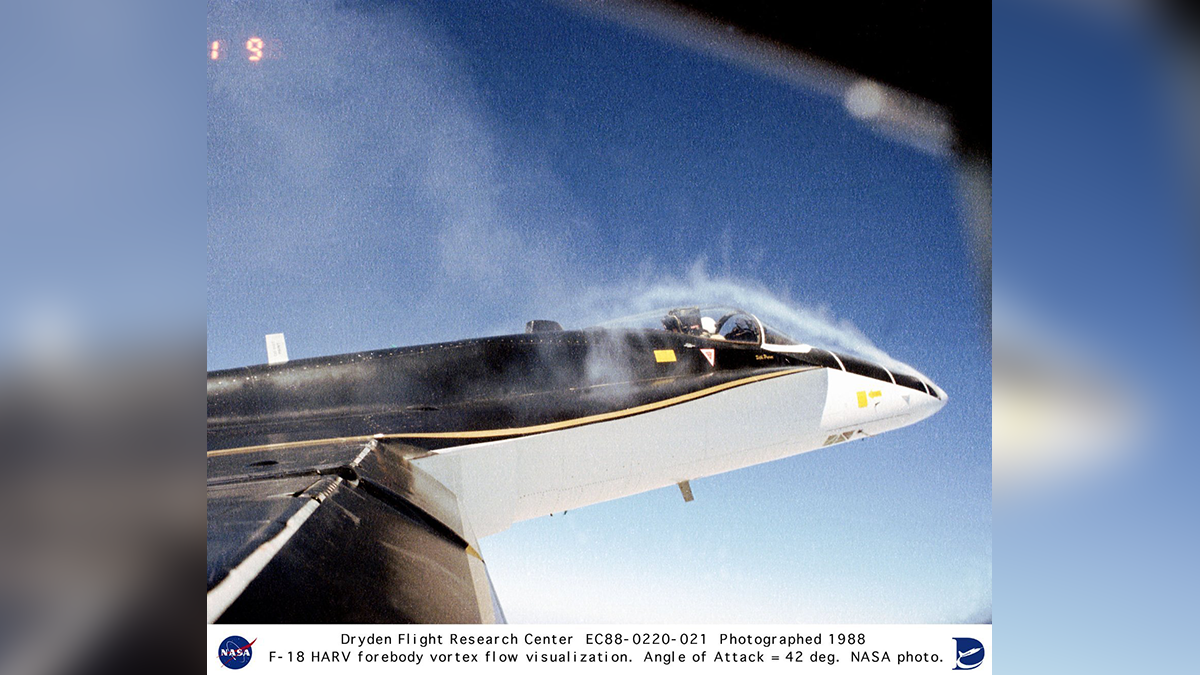
Vortices flow from the nose cone of a NASA F-18 High Alpha Research Vehicle flying from NASA's Dryden Flight Research Center in Edwards, California. (Courtesy of the Defense Visual Information Distribution Service)
Key Points
- FAMU-FSU College of Engineering researchers studied how angles of incidence affect vortex behavior in cone-shaped aircraft bodies traveling at Mach 1.1.
- As the angle of incidence increased from 15 to 30 degrees, vortex asymmetry intensified and airflow shifted from structured and predictable to unstable and erratic.
- The findings, published in the Journal of Aircraft, could help engineers define safe flight envelopes and design more stable high-speed aircraft and missiles.
- Future research will explore vortex behavior at higher speeds and real-time, AI-assisted control methods.
Researchers at Florida State University and the FAMU-FSU College of Engineering have uncovered new insights into how flight angles drive vortex formation and instability in high-speed aircraft—findings that could reshape the design of more stable missiles and next-generation aviation systems.

The study was led by Rajan Kumar, chair of the Department of Mechanical and Aerospace Engineering and director of the Florida Center for Advanced Aero-Propulsion, alongside doctoral student Jordan Wilkerson and Associate Professor Unnikrishnan Sasidharan Nair. The research was supported by the Army Research Office.
“Aircraft in flight are subject to extreme forces, and as speed and maneuvering increase, these forces only get stronger,” Kumar said. “This study helps to understand critical phenomena responsible for those forces so engineers can create efficient and more stable designs.”
What Happens to Vortices at High Flight Angles?
When an aircraft tilts sharply during flight, the surrounding air does not flow smoothly — it twists into powerful, swirling currents called vortices that can destabilize the entire vehicle. A vortex is a rotating region of airflow that forms around moving objects; under normal conditions, they are manageable, but at steep angles, they become unpredictable.
These vortices can cause an aircraft to pull to one side or rotate unexpectedly and, in extreme cases, damage critical components such as sensors or wing flaps.
Kumar’s team combined experimental testing with advanced computational simulations to model complex airflow and identify when and how instability develops. The researchers simulated airflow over a cone-shaped object at Mach 1.1 — just above the speed of sound — across three angles of incidence: 15, 25 and 30 degrees. The angle of incidence is the degree to which an aircraft is tilted relative to oncoming airflow.

What Did The Researchers Find at Each Angle?
At 15 degrees, the primary vortex breaks down into a complex pattern resembling two intertwined spirals, which then split into many thin, tangled strands of swirling air. At 25 and 30 degrees, the breakdown follows a single spiral pattern, indicating significantly stronger instability. As the angle of incidence increased, vortex asymmetry also increased—airflow shifted from structured and predictable to unstable and erratic, illustrating how rapidly control conditions can deteriorate in real-world flight.

In high-stakes environments, particularly military operations, even a slight deviation caused by asymmetric vortices can mean missing a target or losing control entirely.
Why Do Vortices Suddenly Become Asymmetric?
The study addresses a long-standing question in aerospace research. The research shows that growing instabilities within airflow unite to create larger disruptions. As small secondary vortices form and interact with primary vortices, they merge into larger structures that upset an aircraft’s balance. Vortex behavior also depends on several interacting factors, including vortex size and orientation relative to the aircraft. Together, these factors determine the force exerted on the vehicle and how difficult it becomes to control.
How Will These Findings Change Aircraft Design?
The findings carry direct implications for how high-performance aircraft are designed and operated. Engineers can use this data to define safe flight envelopes—identifying when airflow remains stable and when additional control systems are needed. The research also supports new design strategies, including improved control surfaces and flow-control techniques, as well as future systems capable of automatically adjusting during flight.
Kumar and his team are expanding the research to explore vortex behavior at higher speeds and are investigating real-time control methods that could allow aircraft to respond to instability autonomously, potentially incorporating advances in artificial intelligence and automated systems.
How Is This Research Shaping The Next Generation of Engineers?
The research also advances the college’s educational mission. Students involved in the work go on to careers in industry, government laboratories and defense agencies.
“Research outcomes matter, but our most important product is our students. They are the future of engineering and science,” Kumar said.
Editor’s Note: This article was edited for SEO and GEO with the assistance of an AI language model (Claude, Anthropic) under the direction and review of college editorial staff. All facts, quotes and sourced information originate from the original article provided. No AI-generated facts were introduced. Final editorial judgment remains with the college communications team.
RELATED ARTICLES
It’s All About the Flow When It Comes to Supersonic Flight
Researchers Develop New Model for Predicting Noise Feedback Loops From Supersonic Jets
FSU Researcher Secures $3.9 Million Air Force Grant to Advance Hypersonic Technology Research