
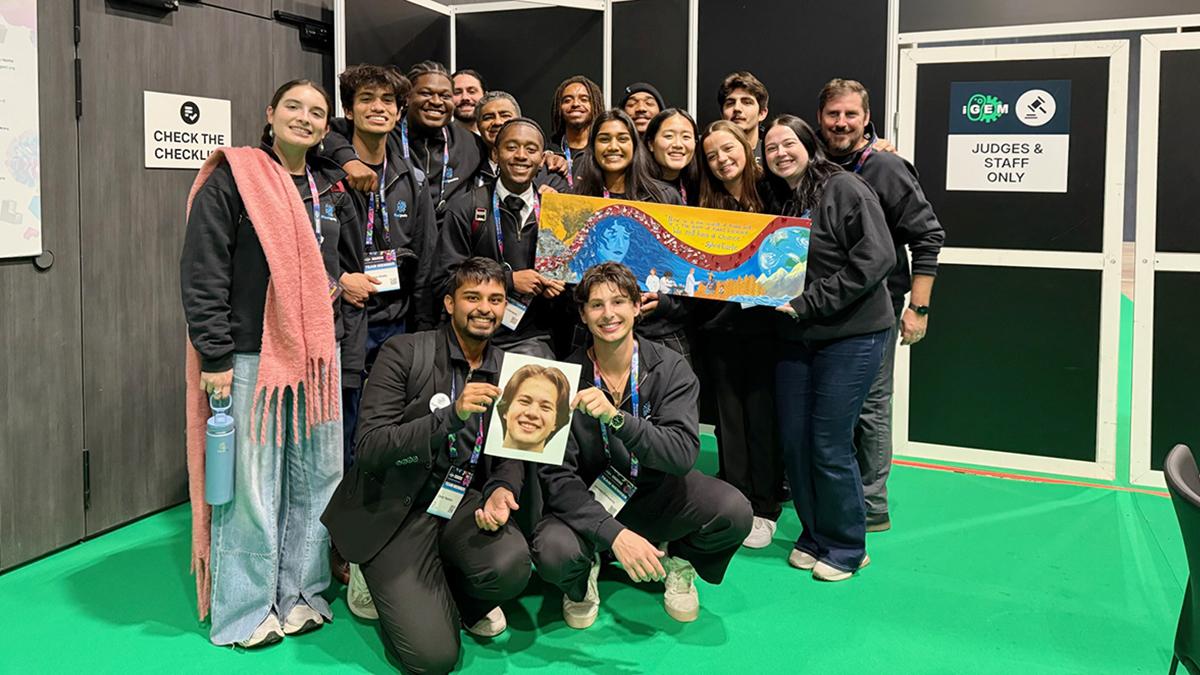
The 2025 FSU iGEM team at the Jamboree in Paris. (Courtesy Dr. Cesar Rodriguez)
FAMU-FSU College of Engineering biomedical engineers play pivotal role in international synthetic biology breakthrough addressing microplastics health crisis
Three biomedical engineering students from the FAMU-FSU College of Engineering helped propel Florida State University’s International Genetically Engineered Machine (iGEM) team to a gold medal at the world’s premier synthetic biology research symposium, showcasing breakthrough work in microplastics mitigation and human health protection.
Rick Geneus, Zarrar Talukdar and Cate Kegel joined an interdisciplinary team of 14 undergraduate students from six colleges across the university to earn FSU’s third gold medal at the iGEM 2025 Grand Jamboree in Paris, France, Oct. 28-31. The biomedical engineering students brought critical technical expertise to the competition, which drew more than 5,000 participants from 50 countries and 420 competing teams.
Engineering Excellence Drives Innovation
The team operated under the guidance of Cesar Rodriguez, research faculty and entrepreneur in residence at FSU’s College of Medicine, and David Montez, associate director of FSU’s Center for Undergraduate Research and Academic Engagement, alongside advisors Alana Chang and Ely Nieves.
Rodriguez emphasized the essential role engineering disciplines play in the competition’s success, noting that chemical and biomedical engineering students have contributed to every FSU iGEM team since the program’s inception in 2017.
“It never gets old to see the members of the iGEM team with their diverse backgrounds learn to work together,” Rodriguez said. “It’s beautiful and impressive. Students majoring in chemical and biomedical engineering have been on every team since 2017. iGEM is fundamentally an engineering competition so the engineering skills and mindset are invaluable.”
The 2025 iGEM team included Malik Gay, Rick Geneus, Nicole Karwowski, Cate Kegel, Colin Largen, Ivan Lepesii, Aidan Marengo, Vicky Montalvo, Priyanka Perumalraja, Esteban Pinilla, Malik Roger, Jordan Schwartz, Zarrar Talukdar and Deirdre Thomson.
Addressing the Microplastics Health Crisis
The team’s gold-winning project, “Plastipeutics,” delivers a preventative solution to microplastics that increasingly threaten human health through environmental contamination and dietary exposure.
As plastics degrade over time, they fragment into microplastics that infiltrate ecosystems worldwide. Recent research has identified these particles in the human small intestine, where they disrupt the gut barrier, trigger inflammatory responses and damage intestinal cells.
The team consulted with experts across multiple fields to develop solutions capable of delivering measurable, positive outcomes for this growing environmental health challenge.
“I’ve grown to really care about this project and team as we’ve worked together for the past year to build something real and earn a gold medal,” Talukdar said. “With that said, the nerves I felt awaiting our result were unreal, so receiving this honor and achieving our common goal felt amazing.”
Translating Research Into Commercial Potential
Plastipeutics represents a prototype for a potentially ingestible product that aggregates microplastics in the digestive system, reducing the accumulation of harmful plastics within the body. Entrepreneurship major Malik Roger authored a business plan proposing distribution through online health supplement retailers and direct-to-consumer channels.
Competing on the Global Stage
The four-day symposium organized more than 420 teams into 15 specialized villages focusing on themes including health, climate and food security. Teams presented their research to international judging panels across separate divisions for high school, undergraduate and graduate students. FSU was the only Florida institution to win gold in the undergraduate category.
Grand prize winners in the collegiate undergraduate/overgraduate division included McGill University from Canada in the foundational advance category, Masaryk University from Czechia in agriculture, and runners-up Zhejiang University-University of Edinburgh Institute from China in infectious disease, EPFL from Switzerland in climate crisis, and Heidelberg University from Germany in oncology.
“The long-term success of FSU iGEM can be credited to each team being self-motivators who stay curious and find value in working as a team,” Montez said. “The investment that FSU makes each year in the program gives the team confidence in what they can accomplish during the competition and beyond.”
Cultivating Engineering Excellence Through Collaborative Research
The iGEM program at FSU operates as a collaborative initiative encompassing the College of Medicine, Center for Undergraduate Research and Academic Engagement, and the FAMU-FSU College of Engineering. The program welcomes students from any major and is run out of the Center for Undergraduate Research and Academic Engagement, a unit of FSU’s Division of Undergraduate Studies.
This achievement demonstrates the power of integrating rigorous engineering principles with interdisciplinary collaboration to address complex global health challenges, reinforcing the college’s commitment to fostering research excellence and preparing undergraduate students for leadership in synthetic biology and biotechnology innovation.
For more information about the iGEM team, visit their project wiki. Additional details about undergraduate research opportunities are available at cre.fsu.edu. A presentation video of the Plastipeutics project is available on YouTube.
Editor’s Note: This article was edited with a custom prompt for Claude Sonnet 4.5, an AI assistant created by Anthropic. The AI optimized the article for SEO discoverability, improved clarity, structure and readability while preserving the original reporting and factual content. All information and viewpoints remain those of the author and publication. This article was edited and fact-checked by college staff before being published. This disclosure is part of our commitment to transparency in our editorial process. Last edited: 12/11/2025.