
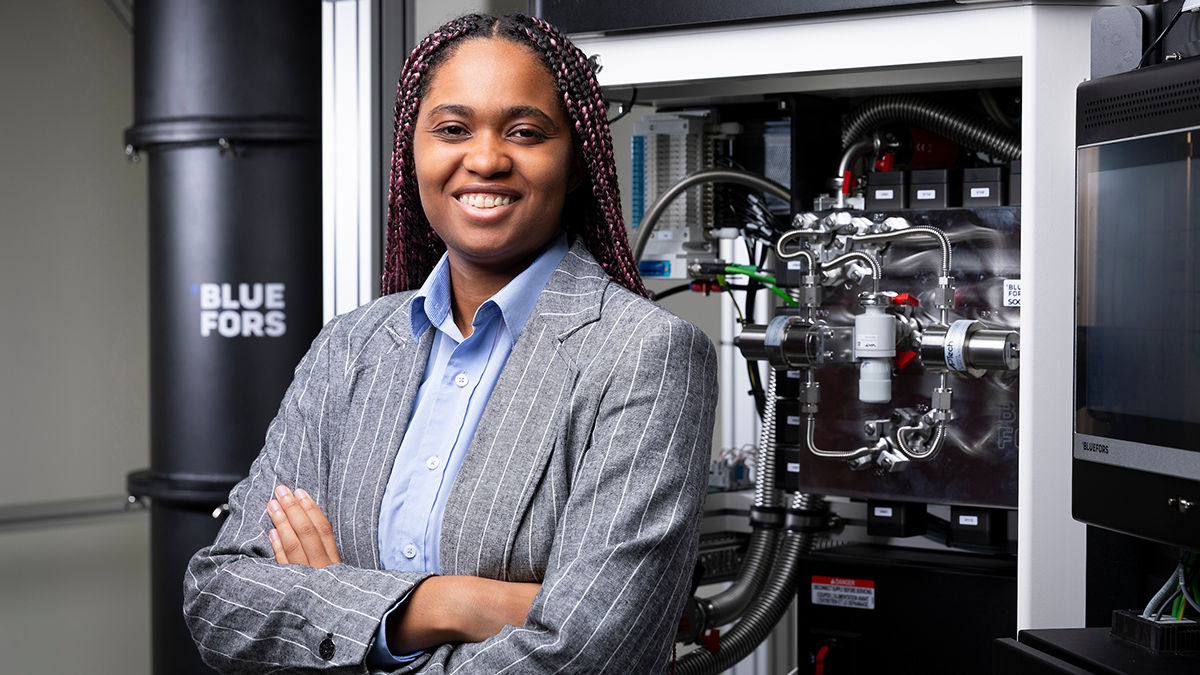
FAMU-FSU College of Engineering electrical and computer engineering doctoral student Mia Reynolds poses with a Bluefors dilution refrigerator in the quantum lab in the FAMU Centennial Building in Tallahassee, Florida on October 13, 2026. Reynolds received the prestigious John Martinis Grant research award for her work on radio-frequency (RF) microwave pulse engineering for multi-scale qubit control. (Scott Holstein/FAMU-FSU College of Engineering)
Mia Reynolds, a Florida A&M University doctoral student in electrical and computer engineering at the FAMU-FSU College of Engineering, has received a research grant through the John Martinis Grants for Experimental Superconducting Device Physics, a program offered by quantum computing company Qolab.
Reynolds earned the grant for her work on radio-frequency microwave pulse engineering for multi-scale qubit control. She is one of two 2026 research grant recipients, and the award was announced at the Adaptive Quantum Circuits Conference in October 2026.
Reynolds was born and raised in Washington, D.C., and earned her undergraduate degree at Purdue University. Her research focuses on developing and improving technology that uses advanced microwave pulses to control qubits, the basic building blocks of quantum computers.
“I am humbled to be awarded the grant knowing that my proposal was chosen over other researchers in the field who share the same passions as me and would have surely done amazing work with the opportunity,” Reynolds said.'
She added, “It motivates me to want to produce good work and represent both my lab and the college well. This grant is helpful as it gives us access to Qolab’s cloud computing platform, which will be very useful for our experimentation.”
What are the John Martinis Grants?
The grants honor John Martinis, a winner of the 2025 Nobel Prize in physics, and provide research and training resources to the next generation of experimental physicists working on superconducting qubits. For 2026, Martinis selected two research grant recipients, including Reynolds. Research awardees receive a $5,000 stipend and a ticket to the Adaptive Quantum Circuits Conference. More information is available at https://qolab.ai/john-martinis-grant.
About the research
Quantum computers could reshape fields ranging from cybersecurity to drug discovery, but the challenge of reliably managing qubits limits their development.
Reynolds’ project addresses that challenge by developing advanced microwave pulse techniques to control qubits more precisely and efficiently. Better control could help unlock processing power and problem-solving capabilities beyond those of today’s computers.
“My research is about finding better ways to use microwave technology to manage the tiny parts that make quantum computers work,” Reynolds said. “By improving the control and reliability of qubits, we hope to help make quantum computing a practical reality.”
How does Reynolds explain her research to someone new to quantum computing?
“Classical computation stores information in the form of bits as 0s and 1s while quantum computing stores information in the form of qubits as a superposition of both 0 and 1 simultaneously,” Reynolds said. “My research is on the microwave pulses that are used to control the qubits.”
She also sees momentum in the field. “As the field continues to grow, I am very excited about the new talent and researchers entering the field. There is a need for more researchers and professionals in the field and it’s exciting to see it grow before my very eyes, even over my short time,” Reynolds said.

(Mark Wallheiser/FAMU-FSU College of Engineering)
Mentorship and what’s next
Reynolds works in the lab of Bayaner Arigong, an associate professor in the Department of Electrical and Computer Engineering at the college. She said Arigong and other members of the lab, including Jonathan Casamayor, another doctoral student in the lab, have been a great help since she first arrived at the college.
“From motivating me to explore new ideas, or talking through problems when I get stuck, they have been invaluable,” Reynolds said. “Besides Professor Arigong’s leadership, guidance and support, I would not have been able to accomplish as much over the past year without Jonathan Casamayor, who is scheduled to defend his thesis this semester.”
Looking ahead, Reynolds hopes the lab’s work will advance the technology.
“I hope our work helps make quantum processing units more reliable and brings us closer to truly fault-tolerant quantum computing,” Reynolds said. “If we succeed, the door opens to breakthroughs in areas like secure communication, life-saving drug discovery and smarter, more efficient energy grids.”
Editor’s Note: This article was edited with a custom prompt for Claude Opus 5.5, an AI assistant created by Anthropic. The AI improved clarity, structure, SEO/GEO optimization and readability, while preserving the original reporting and factual content. All information and viewpoints remain those of the author and publication. This article was edited and fact-checked by college staff before being published. This disclosure is part of our commitment to transparency in our editorial process. Last edited: 10-30-2026.
RELATED ARTICLES
Federal Funding Supports FSU Quantum Communication Testbed for Real-World Conditions
Researcher Wins NSF Early CAREER Award for Developing RF Processors Using Novel Materials