
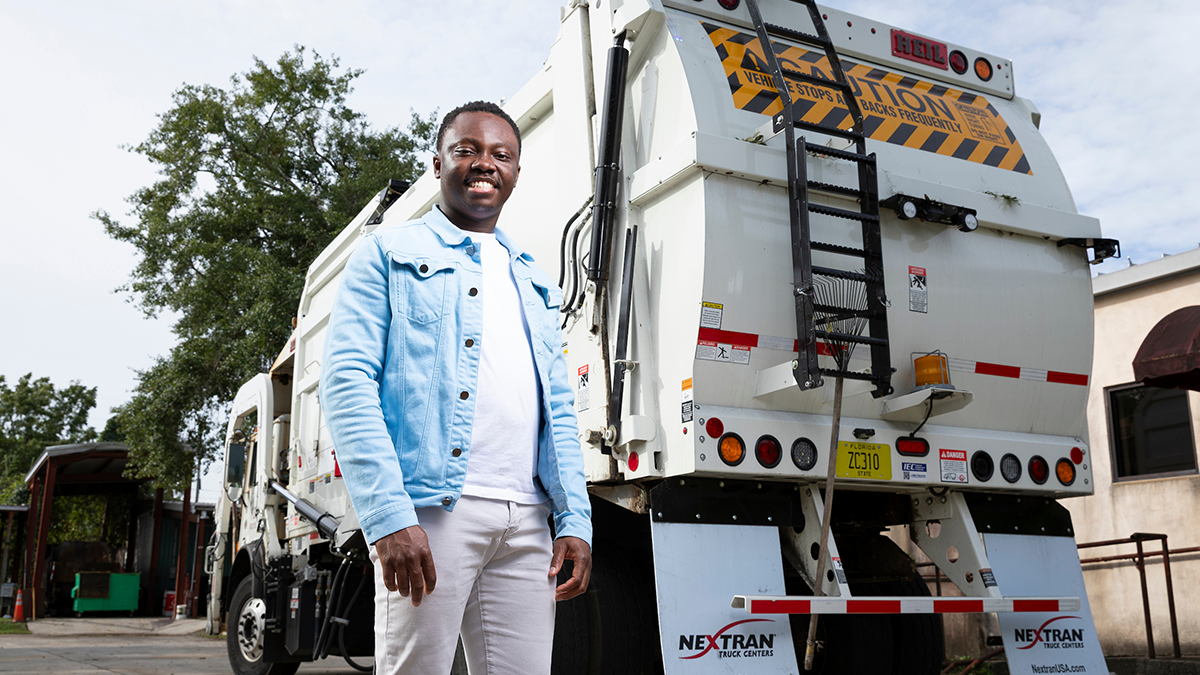
Doctoral student Chinonso Okorie poses with a garbage truck at FSU Waste Management & Recycling in Tallahassee, Florida on October 8, 2026. Okorie’s dissertation research involves optimizing waste collection routes for electric garbage trucks. (Scott Holstein/FAMU-FSU College of Engineering)
Key Points
Researchers at the FAMU-FSU College of Engineering developed new mathematical models and algorithms to plan routes and charging schedules for electric garbage trucks.
The work matters because electric trucks have limited range and need recharging, so routing methods built for diesel fleets no longer work.
Tested on real data from the City of Tallahassee, the algorithms found solutions within 2% of the best possible answer while cutting computation time by up to 90% compared with commercial software.
Cities across the United States are shifting from diesel to electric garbage trucks to reduce emissions and improve air quality. But as communities adopt cleaner fleets, city leaders face a new challenge: building waste collection routes that keep electric trucks powered throughout the day.
Researchers at the FAMU-FSU College of Engineering, the joint engineering college of Florida A&M University and Florida State University in Tallahassee, have taken on that challenge in a new study. Their work introduces mathematical models and algorithms that help cities plan electric waste collection routes, making fleet electrification practical.
Chinonso Okorie, a doctoral candidate at FAMU in industrial and manufacturing engineering at the FAMU-FSU College of Engineering, led the study, which grew out of Okorie’s dissertation research. Yanshuo Sun, an associate professor, co-authored the study.
The research was published in the journal Transportation Research Part E: Logistics and Transportation Review.

Why do electric garbage trucks need new routing methods?
“Solid waste collection is a vital municipal service, but it is also a significant source of emissions and air pollution, since collection has traditionally relied on diesel-powered trucks,” Okorie said. “As municipalities adopt electric trucks to reduce emissions, a new operational challenge emerges. Electric trucks have limited range and require recharging, so the old routing and scheduling methods for diesel fleets are no longer sufficient.”
To solve this problem, the team developed new mathematical models and algorithms that plan efficient collection routes and charging schedules for electric garbage trucks. The tools are designed so vehicles can complete their routes without running out of power.
Why does electric fleet planning matter for cities?
Municipalities provide solid waste collection to protect public health and the environment. As cities move to electric fleets, they need rigorous route and schedule planning tools to make the switch both operationally feasible and cost-effective.
“Our research gives cities the tools to plan this transition responsibly, supporting cleaner air, more reliable waste collection and better use of public funds,” Sun said.
How did the researchers solve the electric vehicle routing problem?
The team built two mathematical models to help cities plan electric truck routes and schedules. One model uses the actual road network of real streets, highways and intersections. The other relies on a simplified map showing direct connections between residential neighborhoods.
The researchers used computer simulations to test how each network model affects route efficiency. They also developed two algorithms capable of solving large, real-world problems that, according to the team, commercial software cannot handle efficiently. One algorithm breaks the problem into smaller steps. The other builds solutions piece by piece.
“This is the first study in the electric vehicle routing field to directly compare these two network models for this type of problem, and to introduce a scalable, near-optimal solution approach that can give practical answers to cities and waste authorities,” Okorie said.
What did the study find?
Applied to real-world data from the City of Tallahassee, the new tools gave city planners practical ways to generate insights for sustainable, cost-effective waste collection as demand grows.
The researchers found that the best network model depends on context. The simplified network often produces more efficient solutions, but the physical road network can work better in some cases, such as when there are few roads and most stops sit along one main route, like a circular road around a pond.
“Our algorithms found solutions within 2% of global optimality, while cutting computation time by up to 90% compared to commercial software. They also outperformed a state-of-the-art metaheuristic algorithm from the scientific literature in both solution quality and computational efficiency,” Sun said.
The Tallahassee data also showed that charging costs make up a significant share of total operating costs as service demand grows.
“We identified some clear trade-offs,” Sun said. “If trucks can drive farther, you need fewer of them. If chargers are faster, trucks spend less time charging—without changing their routing plan.”
How could Tallahassee and other cities use this research?
The team hopes the work will help city planners evaluate how to move waste collection fleets to electric vehicles. Because the models factor in future demand and new truck purchases, planners can compare upfront costs with long-term operating and charging expenses before they invest.
“We demonstrated this approach in Tallahassee, creating optimal routing and scheduling plans looking out to 2045,” Sun said. “Our goal is to make this method a standard part of city planning for electric vehicles—so cities can make informed decisions using real data, not guesswork.”
“What sets this study apart is its foundation in real-world data from the City of Tallahassee, tying our findings directly to actual and projected local needs,” Sun said. “More broadly, this project shows how advanced mathematical modeling can lead to cleaner cities, more reliable services, and better use of public funds as communities move toward electric fleets.”
Who funded the research?
The research was partially supported by Advancing Community-Centric Transportation Systems (ACTS), a U.S. Department of Transportation-funded research center housed at the FAMU-FSU College of Engineering, through a grant from FAMU.
Editor’s Note: This article was edited with a custom prompt for Claude Opus 5.5, an AI assistant created by Anthropic. The AI optimized the article for SEO/GEO discoverability, improved clarity, structure and readability while preserving the original reporting and factual content. All information and viewpoints remain those of the author and publication. This article was edited and fact-checked by college staff before being published. This disclosure is part of our commitment to transparency in our editorial process. Last edited: Oct. 13, 2026.
RELATED ARTICLES
Truck Parking Access, Not Just Space, Key to Reducing Driver Fatigue Crashes
New Model Speeds Up Ship Scheduling at the World’s Busiest Ports
Industrial Engineers Drive Transportation Innovation With Operations Research
FAQ
Electric garbage trucks have limited driving range and must stop to recharge, which diesel trucks don’t. Routes and schedules designed for diesel fleets don’t account for battery limits or charging time, so cities switching to electric fleets need new planning methods that build charging into the daily route.
Chinonso Okorie, a Florida A&M University doctoral candidate in industrial and manufacturing engineering, and Associate Professor Yanshuo Sun developed two mathematical models and two algorithms that plan collection routes and charging schedules for electric garbage trucks, so vehicles finish their routes without running out of power.
According to the researchers, their algorithms found solutions within 2% of the best possible answer and cut computation time by up to 90% compared with commercial software. They also outperformed a leading algorithm from published research in both solution quality and speed.
The researchers tested their tools on real-world data from the City of Tallahassee, Florida, and created routing and scheduling plans projected out to 2045. The data showed charging costs become a significant share of operating costs as collection demand grows.
The FAMU-FSU study found that trucks with longer driving range reduce the number of trucks a city needs, while faster chargers reduce charging time without changing route plans. The models let planners compare upfront truck costs with long-term operating and charging costs.
The study appears in Transportation Research Part E: Logistics and Transportation Review, a peer-reviewed journal. The work was partially supported by Advancing Community-Centric Transportation Systems (ACTS), a U.S. Department of Transportation-funded research center at the FAMU-FSU College of Engineering.