
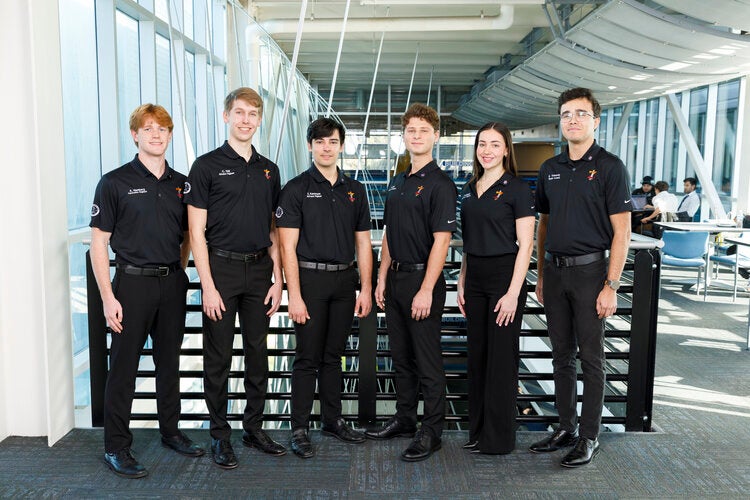
We designed and launched a high-power rocket for the 2026 NASA Student Launch Competition that reached a target altitude of 4,900 feet. The competition follows NASA’s design process, including test launches and iterations, teaching us how to design for safety and functionality.
Our rocket, Anomaly, was built to meet the competition’s unique challenges. Flight performance is scored on multiple criteria: altitude accuracy, with points deducted for every foot above or below our declared height; descent time under 90 seconds for bonus points; and landing proximity to the launch pad. We will achieve success by landing without damage, ensuring the rocket fully reusable. We collaborated with Team 511, whose payload will deploy upon landing to complete its mission.
We constructed the rocket from strong, lightweight materials. The design features a specialized nose cone and fins, with carbon fiber components used in high-stress areas such as the tail cone and nose tip. We designed major sections to separate easily, enabling safe transport, inspection, and repair. An onboard camera provides real-time flight observation. We implemented a dual-parachute recovery system: a drogue chute deployed at apo- gee for initial deceleration, followed by a main parachute at lower altitude to ensure a controlled landing within the required descent parameters.