
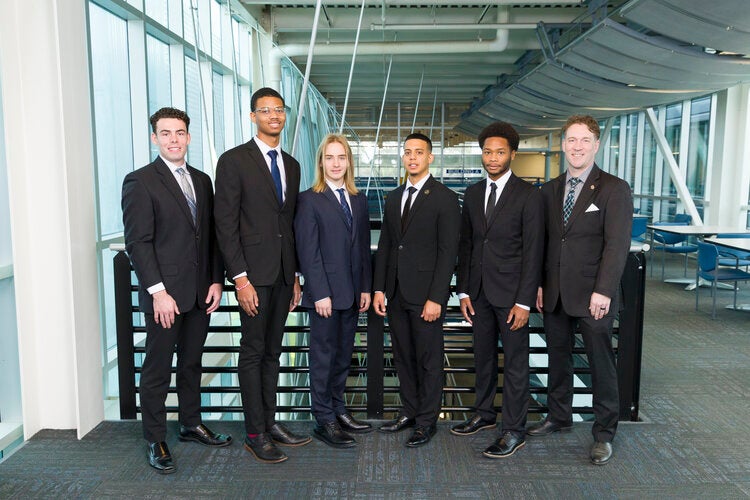
We collaborated with mechanical and aerospace engineering Team 515 to design and build an autonomous ground vehicle capable of independent navigation, wireless communication, and manual operator control when needed. The vehicle’s capabilities addressed the growing interest in self-driving technology by creating a versatile platform that could operate safely without constant human supervision.
We equipped the vehicle with GPS tracking for navigation and mapping, multiple cameras for obstacle detection, and two-way radio communication for remote instruction. The vehicle successfully navigated autonomously, avoiding obstacles without human input while transmitting a live video feed of its surroundings. We implemented a manual override feature that allowed operators to assume direct control when necessary, which proved essential given the vehicle’s speed of 20+ miles per hour.
The vehicle demonstrated robust performance across diverse terrain including grass, sidewalks, curbs, and roads, proving its flexibility beyond controlled indoor environments. This capability, combined with its autonomous navigation and real-time communication systems, created what we characterized as a rugged yet technologically sophisticated platform capable of handling rough conditions.
Our completed vehicle successfully meets all project goals, demonstrating effective autonomous movement, wireless communication capabilities, and seamless operator interaction in real-world environments. The integration of GPS navigation, computer vision for obstacle avoidance, radio communication, and manual override functionality results in a functional autonomous vehicle platform that improves operational safety by reducing the need for direct human presence during exploration tasks.