
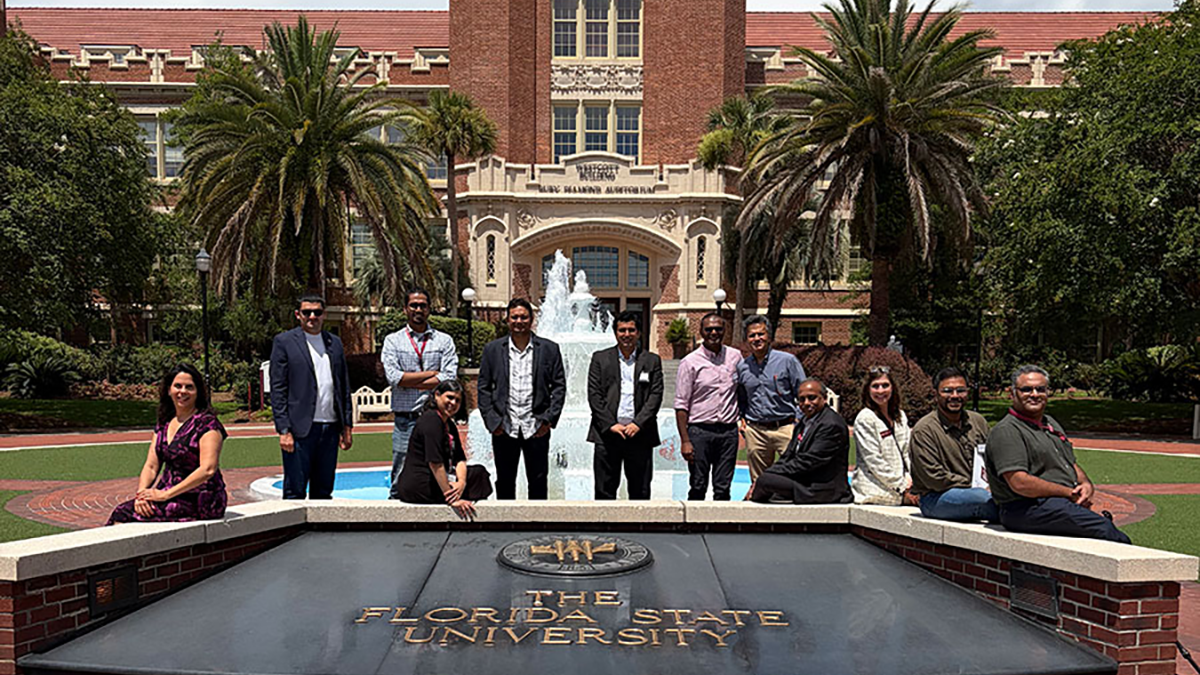
The inaugural Visiting Scholars Partnership Program (VSPP) cohort and program leaders at the Westcott Fountain on Florida State University's Tallahassee campus. (Vilma Fuentes/LSI)
Key Points
FAMU-FSU College of Engineering faculty Tristan Driscoll and Farrukh Alvi were central to FSU’s first VSPP cohort, held July 5-31.
Driscoll, assistant professor of Chemical and Biochemical Engineering, was paired with Namrata Gundiah of the Indian Institute of Science in Bangalore, identifying three potential areas for future collaboration and grant proposals.
Alvi, senior associate provost for Strategic Initiatives and Innovation and the Don Fuqua Eminent Scholar and Professor of Mechanical and Aerospace Engineering, originally conceived the VSPP after a 2025 visit to top Indian research institutions.
Ahead of Alvi’s 2025 visit, Professor Rajan Kumar, chair of the Department of Mechanical & Aerospace Engineering at the college, had already initiated MOUs at two partner institutes through his own existing relationships, providing an early model for the broader institutional agreements that followed.
The program paired researchers months before their monthlong campus residency, a model designed to build on existing research relationships rather than start them cold.
FSU expects to host a second VSPP cohort in May/June 2027.
Several FAMU-FSU College of Engineering faculty members played central roles in the inaugural cohort of Florida State University’s Visiting Scholars Partnership Program (VSPP), a new initiative designed to build lasting international research relationships between FSU faculty and leading global institutions.
What Is The Visiting Scholars Partnership Program?
Unlike traditional faculty exchanges, the VSPP pairs researchers together months before they arrive on campus, creating the foundation for a monthlong residency centered on shared research goals and collaboration that continues after the visit.
The inaugural cohort, held July 5-31, brought eight visiting scholars from four leading institutions in India to FSU’s Tallahassee campus for exploratory research collaborations. Each scholar was matched with FSU faculty whose research interests aligned with their own, with collaborations spanning fields including aerospace engineering, biomedical engineering, biomechanical engineering, materials engineering, quantum physics, entrepreneurship, and materials science and engineering.
Throughout the residency, participants met regularly to exchange ideas, explore shared research interests and identify opportunities for future collaboration. The approach has already produced research publications, grant proposals and expanded international research partnerships.
How Did A FAMU-FSU Engineering Faculty Member Build On An Existing Collaboration?

One collaboration that illustrates the program’s impact brought together Namrata Gundiah, a professor of Mechanical Engineering at the Indian Institute of Science in Bangalore, and Tristan Driscoll, assistant professor of chemical and biochemical engineering at the FAMU-FSU College of Engineering. While this was their first time meeting each other in person, Gundiah and Driscoll had already collaborated on a paper published earlier this year examining how cells respond to mechanical forces.
“This was an occasion for us to actually meet in person and also learn a few new things and build on this initial paper that we had,” Gundiah said.
The VSPP helped Gundiah and Driscoll identify three potential areas for collaboration and future grant proposals, building on their shared interest in how mechanical forces influence cellular behavior and disease progression. By combining Driscoll’s expertise in cellular force measurement with Gundiah’s advanced platforms for applying controlled mechanical stress, the researchers aim to better understand disease processes and pursue new approaches for therapeutic discovery for conditions like Marfan syndrome and lymphedema.
“It’s important for us to step out of our comfort zone periodically,” Gundiah said. “I am at a point in my life where I’m willing to look outside and think more globally about not just my own research, but what I bring back to my community in India.”
Who Conceived the VSSP, and Why?
The initiative was originally conceptualized by Farrukh Alvi, senior associate provost for Strategic Initiatives and Innovation and the Don Fuqua Eminent Scholar and Professor of Mechanical and Aerospace Engineering at the FAMU-FSU College of Engineering.
Alvi embarked on an eight-day visit to some of the top institutions in India in 2025, where discussions with university leaders evolved into a new framework for long-term institutional partnerships.

Deborah Gautier, director of FSU’s Strategic Initiatives and Innovation in the Office of the Provost, has worked alongside Alvi since the program’s inception, helping coordinate the initiative’s development, planning strategic engagements and negotiations with participating universities.
Ahead of Alvi’s visit, Professor Rajan Kumar, chair of the Department of Mechanical & Aerospace Engineering at the joint college, had already visited two of the partner institutes and initiated MOUs at the department and college level through his own existing relationships. Those early agreements became a working model for the broader, institution-wide MOUs FSU has since pursued.
Home to some of the world’s fastest-growing research and technology institutions, India offers significant opportunities for long-term global research collaboration.
“It’s about building connections with experts in their domains across the world and bringing together complementary expertise to solve bigger problems and provide better training and education—not just in Florida or in Tallahassee or in the U.S., but across the world,” Alvi said.
Participating partner institutions included the Indian Institute of Technology Madras (IIT Madras), Indian Institute of Technology Kanpur (IIT Kanpur), Indian Institute of Technology Delhi (IIT Delhi), and the Indian Institute of Science (IISc). FSU has established or is finalizing MOUs with all four universities and the Indian Institute of Technology Bombay (IIT Bombay) to expand international research and academic partnerships.
While Alvi and Driscoll anchor this story, the inaugural cohort’s success drew on a wider group of FAMU-FSU College of Engineering faculty who hosted VSPP scholars and helped shape the program’s early relationships, including Zhiyong (Richard) Liang, associate dean for research; Associate Professor Unnikrishnan Sasidharan Nair; Professor Subramanian Ramakrishnan; Assistant Professor Raghav Gnanasambandam; and Kumar. Their existing connections and research expertise were central to making the pilot cohort work.
Who Runs the Program, and What Other Collaborations Emerged?
Housed in the Office of the Provost, the VSPP receives strategic oversight from the Office for Strategic Initiatives and Innovation and is implemented by the Learning Systems Institute (LSI), which conducts research and develops evidence-based interventions to improve individual and organizational performance. The Center for Global Engagement also supported the program’s launch by helping coordinate operations and facilitating immigration and onboarding processes for the visiting scholars.
Vilma Fuentes, director of FSU’s Ukraine Task Force and visiting associate in research at LSI, served as the inaugural program director of the VSPP. An experienced leader of international exchange programs, Fuentes previously implemented 15 Community College Administrator Programs (CCAP), bringing higher education leaders from around the world to the United States to explore the community college system and gain insight into its administrative practices and academic opportunities. She has also hosted several cohorts of BridgeUSA Fellows from Ukraine at FSU.
“I had the privilege of seeing magic happen before my eyes,” Fuentes said. “These types of research partnerships require intentionality. We can say, ‘it was serendipity’—two different researchers met at a conference and made a connection. But with intention and purpose, we can achieve so much more.”
Through the program’s immersive structure, this year’s scholars explored FSU’s facilities, including the National High Magnetic Field Laboratory (MagLab), the Challenger Learning Center, FSU Libraries, the Innovation Hub, IGNITE Tallahassee, Florida Institute for Pediatric Rare Diseases and the Florida Center for Advanced Aero-Propulsion (FCAAP), which Alvi helped establish at FSU in 2008.
Participants also met administrators across multiple departments and engaged in rich, one-on-one collaboration with their faculty peers several times each week. Amit Mehndiratta, professor of Biomedical Engineering at IIT Delhi, was paired with Bill Lickson, specialized faculty in FSU’s Jim Moran College of Entrepreneurship, and Pradeep Bhide, the Jim and Betty Ann Rodgers Eminent Scholar Chair of Developmental Neuroscience and director of the Florida Institute for Pediatric Rare Diseases and the Center for Brain Repair at the FSU College of Medicine. The trio identified several potential areas for collaboration, including healthcare entrepreneurship and opportunities to connect research with commercialization.
“I think science has evolved as a global platform where scientists are agnostic to boundaries, and platforms like this give us an opportunity to explore different ideas and think laterally,” Mehndiratta said. “In our busy teaching and research schedules, we don’t often get that opportunity.”
What’s Next for the VSPP?
The inaugural VSPP cohort marks the beginning of FSU’s broader efforts to build a sustained global research network. In partnership with International Programs, FSU will host two global congress events at the FSU Valencia Study Center in February 2027: the Global Congress on Quantum Networks and Information and the Global Congress on Rare Diseases and Detection. Administrators are also exploring opportunities to expand the VSPP to additional regions, with a second cohort of visiting scholars expected in May/June 2027.
Visit the Visiting Scholars Partnership Program webpage to learn more about VSPP. For more information about LSI, visit lsi.fsu.edu. To learn more about FSU’s global footprint, visit global.fsu.edu.
AI EDITING DISCLAIMER: This article was adapted from an original Florida State University news release for the FAMU-FSU College of Engineering news page using Claude Sonnet 5 (Anthropic), with editorial oversight and fact-checking by College of Engineering communications staff. Structural and framing changes were made to center the college’s role in the story; no facts, statistics, or direct quotations were altered or added. Last edited: 08/05/2026.
RELATED ARTICLES
Hui Wang Among Seven FSU Faculty Earning Fulbright U.S. Scholar Awards for 2026-27
Students Partner with Ukrainian Peers to Design Disaster Recovery Solutions
International Amyloid Disease Symposium Drew Global Experts to Campus