
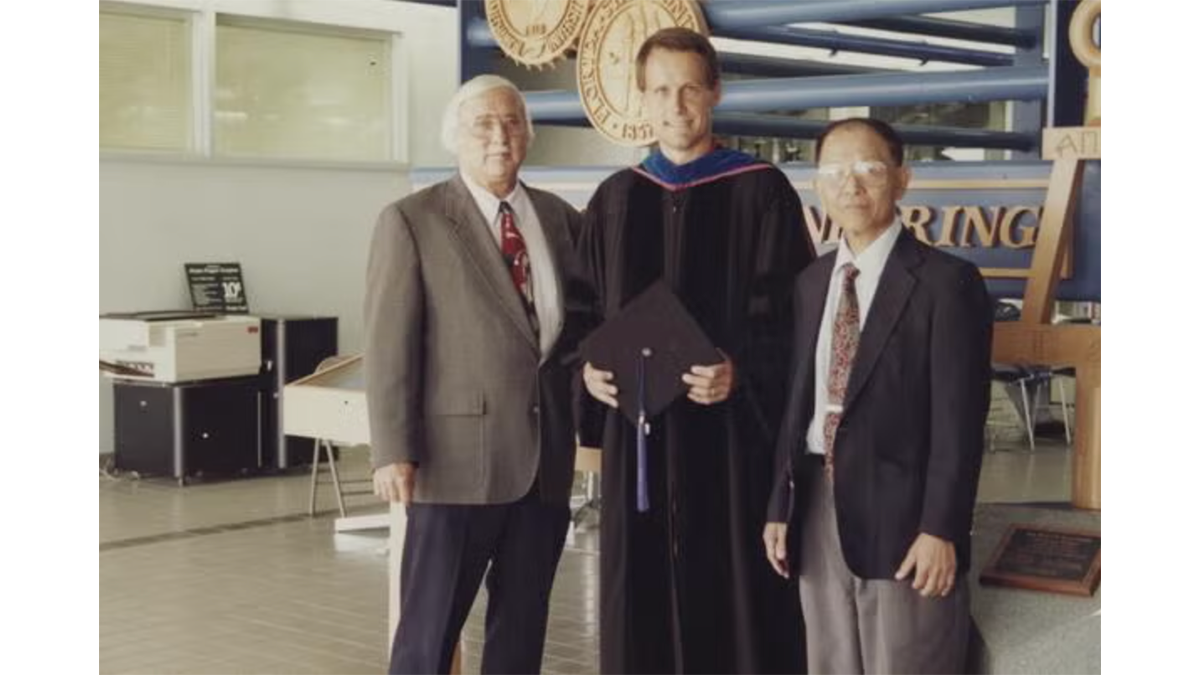
Ph.D. graduate Geoffrey Brooks, center, in cap and gown with Dr. Fred Simons and former FAMU-FSU College of Engineering Dean Ching-Jen Chen in 1996. (FAMU-FSU College of Engineering)
Geoffrey Brooks, Ph.D., was only three weeks into his time as a professor at FSU Panama City when the 9/11 attacks occurred in 2001.
“We had four students then and were challenged to grow an engineering program,” he said. After the terror attacks, “a student expressed her anger, wanting to graduate to work for the Navy to become part of the solution. I quickly realized the significance of training our future engineers, many of whom would serve the DOD as I had.”
Brooks, a professor of electrical and computer engineering at the joint college, will retire in May after 25 years at FSU Panama City.
Dean Randy Hanna noted that Brooks took a remarkable trajectory from his own studies to finishing his career at the forefront of building a strong engineering program in Panama City.
“Geoffrey was the first Ph.D. graduate in Electrical Engineering from the FAMU-FSU College of Engineering,” Hanna said. “He later joined FSU PC to start the EE program here. “Electrical Engineering was the first engineering program we had at FSU PC, followed shortly by Civil Engineering.”
Brooks received his doctorate from FSU in 1996.
“So, it was natural for me to work with the same department while building the Panama City program,” he said. “The success of the EE program helped to bring civil engineering and later mechanical and systems engineering to FSU PC.”
Brooks said his career has been exciting, challenging and rewarding. He gave as examples the fact that former EE graduates he taught are now hiring his current EE graduates, and two of his former students later earned doctorates and were hired by FSU Panama City as his colleagues.

Life By the Numbers
Born in Pensacola in 1959, Brooks graduated from Holmes County High School in 1977. He received his bachelor’s and master’s degrees from the University of Florida and, as mentioned, received the first Ph.D. in electrical engineering from the FAMU-FSU College of Engineering’s Department of Electrical & Computer Engineering in 1996. This achievement was recognized in articles in the U.S. Air Force’s Leading Edge magazine, the Eglin Eagle and other papers.
He joined the ECE faculty in August 2001, teaching, recruiting and advising at FSU Panama City. He successfully directed several master's theses and developed a unique course in biomimetics, which explores the development of sensory systems.
His class projects led to an undergraduate research contract with the Naval Experimental Dive Unit (NEDU), as well as senior design projects sponsored by local engineering firms. Other projects included obstacle avoidance robots and a surface vessel remotely controlled sending wireless video/sensory data to a land-based computer.
From 1999 to 2001, he served as lead engineer for the world's first mobile infrared scene projector system while employed with the Modeling and Simulation Division of the U.S. Army Aviation Technical Test Center at Fort Rucker, Ala. He also successfully directed simulated flight tests that were used to refine missile target detection and tracking algorithms for Lockheed/Martin.
From 1989 to 1999, Brooks served the U.S. Air Force Research Laboratory Munitions Directorate at Eglin Air Force Base. He managed advanced signal processing research and development programs, including biologically-inspired signal processing algorithms and sensory architectures.
Brooks was awarded a surf-zone image analysis research grant from the Navy that focused on investigating natural sensory object classification algorithms. Other activities included directing high school, undergraduate, graduate and post-doctoral summer research participants.
From 1981 to 1989, he served as a co-op engineer for DuPont, offshore oil exploration engineer, and signal processing engineer for submarine sonar systems at the Naval Underwater Systems Center. During that time, he also worked for NWSC in Panama City as a ship-board integration engineer for a combat simulation test system, assembly software developer for an acoustic device countermeasure, and countermeasure evaluator software developer. While at Eglin, he was a missile software engineer and F-15 test engineer.
Brooks is a member of several professional societies, including the Association for Unmanned Vehicle Systems International. He served as president of the Emerald Coast Chapter of the Optical Society of America in 1998-1999.
He has also long been active in community service, including as choir director and Sunday school teacher at Westwood Presbyterian Church in Dothan, Ala.; a hospice volunteer; a puppy raiser for Southeastern Guide Dog Association; a host parent for international exchange students; and musician with the Eglin Sax Quartet and the White Sands Dance Band, among many others. He also served as sergeant-at-arms and vice president of the local chapter of Toastmaster’s International.
Among his honors and awards was the invitation to join Eta Kappa Nu, the international Electrical Engineering Honor Society.
The Future Looks Bright
“I was fortunate to have been able to purchase our family farm in Bonifay in 1986,” Brooks said, adding that he has commuted for work ever since, including stints at Naval Surface Warfare Center Panama City, Eglin Air Force Base, Fort Rucker and FSU PC.
While Brooks has no plans of slowing down in retirement, he said, “I am looking forward to spending more time with my wife pursuing our interests together and being available for our son, who is now in the U.S. Marines.”
He also plans to continue taking graduate courses at the Seminary for the Third Millennium. While he has no interest in pursuing the ministry as a profession, Brooks said the object of his personal faith has become clearer to him.
“During this process, my career interests have grown strangely dim as the answers to the big questions in life have come into clearer focus,” he said. “It is indeed time to move on. I am very grateful to our hard-working students and to Dr. Walid Hadi for assuming leadership and taking our program to the next level.”
RELATED ARTICLES
Remembering Wright C. Finney: A Legacy of Service and Excellence in Engineering Education