
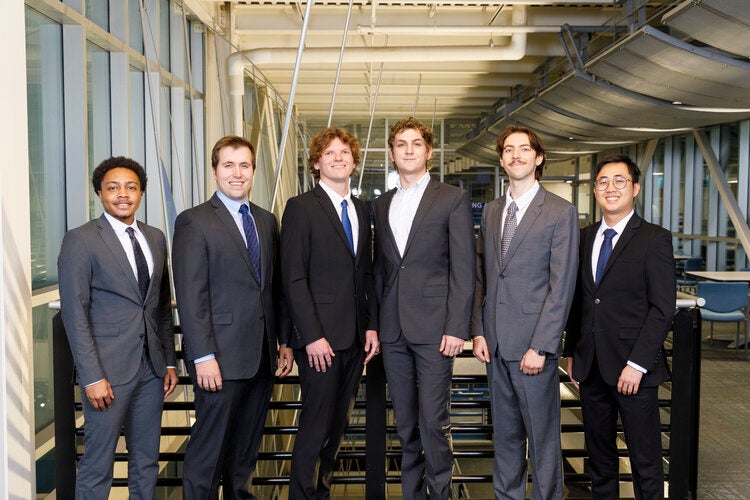
We developed an affordable, open-source platform for teaching robotic hand manipulation to high school and college students. Many schools lack access to robotics education due to prohibitive equipment costs, so we designed a system built entirely from 3D-printed components and readily available parts to lower that barrier.
The system consists of two main components: a wearable glove and a robotic hand. The glove tracks the user’s hand movements and translates them in real time to the robotic hand. Vibration motors at the fingertips provide haptic feedback when the robotic hand contacts a remote object, simulating touch. We 3D-printed a mold to shape a soft foam hand that approximates the feel of a human hand. A motor bank below the foam hand drives ten- don-like strings that bend and move the fingers smoothly and naturally. We mounted the robotic arm to an overhead frame that enables movement in all directions, similar in mechanism to a claw machine, while an integrated wrist joint provides additional degrees of freedom for twisting and turning. Together, the frame and wrist allow the hand to move and orient freely in space, enabling realistic manipulation tasks and demonstrations.
This project contributes to the National Science Foundation’s Engineering Research Center for Human AugmentatioN via Dexterity (HAND ERC), which advances dexterous robotics for operations commonly performed by humans. By delivering a hands-on, low-cost educational tool, we helped expand access to quality STEM resources in public schools and gave students a practical platform for exploring robotic dexterity.